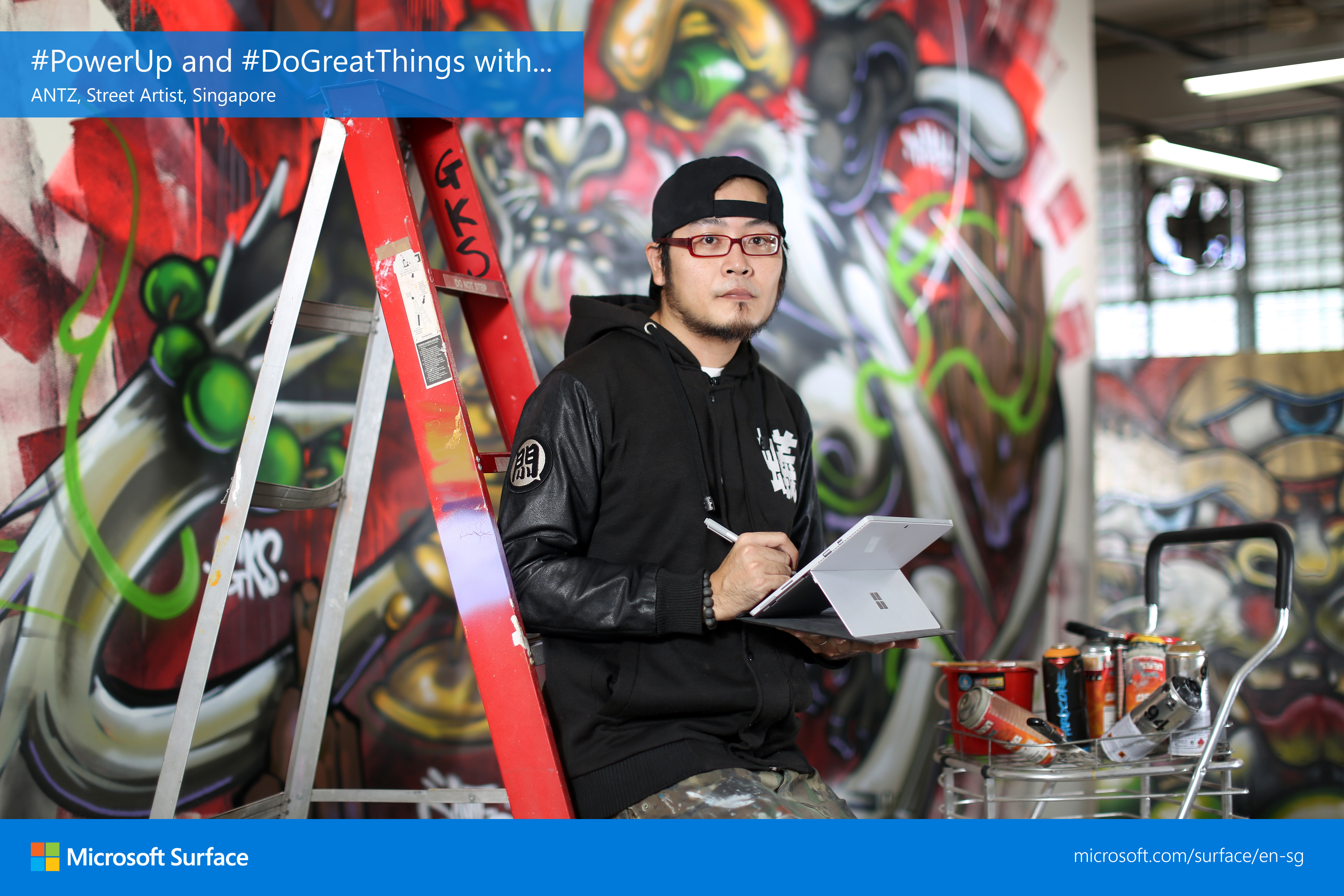
In straitlaced Singapore, it goes without saying that graffiti art is mostly frowned upon. However, to Singaporean street artist ANTZ, graffiti is a valuable art form that resonates with the voice of the people.
Speaking to Microsoft Singapore as he brought us through the spray and dust of his art studio, where he showed us how he leveraged Surface Pro 4 in his creative process, ANTZ said, “Graffiti was originally born from the streets, and each piece of art is a strong statement from the poor and the hungry.”
ANTZ loved street art so much he traded in his previous job for a can of spray paint close to ten years ago, and he hasn’t looked back since. “It’s an art form that requires guts,” he said, “So taking the jump makes sense.”
The soft-spoken artist is far from the stereotypical image that comes to mind when we think about graffiti artists. Today, ANTZ is a key figure of the local street art community and has played an important role in the legitimisation and commercialisation of the graffiti scene in Singapore.
What’s a typical day like for a graffiti artist?
Despite what you may think, graffiti artists don’t wake up every day thinking of the next public wall or monument that they want to deface! We’re artists, and like all other artists, my work day depends on the projects that I’m currently running.
Sometimes I could be playing around my studio the whole day, just exploring and experimenting with different tools, materials and design. However, most of the other times, I have deadlines to rush and complete for my commercial clients.
I’ve worked with both global and local brands, including Facebook, Tiger Beer, American Express, and Pasarbella. The graffiti artwork at the latest Pasarbella outlet at Suntec City, for example, was done by me and my crew.
I also conduct workshops for those who are interested to learn more about street art and graffiti – and this includes the 10 young people who are currently apprenticing under me all these years. I personally feel that it is a good way to help them better understand what exactly it means to be a street artist, and it’s my way of giving back to society and the community.
One thing is for sure – my work never stops!
Do you have to travel or move around a lot for your work?
I work mainly in two studios, one in Ubi, and one in the Aliwal Arts Centre. I spend most of the time at the Ubi studio, where I do most of my “proper” work like canvas painting, sculpting, and customised toys. However, when I get the time, I travel to the studio at Aliwal, which is more for fun and for connecting myself to the community.
Of course, as my main creation is graffiti street art, moving around is pretty much a requirement. I frequently have to paint outdoors, and wherever my work takes me.
My work also takes me overseas frequently, and I’ve received commissions that brings me to places like Cambodia, China, Indonesia, Japan, Laos, Malaysia, Thailand and even as far as Denmark and the USA. I love bringing my art overseas; meeting foreign artists is a great way to exchange ideas and skills and increase our understanding of different countries and cultures.
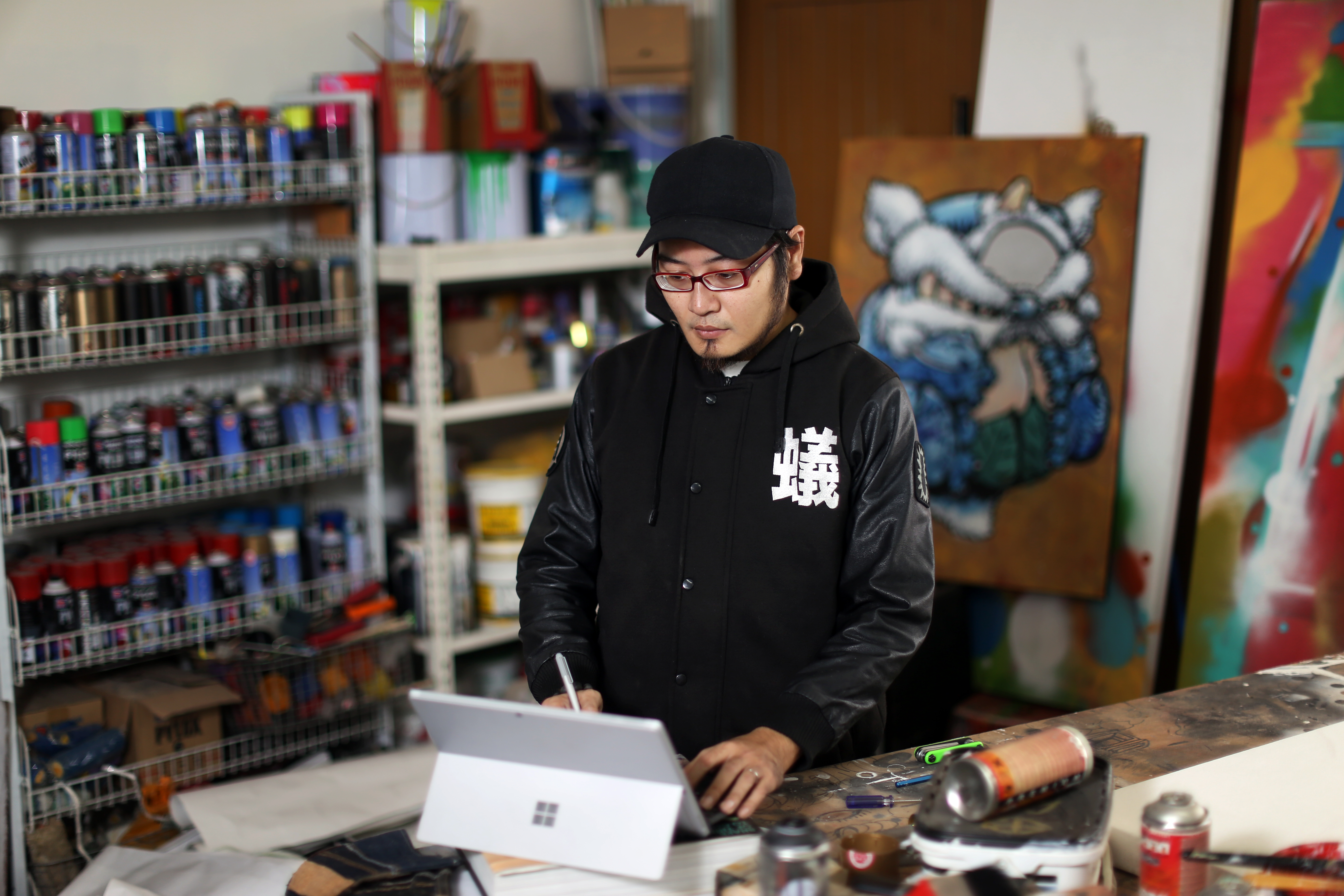
How has Surface Pro 4 changed the way you work?
Technology really helps me in my work. Like everyone else, I use my computer and smartphone to handle most of my communication and administrative tasks.
I used to think of technology as an indispensable utility for running the business side of my work, but Surface Pro 4 went way beyond that. I can actually create art on it thanks to some of its unique features.
The pen, for one, is the best digital pen I’ve ever used. I’ve tried many styluses, but nothing comes close to the texture and feel of the Surface Pen. Drawing in the screen feels almost as natural as drawing with pencil and paper.
Thanks to the pen, I can use Surface Pro 4 to complete most of the early stages of my work – sketching out ideas, fleshing out concepts, and carrying out the planning and the preparations for the final painting.
I’ve even managed to complete an entire art project using nothing but Surface Pro 4 alone, that’s how powerful it is. It runs my favourite Adobe Photoshop and Illustrator programs without a hitch – definitely not something that I’ve seen other tablets do. And once I’m done, I can immediately email the artwork off to clients for their review, no need to fiddle around with scanning and digitising.
Of course, at the end of the day, I still have to get my hands dirty to create my painting. But the Surface Pro 4 speeds up the time it takes to get to that stage, and it does change my life and the way I work. The features it offers in one light package has already replaced almost everything else I rely on – my chunky sketch book, camera, laptop, just to name a few.
What’s your favourite part of the job?
It always feels fantastic when I meet a deadline and hand in my work to a satisfied client. Whether it’s a local or overseas client, delivering great work gives me a great feeling of accomplishment and satisfaction.
I also love collaborating with people wherever I go. The great thing about art is that it brings people together. It doesn’t matter if you don’t speak the same language or understand each other’s politics – art goes beyond all that. With the Surface Pro 4 I can do just that on the spot. We can draw together on one device and flesh out our ideas instead of passing around so many pieces of paper.
What do you do to help you “Power Up” and stay energised for the challenges ahead?
One particular activity that I like to do is meditation. It helps to clear my mind and I can try to learn to see things from a new perspective.
Listening to music also helps. I used to work as a sound designer and was exposed to many different genres of music. Depending on what I’m working on and on the sort of stuff I’m painting, I will play music to set a certain type of atmosphere. I find that the right vibrations help to enhance the mood and give me more inspiration.
Any advice for young people looking to get into street art as a career?
 Think twice!
I’m kidding, but it’s important to ask yourself whether you want to commit to the craft because it’s not going to be easy. Even if you think of yourself as a great artist, there’s always something new to learn, someone better than you to look up to.
It’s a great career because you’ll constantly challenge yourself – to come up with ideas, to meet deadlines, to work under harsh conditions, to make use of equipment creatively, and to recover from your mistakes. You can choose to be consistent or you can be a one hit wonder and fade off.
Graffiti is increasingly seen as a more legitimate art; today, you can even see it in art galleries. It’s a commercially viable, too — more and more brands are looking at using graffiti to communicate their identity.
It’s very exciting, and I do hope to see more artists come in and build the community together.