Written by Emmet Ryan
In 1985, the technology landscape was unrecognisable compared to today. Back then, the most important tool for PC users was a 5.25-inch floppy disk that stored just 360KB of data. When the 3.5-inch disk arrived, holding over a megabyte, it was considered revolutionary. Internet had yet to reach Irish homes and the idea of Artificial Intelligence in our day to day lives belonged mostly to science fiction.
Against that backdrop, Microsoft’s decision to establish a small Irish operation might have seemed unremarkable. Yet, viewed through the lens of 40 years, it marked the quiet beginning of a long-term partnership that has helped shape Ireland’s modern digital landscape.
What followed was not simply the growth of one company, but the evolution of an ecosystem. As Ireland embraced globalisation and the knowledge economy, Microsoft expanded from a modest foothold in Ireland into one of its largest international hubs. The company’s journey mirrors Ireland’s own: ambitious, outward-looking, and increasingly driven by digital innovation.
Microsoft’s 40-year anniversary in Ireland offers something slightly different – a chance to reflect on how a single investment helped accelerate Ireland’s emergence as a digital leader. Independent research by Indecon, captured in the Microsoft Ireland 2025 Economic and Social Impact Report, provides a data-rich glimpse at that influence, but the story extends well beyond numbers.
A shared journey of growth and impact
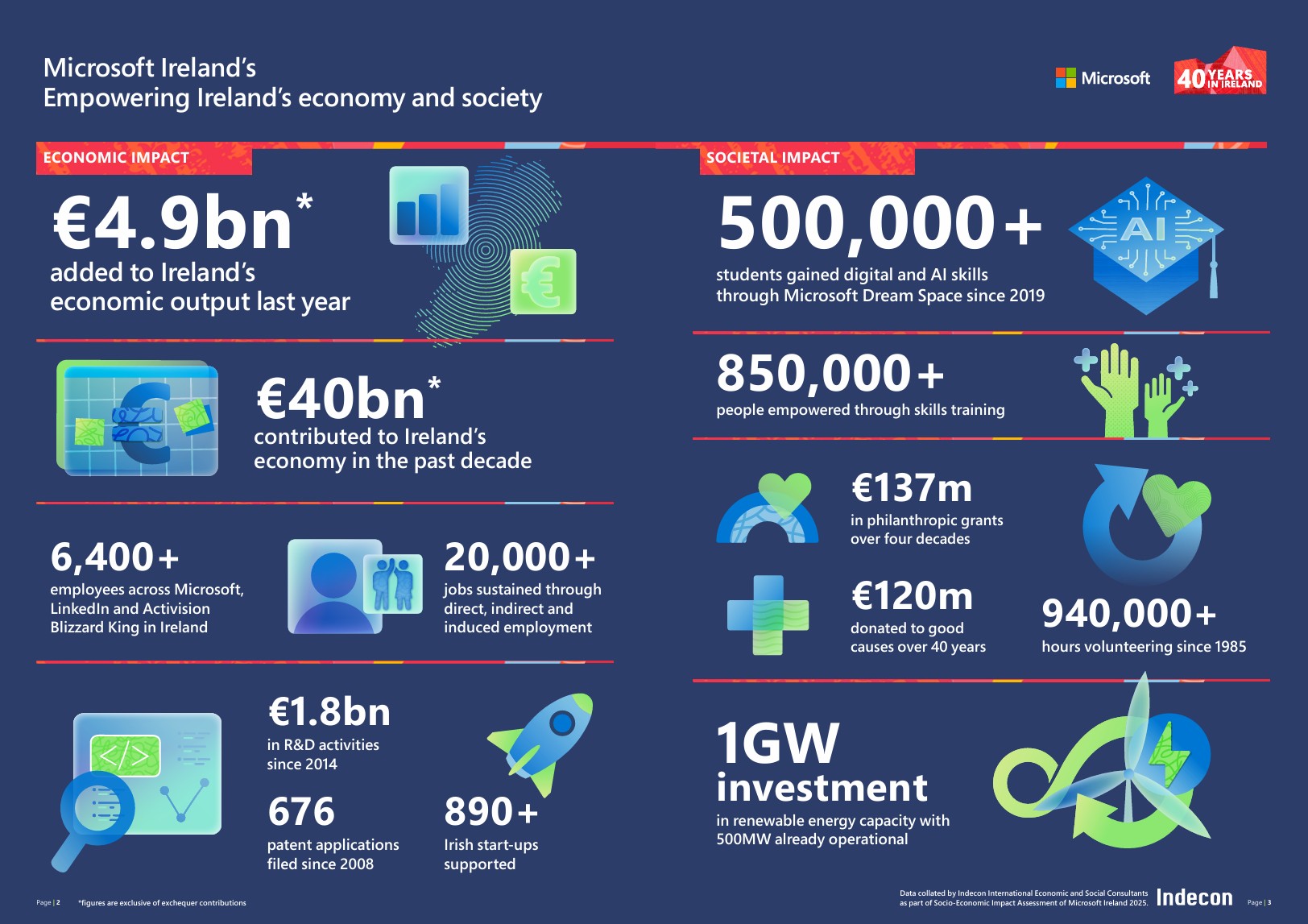
Ireland’s technology sector is often described as one of the country’s great economic success stories. Microsoft has undoubtedly played a part in that rise. In four decades, the company has contributed significantly to economic output – €4.9bn in the last year alone – and now employs more than 6,400 people across roles in engineering, operations, data centres, digital services, and gaming.
But perhaps the more interesting observation is how its presence helped catalyse a broader digital economy. The company’s supplier relationships, construction activity, and support for Irish start-ups have contributed to what many describe as Ireland’s “innovation flywheel” — where talent attracts investment, which attracts more talent, and so on.

Michael Lohan, CEO of IDA Ireland, captures this dynamic: “Microsoft’s decision to invest in Ireland forty years ago has been nothing short of transformational and one that has shaped our economic landscape for the better.
“The company’s enduring presence here has been central to establishing Ireland as a premier destination for technological investment and innovation,” he added.
His remark reflects a sentiment echoed across Government and industry: that Microsoft’s long-term presence both benefited from and contributed to Ireland’s increasingly global footprint.
The new frontier of AI
One of the more subtle dimensions of Microsoft’s influence is the way technology has helped make transformation possible within Irish organisations.
While Ireland’s reputation as an early adopter is well earned, it is worth remembering that this culture did not emerge overnight. From the first deployments of productivity software in the 1990s to large-scale cloud migrations in the 2010s, technology’s role in Irish business and public life has deepened incrementally.
As the fourth industrial revolution, AI is driving another shift. From banks to hospitals to semi-state companies, Irish institutions are experimenting with AI not as an abstract future concept but as a tool that can be used today.
Inside AIB, for instance, AI-powered assistance is being used to streamline administrative work at scale, freeing staff for more specialist tasks. At St James’s Hospital, clinicians are using real-time data and AI to support faster decision making – early steps that hint at the possibilities of personalised medicine. An Post has also been using AI in creative, customer-facing ways that help people navigate postal services more easily.
Taken together, these examples suggest a quiet but significant shift which Microsoft is helping to enable. AI in Ireland is no longer confined to specialist labs or innovation teams. It is beginning to embed itself in day-to-day operations, often in ways that are incremental rather than dramatic — yet these early adopters, or “frontier firms,” are helping to define the frontier of AI in the Irish economy.
And this momentum isn’t limited to large organisations: through its support for nearly 900 start-ups, Microsoft is helping ensure that innovation takes root and fuels the growth of indigenous organisations.
Engineering Ireland’s AI future
Perhaps the most significant aspect of Microsoft’s Irish footprint is its engineering capability. Over the past decade, Dublin has evolved into a centre for product development and research, with more than 1,600 engineers contributing to global technologies. This investment – €1.8 billion in R&D since 2014 – has resulted in hundreds of patents and new products.
But beyond the figures, it represents something more important for Ireland: a reinforcement of the local innovation ecosystem and an enhanced position as an engineering hub globally. Microsoft’s highly skilled workforce is not just building products for international markets; they are shaping the technologies that will influence industries and everyday life in years to come.
At the same time, their work has helped foster connections with universities, research institutions, and Irish businesses, creating a network of collaboration that strengthens skills, supports start-ups, and stimulates wider technological adoption.
Preparing people for the next technological wave
The rapid pace of technological change raises a real and pressing issue not only for workers, but for employers and the State at large: how to equip people with the skills needed for the future.
According to estimates from the World Economic Forum, nearly 40% of current skills will evolve significantly within the next few years. That reality is already being felt in Ireland, where employers report rising demand for AI literacy, data competency, and digital fluency.
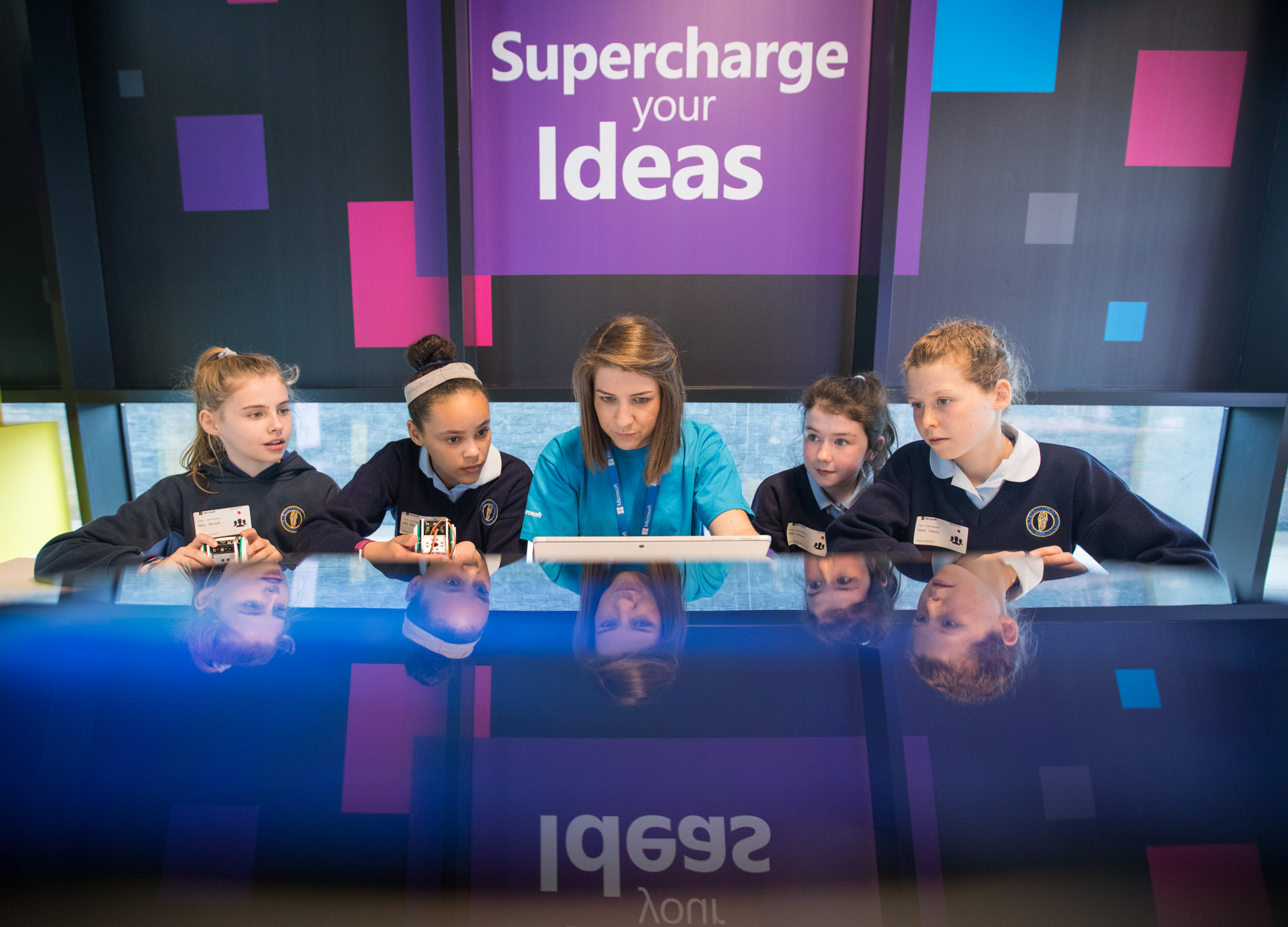
Few places are doing more to ensure Ireland is skilling up for the future than Microsoft. Its Dream Space education initiative, which has reached over half a million students since 2018, is one part of this effort. But it is also focused on giving every person – irrespective of their age or background – the skills to engage with AI.
James O’Connor, Microsoft Ireland Site Leader and Corporate Vice President of Microsoft Global Operations Service Centre, describes the broad goal: “As we look to the future, our focus is on ensuring that the benefits of technology and AI are accessible to all, helping Ireland continue to thrive as a leader in the digital era.”
A partnership rooted in community
The impact of Microsoft in Ireland reaches beyond business and technology, touching people and NGOs across society. Over the years, Microsoft employees have contributed over 940,000 hours to volunteering, supported charities with €137 million philanthropic grants, and partnered with organisations such as LauraLynn and Enable Ireland to develop accessible tools and technologies.
These initiatives often operate far from public attention, yet their impact is tangible: digital tools that simplify everyday tasks for people with disabilities, support systems that strengthen frontline services and fundraising that supports children with life-limiting conditions and their families.
Reflecting on the long-standing partnership between Microsoft and LauraLynn, Kerry McLaverty, chief executive at LauraLynn, highlights the dedication of the company’s team, who participate in the annual charity cycle to support the hospice: “Their commitment goes far beyond fundraising; it’s a message to the children and families we support that there is a huge community standing with them. This partnership is built on something special.”
Next 40
If you could jump in a Delorean and go back to 1985, when Microsoft first set up in Dublin, what would you tell the less than 100 staff there of the future?
Would you talk about the scale of Microsoft Ireland’s economic impact? What about the number of jobs supported? Perhaps you might tell them about the role played in developing an ecosystem of businesses and transforming Ireland through technology.
The one certainty is that the change isn’t stopping. Today, artificial intelligence represents the next frontier — one that is reshaping how businesses operate, public services deliver, and people work and learn.
That’s why Microsoft Ireland is committing an additional €4 million to AI skilling initiatives, building on past investments to help equip the country for this new era. The goal is to support businesses, communities, and individuals in developing the skills needed to thrive in a rapidly evolving digital landscape.
James O’Connor reflects on the company’s approach: “By investing an additional €4 million in AI skilling, we will continue to deliver on our mission of providing every person across the island with the skills to thrive in the era of AI. As the sector evolves, developing a resilient, skilled workforce is essential to unlocking many career opportunities, empowering people to thrive in a digital-first economy both locally and globally.”
That impact isn’t recognised just by the people we work with but this nation’s leaders as well. Just ask Taoiseach Micheál Martin.
“Over four decades, Microsoft has driven technological progress, supported economic growth and helped shape the digital economy we know today. Microsoft’s commitment to advancing AI reflects Ireland’s ambition to be at the forefront of this revolution,” he said.
“Its decision to establish and grow here was a gateway investment that has greatly helped to position Ireland as a global digital leader, built on world-class talent, a vibrant technology ecosystem and a strong culture of innovation.”
Just think of what 2065 might bring. In another 40 years, there’ll be more stories to tell, more businesses and people helped. One thing that won’t change will be Microsoft’s commitment to innovation.