
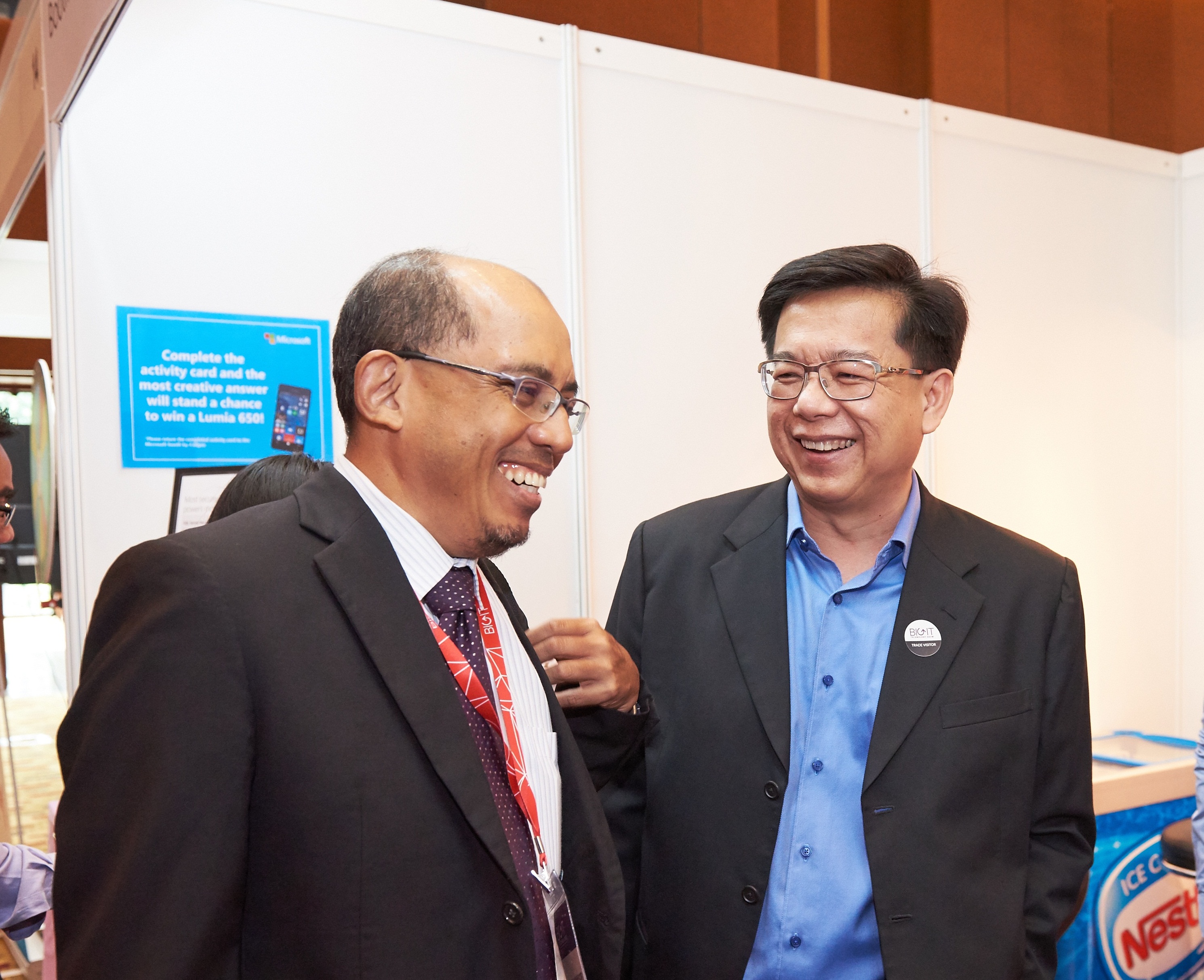
In this Microsoft news feature series, we delve into some of the key industry trends in technology – big data, cloud analytics and machine learning. Dr Dzahar Mansor, National Technology Officer of Microsoft Malaysia interviews prominent key opinion leaders in tech and partners of Microsoft to find out how big data is applied across businesses in Malaysia.
In the second interview of the four-part series, Dr Dzahar speaks to Laurence Liew, Chief Executive Officer of REAL Analytics – which provides mentoring and strategic consulting to organizations who want to embark on the big data and science journey – to gain an insight on what goes behind the scenarios of real-time analytics and what lies beyond Big Data.
Dr Dzahar: What are the common customer scenarios for analytics and machine learning in South East Asia?
Laurence: When we started Revolution Analytics in this region back in 2012 – it offered an enterprise version of the popular and de facto standard analytics programming language, R. During this time, we saw requests for sentiment analysis (text analytics), followed by marketing/customer analytics for banks and insurance houses.
In the last two years, however, there’s been a push for Analytics and Internet of Things (IoT) at the shop floor, for scenarios like preventive maintenance, and improving yield. And today, we see a lot more organizations adopting analytics across multiple domains.
Marketing, Customer Relationship Management (CRM) and Customer Segmentation Analytics have always been around, executed with traditional tools like SAS, SPSS, Excel and even R on smaller datasets.
However, with the explosion of big data, these tools broke down and that is where RevoR (at that time) came in as we could handle big data. IoT was the hot topic in 2013-2015 and we rode that wave. The Intel project in Penang was a good example of this – it was about how data analytics was applied to factory equipment and sensors, which resulted in lower cost savings to the manufacturing process.
Singaporean and Malaysian local companies are still not very mature when it comes to analytics. So far, a lot of projects are still Proof of Concepts (POCs). But I can see that with the acquisition of Revolution by Microsoft and launch of Azure ML, more and more companies are beginning to adopt analytics and tools like R and Python.
A few years ago, we used to get asked, “Why should I use R for analytics when I have Excel, SAS, or SPSS?” Now the question is more – “How do I learn R or should I be using R or Python for analytics?”

Dr Dzahar: What are some example of real-time analytics being deployed?
Laurence: As I had mentioned earlier – the Intel example about factory optimization and analytics over in Penang, as well as other everyday examples such as scoring people entering a country at immigration checkpoints, or every time you use Grab/Uber, some analytics is happening.
Dr Dzahar: What do customers require from big data? Do they really need it? And how do they begin to approach that in the way that benefits them?
Laurence: Let’s put this straight. Not many people will have big data, but everyone has data. And all data (small or big) can generate insights – data collected can be mined to extract insights. The best way is always to ask what the customer’s pain points are, what is the business problem to be solved, and to then see if there is data to help solve that problem.
You may have a lot of data (even big data) but if the data does not help you solve a particular problem, it’s just a waste of bytes.
Dr Dzahar: How would you describe Microsoft’s current position in the data industry and overall standing as a data platform space?
Laurence: I would consider Microsoft as the leading platform and the right choice for a lot of organizations (big or small) here in South East Asia. It offers a more user-friendly and technologically more “complete” stack for any organization to adopt quickly.
If you are well funded and can attract of top engineers, perhaps another cloud offering may make sense. But for a lot of us here, I find the Azure platform to be quicker to onboard an application – be it analytics, big data or a normal mobile/cloud app.
And the fact that Microsoft supports other open source technologies like Linux, Hadoop, Python etc. makes it an ideal platform for start-ups and enterprises alike.

Dr Dzahar: Going beyond big data, what does the future of analytics/machine learning look like? Do you have any predictions on how this is going to change or grow in the future?
Laurence: More and more organizations will adopt machine learning. It will soon become embedded into all our life. When I started with machine learning 20 years ago (it was called artificial intelligence (AI) back then), the AI folks said it would change the world! Then, people thought AI had fizzled out except for it being used in smart washing machines or refrigerators. The reality is that many people continued to work on AI and when the convergence of commodity clusters, big data and cheap Internet came about, AI became the spark that allowed organizations like Google, LinkedIn, Facebook to become what they are today.
Moving forward, we will see driverless cars, personal bots, organizational bots, machine vision, and robotics powered by machine learning to make the lives easier, freeing up personal time to spend on what is more important!
In the near future, I foresee that will be able to ask my personal bot to go put together a workshop presentation on Microsoft R/SQL/AML, and the bot would automatically go gather the latest/updated nodes/slides, arrange the presentation with my usual preference and constrained it to the time allocated for the session.
Dr Dzahar: How do you think players like Microsoft actually lower the bar for partners and customers to benefit from analytics & machine learning?
Laurence: The Microsoft of today is very different from when I first engaged them, many years ago. The Azure Cloud is a big differentiator and is the “secret” weapon to outdo competitors, who are still proposing capital intensive on-premise Big Data Analytics solutions costing $500,000 or more. Today I can spin up an end-to-end data analytics pipeline in less than half a day, spend another three to four weeks to optimize it, and build/train a model, and it’s off we go!
I still scratch my head when someone is willing to pay $250,000 for a text analytics “solution” on-premise, when, with Cortana Text Analytics it is a fraction of the costs and probably more accurate, always up to date and always being improved without needing to install or schedule any downtime.
With Azure Machine Learning, it is one click to deploy the AML model and is exposed via a simple RESTAPI – this is months of man-hours saved and you get it for nearly free. This was not possible three or four years ago.
ABOUT THE SPOKESPERSONS:

Dr Dzahar Mansor, National Technology Officer, Microsoft Malaysia
Dr Dzahar has been at the heart of all the cloud and big data related initiatives in the organization. With his passion in technology, Dr Dzahar consistently represents Microsoft Malaysia as a technology thought leader at relevant events in both Malaysia and South East Asia, while acting as an academic advisor in several national universities and research institutions. He also previously contributed to the development of national technology and strategic roadmaps such as the Economic Transformation Program, the National IoT Blueprint and the National Strategic ICT Roadmap.

Laurence Liew, CEO, REAL Analytics
Laurence introduced enterprise R analytics into Asia and manages the Centre of Excellence for Analytics in Singapore. As a veteran of the open source, Laurence has been promoting the use of Linux/HPC/Grid/ Cloud since 1998. He was also instrumental in building the very first commercial Linux cluster for an A*STAR research institute in 1999 and has since implemented and consulted for many organizations in APJ, Europe and US, on HPC, Grid, Cloud and now big data analytics. Laurence also sits on the Singapore IT Masterplan 2025 committee board, and mentors several startups in Singapore. He is a long time Editor of Transactions on Computational Sciences by Springer Journal.
Stay tuned for Part 3 of the series where Dr Dzahar speaks to one of Microsoft’s customers, Heinrich Wendel, the Chief Technology Officer of iPrice!