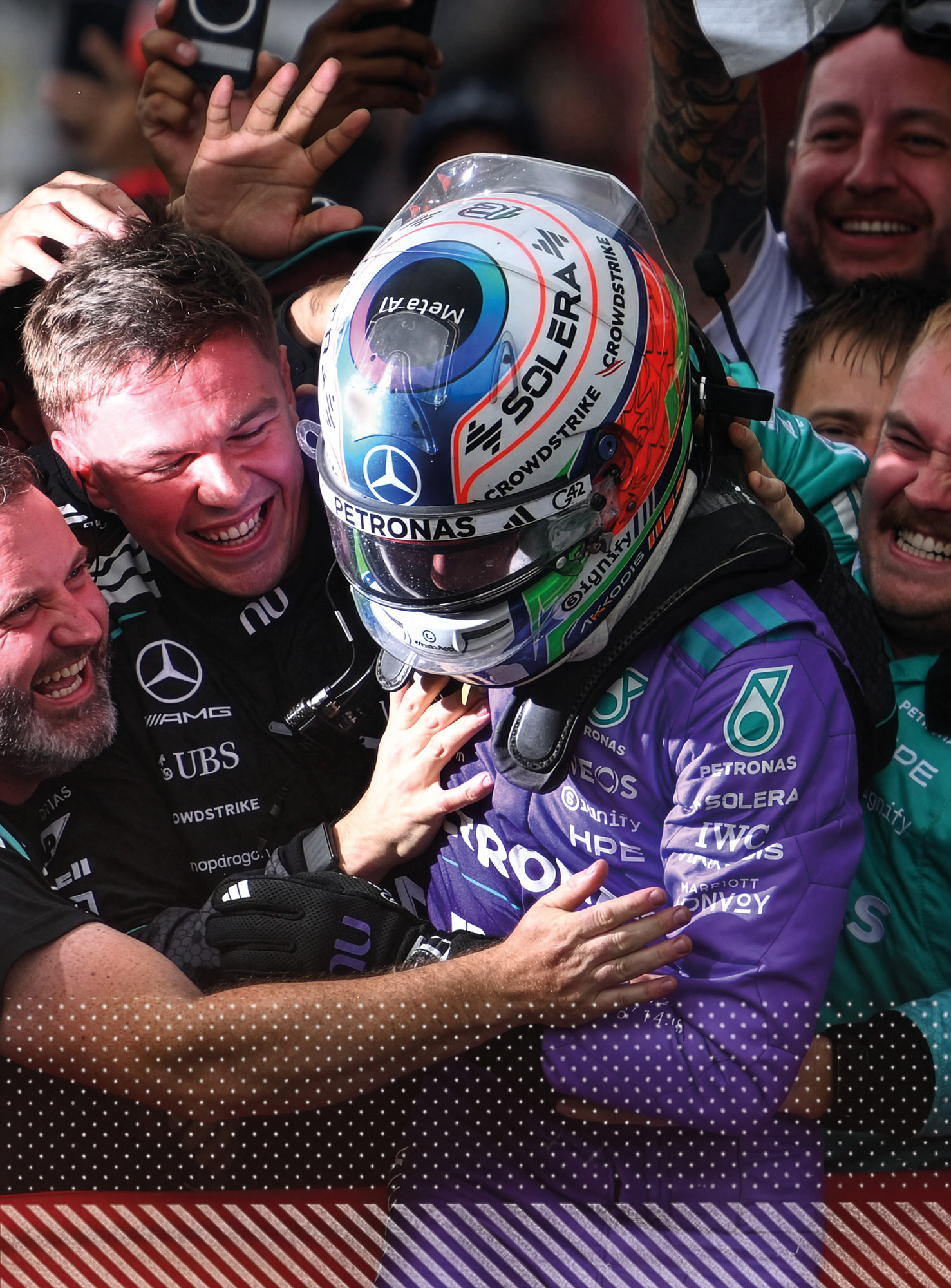
Sunday, May 3, 2026, Miami International Autodrome, Miami
Joseph “Joey” McMillan has been watching the numbers, and the skies above. With the start of the Miami Grand Prix just a few moments away, the Lead Race Strategist for the Mercedes-AMG PETRONAS F1 Team sits at his console, perched on the pit wall above the start line, listening to multiple different intercom channels at the same time, checking the weather reports and thinking about the race ahead.
The team’s drivers have performed well over the race weekend, both in practice and in qualifying. British driver George Russell is starting fifth on the grid but, ahead of him, Kimi Antonelli is in pole position. The Italian teenager has been the breakout star of the season so far and is aiming to win his third Grand Prix in a row. At 19, Antonelli would be the youngest driver ever to achieve that feat.
Antonelli and Russell are just two of Mercedes’ vast F1 team, around 1,300-strong, mainly engineers dedicated to making their cars go faster. But McMillan isn’t an engineer. His job is not about squeezing an extra ounce of speed from the engine, but saving time by executing a plan of action on the track, analyzing the variables his drivers can’t see and can’t control. “The strategist is sort of the black sheep in the sense that we are not really focused on making the car [go] faster,” explains McMillan. “Our job is to try and navigate those two cars through the race weekend. And to do that, we’re often looking at a lot more than just our car. We’re focused on every car on the grid, what every team is doing.”
Like all sports, F1 is obsessed with marginal gains and McMillan’s mission is to find an edge on rival teams, making decisions based on multiple streams of data and running multiple simulations. In a sport where a thousandth of a second can be the difference between winning and losing, every factor needs to be considered. “By far the most important thing we do is decide what tire compounds to use in the race and what laps to make pit stops on,” he says. “That combination is known as the strategy.” There are five types of tires to choose from during a race, all color coded for different conditions: three types of slicks for dry conditions (soft, medium and hard), and two treaded tires (intermediates for light showers and wet tires for heavy rain). “If we knew the degradation rate of each of those compounds, essentially how much slower they get each lap in milliseconds, strategy would be so easy.”
But things are rarely easy in F1. As well as monitoring the pace of rival cars and trying to judge how the tarmac will affect the tires, the strategy team’s simulations also need to know the answer to the question dominating McMillan’s thoughts as he sits at his trackside console. Is it going to rain? And in Miami, a storm is coming. The race is taking place at the start of May, six weeks before Florida’s Atlantic hurricane season usually begins, but the bad weather is ahead of schedule. The threat of lightning strikes is so severe that the organizers have brought the start of the race forward by three hours.
Rain briefly fell in the morning, and McMillan is being fed local weather radar data that suggests rain might fall again during the race. Will it be a passing shower? Or a deluge? A decision has to be made about which tires to start on: the faster slicks, the intermediates or the wet tires. That choice could win or lose the race before it even starts.
McMillan and the team make a play based on the data at hand and their instincts. The drivers will not start on wet tires, they will be on slicks and hope the weather holds. As the lights go out and the race begins, the drivers roar toward the first corner on a dry track under skies pregnant with rain. And then all hell breaks loose.