
– The estimated reading time is 5 min.
New book shows how leaders can build trust when everything is changing
Author
 Samantha KubotaMicrosoft writer
For most of her career, Julie Averill held roles that came with clear definitions, and chief information officer was one of them. As CIO at lululemon and REI, her work was measurable, and her responsibilities were mapped.
But over time, she noticed something that didn’t fit neatly into that structure: The biggest outcomes weren’t coming from the systems themselves, but from the ripple effect of what those systems set in motion across teams, customers and culture.
That shift sits at the center of Averill’s new book, “Chief Impact Officer.” It reframes leadership as a way of thinking about outcomes: Not just to run a specific function like IT, for example, but to understand what that function makes possible across an organization.
As AI reshapes how businesses operate, she says, that shift in mindset can change everything.
The book is the eighth from Microsoft’s 8080 Books imprint, which publishes original research and ideas from authors inside and outside the company about technology, science and business. The goal is to speed the path from manuscript to market, helping advance public discourse, while donating net proceeds to charity.
Here Averill reflects on the personal shifts that shaped her leadership style and why influence, not authority, is ultimately what drives change.
What does the role of Chief Impact Officer mean to you — and why do leaders need to think that way now?
The CIO title traditionally means Chief Information Officer. I held that title a decade. But the question I kept asking myself was: information for what? Technology for what? The real job was never the systems. It was the impact those systems created — on customers, teams, communities, culture.
Chief Impact Officer is a way of thinking for every senior leader. Not “what does my function do” but “what does my function make possible.” In a world where AI is reshaping everything and organizations are under pressure to prove they matter, leaders who stay inside their lane won’t move the needle. Leaders who think in terms of impact will.
How did being in a leadership position change after you announced you were LGBTQ+?
I expected things to get harder, but that wasn’t what happened. Instead, they got more real. Coming out as a senior executive meant I could stop spending energy managing what people knew about me and start spending it on what actually mattered. That shift was enormous. What surprised me was how it changed my relationships with my teams. People saw that I was willing to be honest about something hard, and it gave them permission to be more honest too. That’s psychological safety in practice. It’s not a program or a policy. It’s a leader going first. I became a better leader after I came out — not in spite of it, but because of it.
 What distinguishes leaders who build trust in a crisis from those who lose it?
Speed to action. When teams trust you, they speak candidly. Leaders who hold bad news, wait for perfect information, or manage the narrative lose trust fast. Leaders who say “here’s what we know, here’s what we don’t, here’s what we’re doing” build it — even when the news isn’t good.
I’ve seen executives spend enormous energy trying to look “in control” during a crisis. Almost always wasted. People don’t need you to have all the answers. They need to believe you’re telling them the truth. Trust is earned in the moments when honesty is inconvenient. That’s the whole test, and most leaders don’t realize they’re taking it until it’s over.
How should leaders be thinking about AI’s role in shaping business impact today?
Stop asking what AI can do and start asking what you’re trying to accomplish. Many organizations are running AI experiments in search of a use case. That’s backwards.
The leaders getting real value started with a clear view of where their organization was losing time, losing customers or making decisions slowly. AI became the accelerant, not the strategy.
The other thing: don’t underestimate the cultural work. AI adoption fails more often because of trust, fear and change resistance than because of technology. You have to build psychological safety before you scale the tools. That’s true whether you’re deploying a new system or a new model. Skip that step and you’re just spending money faster.
What’s one mindset shift you hope readers walk away with from the book?
Influence is the job. Authority is just the starting point.
Most leaders think about impact in terms of what they control: their team, their budget, their decisions. But the biggest problems in any organization sit between functions, between teams, between what the strategy says and what the culture actually does.
The leaders who create the most impact operate well beyond their formal authority. They build trust across the organization. They earn the ability to shape things they don’t own. That’s not a soft skill. It’s the hardest and most important skill a senior leader can develop. I want readers to walk away seeing that shift as the whole game — not a nice-to-have.
As AI automates job functions, it’s the human parts that we need to get right.
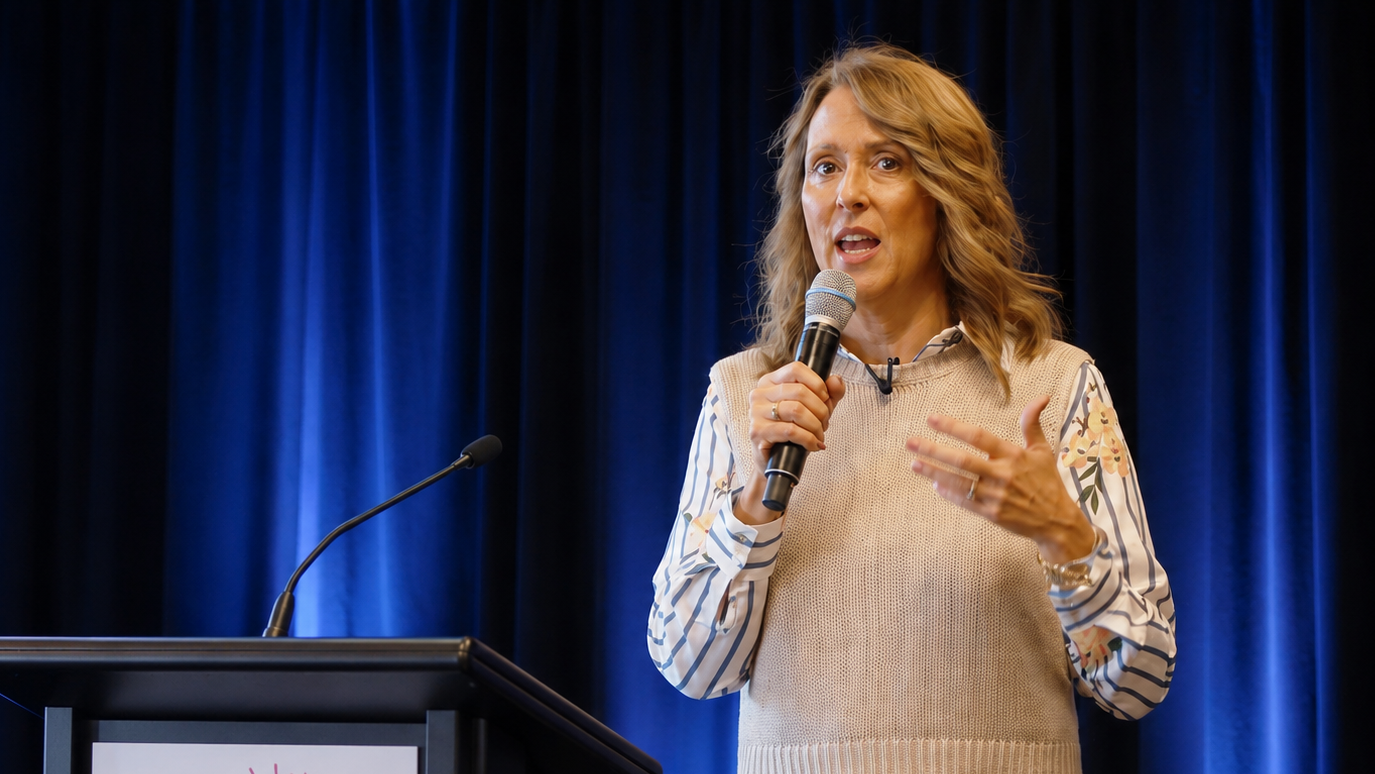
Lead image: Averill speaks at an event about opening doors for girls to build careers in STEM. (Photo by Aaron Ferrell).
Samantha Kubota reports on everything AI and innovation for Microsoft Signal, with a recent focus on how AI agents are reshaping everyday work, Microsoft’s research breakthroughs and the responsible use of emerging technologies. Prior to Microsoft, Kubota was a journalist at NBC News. Follow her on LinkedIn.