


Microsoft’s 2025 Work Trend Index reveals how Canadian organizations are preparing to lead in the age of AI-powered work
This year marks a turning point for work in Canada. We are entering a new reality—one in which AI can reason and solve problems in remarkable ways. This on-tap intelligence will rewrite the rules of business and transform knowledge work as we know it.
To help leaders and employees understand and prepare for the shift, Microsoft’s 2025 Work Trend Index analyzed survey data of 31,000 employees across 31 countries, LinkedIn hiring and labour market trends, and trillions of Microsoft 365 productivity signals.
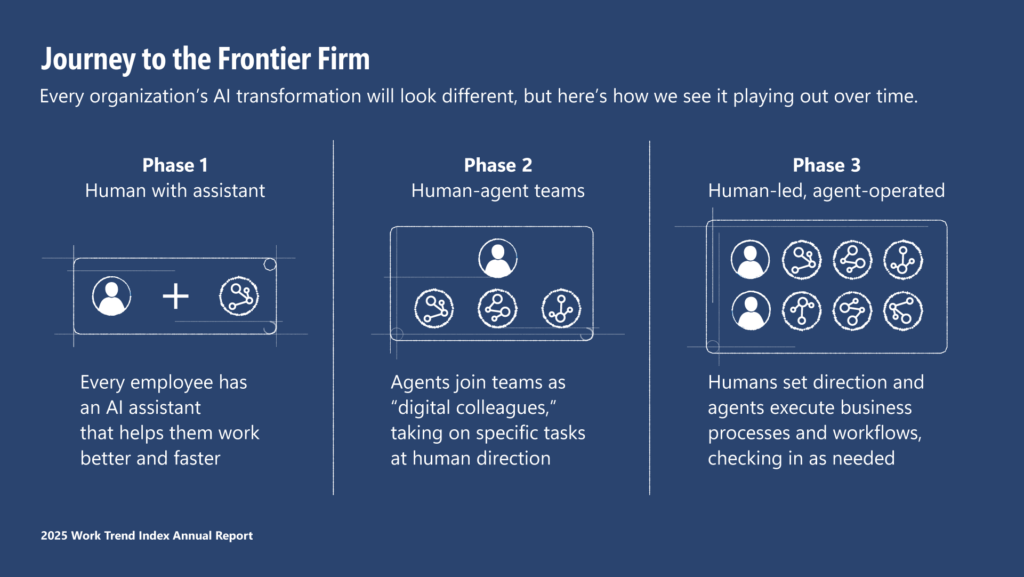
The data reveals the emergence of a new kind of organization: the Frontier Firm— defined by intelligence on tap, human-agent teams, and a fundamentally different approach to how work gets done. Notably, 71% of workers at these firms say their company is thriving, compared to just 37% at non-frontier firms globally.
The report captures a global workforce in transformation. For Canada, the message is one of quiet urgency: the country is preparing for a future where success will depend not just on adopting AI, but on reimagining work around it.
The Opportunity for Canada
Across the country, business leaders are rethinking how work gets done, and in a world where AI unlocks new expertise, how people grow beyond traditional roles. 78% of Canadian leaders say 2025 is a pivotal year to revisit core strategies and operations—a figure in line with North American trends.
But Canada’s approach is distinct. Just 39% of leaders say productivity must increase, compared to the global average of 53%. Yet 76% of Canadian workers say they lack the time or energy to do their job. That growing gap between capacity and business demands is driving a shift toward digital solutions.
On-demand Intelligence Can Close Canada’s Capacity Gap
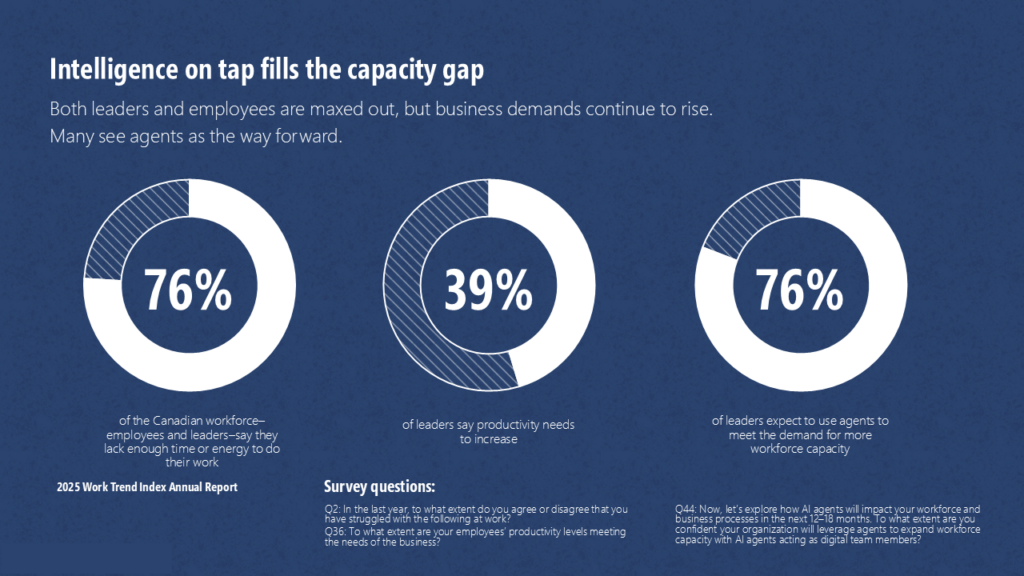
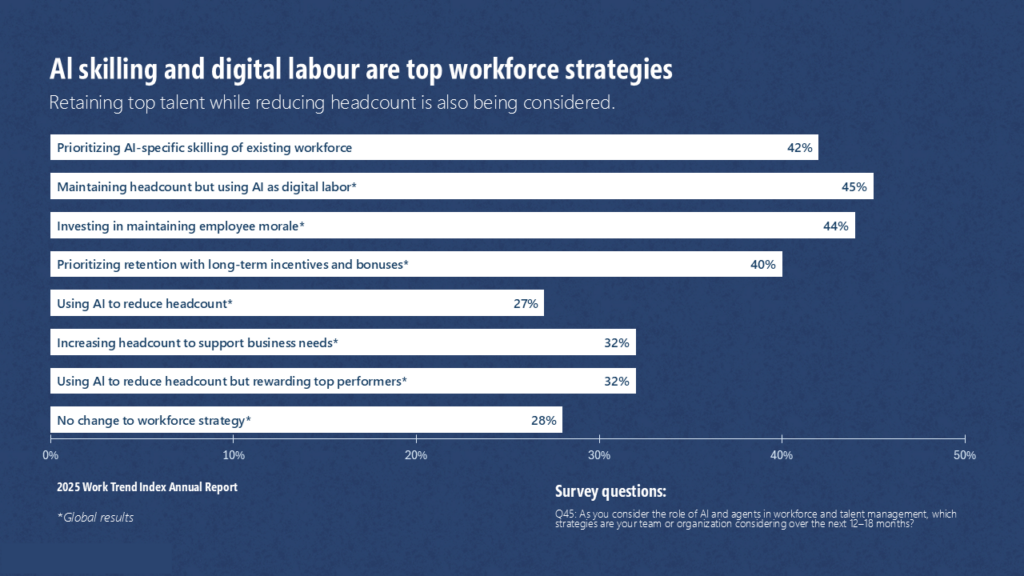
Canada’s digital future depends on a workforce that can effectively collaborate with AI. With 76% of Canadian leaders confident that AI agents will expand workforce capacity in the next 12 to 18 months, there is a clear mandate to act. Nearly half (46%) of Canadian business leaders have already made expanding team capacity with digital labour a top priority—second only to upskilling (42%).
Globally, this shift marks a moment when companies are moving beyond experimenting with AI and beginning rebuilding around it. Like the digital native companies of a generation ago, they understand the power of pairing irreplaceable human insight with AI and agents to unlock outsized value.
Workforce Readiness is Lagging
Despite strong momentum at the leadership level, employee readiness lags behind. Only 35% of Canadian organizations are currently using agents to automate workflows. While 72% of leaders are considering hiring for AI-specific roles—from AI trainers to AI strategists—employee confidence and skill adoption aren’t keeping pace.
This gap represents more than a missed opportunity. Without broad-based AI skilling, there’s a risk that the productivity and growth potential of AI will be unevenly distributed—deepening inequality and slowing progress.
Training the Next Generation of ‘Agent Bosses’
As agents increasingly join the workforce and organizations transition to Frontier Firms, we’ll see the rise of the agent boss—someone who doesn’t just use AI, but manages it. Agent bosses design workflows, delegate to AI agents, refine outputs, and guide performance. It’s a defining role in organizations where human-AI collaboration drives scale and speed. This shift is multifaceted—every industry and role will evolve differently as the technology diffuses across business and society. Preparing for what’s next is no longer optional. Employees must build AI skills, and companies must support them with the right tools and training.
Already, 44% of Canadian managers expect AI upskilling to become part of their role within five years. As teams begin to build multi-agent systems and redesign processes, skilling will be key to unlocking the full potential of the Frontier Firm.
To prepare Canadians for this shift, Microsoft’s AI National Skilling Initiative is delivering practical, job-ready AI training across the country with leading organizations to launch customized Gen AI training initiatives tailored to meet the unique needs of Canadians in a variety of sectors. The goal: equip every worker—not just tech specialists—to lead in an AI-powered workplace.
Copilot is the new UI for AI
Today we’re announcing the Microsoft 365 Copilot Wave 2 Spring release—designed to power the next era of human–agent collaboration. Copilot is now your window into the world of agents, with new capabilities for this next phase—driven by more advanced models, adaptive memory, and reasoning agents that work alongside you. Updates include:
- Researcher and Analyst agents powered by OpenAI’s deep reasoning models rolling out to customers through the Frontier program—and with our new Agent Store, you can easily find, pin, and use agents— from partners like Jira, Monday.com, Miro—or your own custom agents.
- Create brings OpenAI’s GPT‑4o AI image generator to work, unlocking design and content creation skills for everyone. Easily modify or customize brand images or generate AI images aligned to your company’s approved brand guidelines, and create everything from marketing copy and social assets to newsletter banners, videos and more.
- Copilot Notebooks transforms your notes, documents, and data into immediate insights and actions. By grounding Copilot in a notebook containing specific chats, files, meeting notes, and more, it can focus on the most relevant information – all while constantly scanning your source material to update in real time as your data evolves.
- Copilot Search is a new AI-powered enterprise search that helps you find what you need instantly with rich, context-aware answers from across your organization’s apps and data. It connects to first- and third-party apps—from ServiceNow to Google Drive, Slack, Confluence, Jira, and more—so you get fast, relevant results at work no matter where your data lives.
- New capabilities in the Copilot Control System empower IT pros to enable, disable, or block agents for specific users or groups—to help ensure the right agents are being used by the right people.
From Pilot to Transformation
The road ahead will look different for every Canadian organization. But one message rings clear: the pilot phase is over.
The most successful companies of this next era—the Frontier Firms—won’t just use AI to optimize old ways of working. They’ll rebuild around it. These organizations will be defined by their ability to scale quickly, operate with agility, and generate value through human-agent collaboration.
And in Canada, the seeds of this transformation are already taking root. Leaders are prioritizing thoughtful integration, workforce empowerment, and long-term capability-building. The future of work isn’t coming—it’s here. The question is no longer if AI will reshape the Canadian workplace. It’s how ready we are to lead it.