

AI, human agency, and the opportunity for every Canadian organization
New Microsoft research shows as AI and agents take on execution, our own agency expands. The question is whether organizations are built to capture it.

Introduction
AI at work is no longer emerging – it’s here and increasingly reshaping how work gets done inside Canadian organizations. And according to the 2026 Work Trend Index, it’s being driven by a small but highly effective group of workers leading the way: Frontier Professionals, advanced AI users who integrate AI into how they think, create, and get work done.
At the centre of this shift is a new reality. The opportunity for human potential at work has never been greater. People are using AI and agents to expand what they can do and who gets to do it, and new research shows that’s only accelerating. Call it the new agency equation: as agents take on more of the execution, humans increasingly have more agency—more room to direct the work, make the calls, and own the outcomes. The question is, are organizations ready for this change?
This year’s Work Trend Index draws on trillions of anonymized Microsoft 365 productivity signals, alongside a global survey of 20,000 full-time and self-employed knowledge workers who use AI at work across Canada and key global markets.1
While Canadian workers are increasingly using AI in advanced, resourceful ways, most organizations are not keeping up. The constraint for many Canadian organizations is the gap between what their employees can now do with AI and what their organizations are structured to support.
Globally, organizational factors—such as culture, leadership alignment, and talent practices—account for more than twice the impact of individual effort alone (67% vs. 32%), reinforcing that transformation is not just about adoption, but redesigning how work gets done.
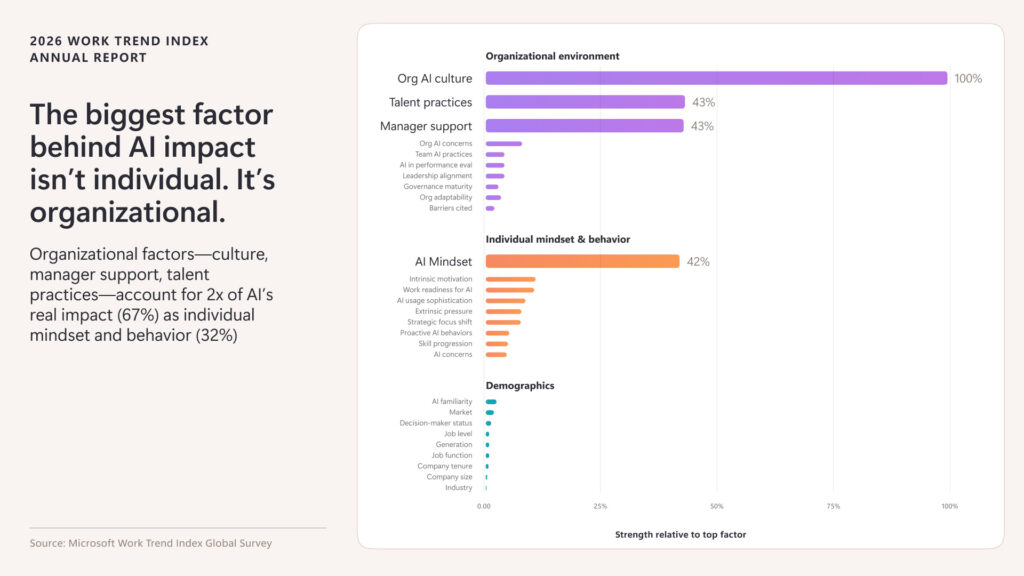
This gap is playing out in what can be described as the Transformation Paradox. In Canada, 66% of AI users report that they fear falling behind if they do not adapt quickly, while 49% say it feels safer to focus on current goals than to redesign work with AI. This mirrors global patterns, where workers are ready to adapt, but organizational systems, incentives, and structures continue to reinforce existing ways of working.
Leadership alignment is part of the challenge.Like global trends, only just shy of one in four (22%) Canadian AI users say their organization’s leadership is clearly and consistently aligned on AI. And even when workers take initiative, just 8% say they are rewarded for reinvention.
The result is a system where ambition is accelerating faster than the structures that support it. This aligns with global findings, where leadership alignment remains one of the biggest barriers to scaling AI impact.
The companies already addressing this gap – Frontier Firms – are pulling ahead. They are not just adopting AI tools, they are rearchitecting how work gets done across employees, leaders and the organization. In Canada, 13% of workers are Frontier Professionals, compared to 16% globally. This signals a meaningful opportunity: where the right conditions exist, Canadian talent is already demonstrating a globally competitive capability – but these ways of working with AI have yet to scale broadly.

Section I: Employees – A small group of Frontier Professionals is redefining how work gets done
Frontier Professionals represent a minority of workers in Canada, but their impact is already significant. These workers are not simply working faster with AI; they’re working differently. Frontier Professionals offer an early signal of what becomes possible when organizations create the right conditions for AI-enabled work.
AI is increasingly expanding what employees can do. In Canada, 54% of AI users say they are producing work they could not have produced a year ago – consistent with global trends (58%) and rising sharply among Frontier Professionals (81% in Canada; 80% globally). This points to a meaningful shift in how capability is expanding for those who are integrating AI into how they execute, create, and deliver.
At the same time, the nature of work itself is shifting. Nearly half (49%) of Microsoft 365 Copilot interactions now support cognitive work—including analysis, problem solving, and decision-making—expanding access to high-value work that once required deep expertise.
What sets Frontier Professionals apart is not just access to AI tools or frequency of use. It is how they integrate AI into their workflows and how intentionally they decide when to use AI and when not to.
- 45% deliberately do some work without AI to keep their skills sharp (vs. 35% of non-Frontier others)
- 51% pause before starting work to decide what should be done by AI versus a human (vs. 34%)
This is one of the clearest signals that frontier-style work is not simply about using AI more. It is about redesigning workflows around AI, and doing so with human oversight built in. Employees are increasingly acting as “agent bosses,” guiding AI outputs, applying judgment, and taking ownership of results. In Canada, that is already translating into more creative, complex, and differentiated work.
The implication is clear. Canadian workers are already demonstrating frontier-style capability. The opportunity now is to build on this capability and scale it across organizations.

Section II: Leaders – The job of every leader is to rearchitect work
The difference between Frontier Professionals and other workers is not explained by technology alone. Leadership behaviour and workplace culture are defining whether AI adoption translates into meaningful transformation.
According to the data, Frontier Professionals in Canada are far more likely than their non-Frontier peers to work in environments where managers:
- Use AI openly (85% vs 59%)
- Set quality standards for AI work (81% vs. 50%)
- Create space for experimentation (80% vs. 52%)
- Encourage more ambitious work redesign (82% vs. 55%)
In these environments, AI is not something employees navigate on their own. It is visible, supported, and continuously shaped by leadership. These patterns suggest that Frontier Professionals are not just different workers, they are working in fundamentally different environments.
These differences point to a broader shift in what leadership looks like in the AI era. Technology adoption alone is not enough. Managers play a key role in shaping how work evolves by creating AI-supportive environments.
For leaders, this means moving beyond deployment toward redesigning workflows, roles, and team structures.
In this new reality, every leader is responsible for rearchitecting work.
Section III: Organizations – Every company is becoming a learning system
As organizations move from experimentation to transformation, a new model is emerging.
The most effective organizations are not just adopting AI, they are learning how to work with it in a disciplined and repeatable way.
As AI and agents take on more execution, human skills become more critical. In Canada:
- 49% of AI users say quality control is increasing in importance
- 48% of AI users say critical thinking is increasing in importance
At the same time, most workers recognize their role in overseeing AI. 86% of AI users say they treat AI outputs as a starting point—not a final answer—remaining responsible for the thinking.
Organizations that succeed in this environment are evolving into learning systems. These leading organizations:
- Capture insights from AI-enabled work
- Share and refine those insights across teams
- Embed them into how work gets done over time
In doing so, they create owned intelligence – aset of AI-powered workflows andcapabilities that compound over time and are difficult to replicate.
The competitive advantage is no longer access to AI tools alone. It’s how effectively organizations embed them into everyday work and turn AI into institutional learning.
Looking ahead
Frontier Professionals offer a clear view of where work is heading, but they remain a small segment of the workforce in Canada today.
The next phase will be defined by how organizations scale these ways of working beyond this group. The organizations that succeed will not simply adopt AI tools faster. They will rethink how work gets done across workflows, teams, and operating models.
For Canada, the opportunity is significant. A growing group of organizations are already showing what this looks like in practice. These kinds of investments reflect a broader shift from experimentation to transformation, where AI becomes part of how work is structured and delivered.
By expanding frontier-style work across industries and employee groups, organizations can unlock new levels of innovation and creativity.
The capability is already here. The challenge now is making it the norm.
1The Work Trend Index survey was conducted by an independent research firm, Edelman Data X Intelligence, among 20,000 full-time employed or self-employed knowledge workers who use AI at work across 10 markets between February 18, 2026, and April 7, 2026. This survey was 20 minutes in length and conducted online, in either the English language or translated into a local language across markets. 2,000 full-time workers were surveyed in each market, and global results have been aggregated across all responses to provide an average. Global markets surveyed include: Australia, Brazil, France, Germany, India, Italy, Japan, Netherlands, United Kingdom, and United States. Additionally surveyed markets conducted between February 18, 2026, and May 1, 2026, include Canada, China, Colombia, Hong Kong, Indonesia, Malaysia, Mexico, Philippines, Saudi Arabia, Singapore, South Korea, Spain, Sweden, Switzerland, Taiwan, Thailand, and Vietnam.