This is a digital version of select stories from Issue 5 of Signal Magazine. Explore the full issue here.

Issue 05

Welcome to issue five of Signal Magazine

Every edition of Signal Magazine is packed with stories of innovation, and issue five is no exception. You can read the entire magazine, including pieces on how NFL team the New York Jets is using AI to get an edge at the draft and Joanna Stern‘s account of a year spent using AI to do (almost) everything, as a flipbook here. We’ve also created special digital versions of some of the pieces for you to enjoy.

The click – Frank X. Shaw, Chief Communications Officer, Microsoft and Executive Editor, Signal Magazine, on the tipping points of technology 

Field of dreams – A report from the wonderful world of competitive spreadsheeting 

Growth industries – How Land O’Lakes is helping farmers navigate crop protection with AI 

Peter Lee – Microsoft Science’s president, discusses the important new roles that AI has begun to play in healthcare 

Project Ex Vivo – an interview with Ava Amini of Microsoft Research about a project designed to find imaginative new ways to tackle cancer  

Giant leaps – A brief history of the innovations that have driven NASA’s space exploration 

We hope that you enjoy the issue and you can learn more about Microsoft Signal Magazine here 

Close-up of a blooming sunflower with a Microsoft logo, "Signal" magazine title, and article headlines about healthcare, NASA, AI, spreadsheets, and football featured in white and yellow text on the cover.

There’s a moment using a tool when something ‘clicks’

If you’ve experienced it, you know exactly what I mean. It’s not gradual, it does not feel incremental. For me, it was a typewriter…

A mostly black image with a speckled gray strip at the bottom, resembling a rough surface. In the top right corner, there are six small horizontal color bars in red, blue, green, yellow, gray, and white.
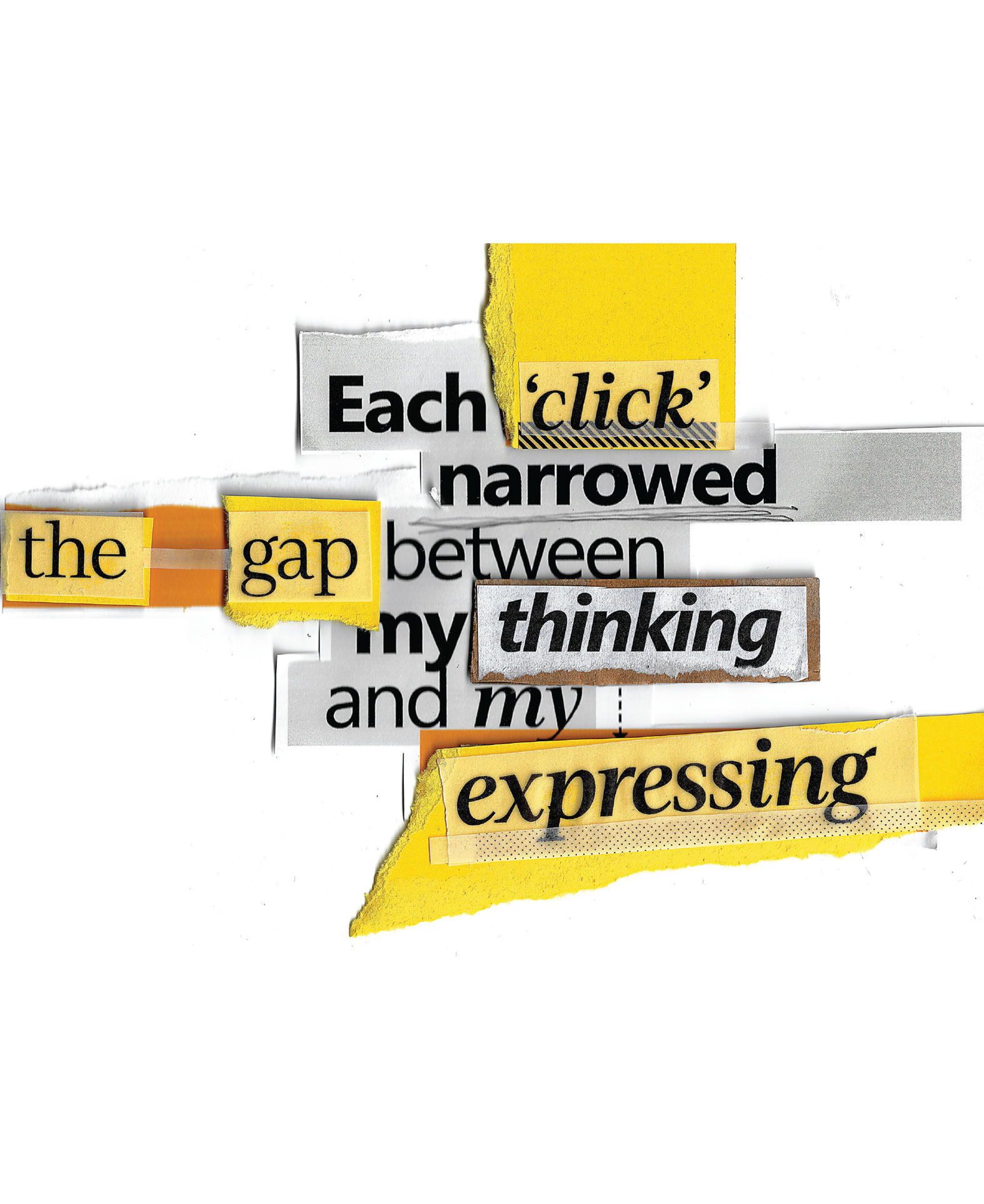
A collage of cut-out words reads: "Each 'click' narrowed the gap between my thinking and my expressing" on layered yellow, white, and gray paper strips.
A middle-aged man with short hair and a slight smile, wearing a black crew-neck shirt, poses against a plain light gray background.

As a kid, I had terrible handwriting – still do. I had ideas, but getting them down on paper was slow and frustrating. Somewhere along the way, likely out of shared frustration, my parents brought out an old manual typewriter. I still have it.

And almost immediately, something shifted. I wasn’t fighting the mechanics of writing anymore. The words started to keep up – if not with my thoughts, at least closer to them. It felt different. Lighter. More natural. Like I could finally do the thing I had in mind.

Over time, there were more of those moments. Electric typewriters. Early word processors. PCs. Each ‘click’ narrowed the gap between my thinking and my expressing, between intent and output. Each one making it easier to communicate something closer to what I meant.

If you step back, that’s the story of tools.

Think about the physical ones first. A hammer that feels right in your hand. A level that tells you what your eyes can’t. After years of failing at pie crust, I got a French rolling pin, then threw out all the other rolling pins I had. Tools aren’t just objects – they’re extensions. When they work well, they disappear, and the work becomes almost effortless.

Seamus Heaney captured this perfectly in his poem The Pitchfork:

“Of all implements, the pitchfork was the one That came near to an imagined perfection: When he tightened his raised hand and aimed with it, It felt like a javelin, accurate and light.”

That line – accurate and light – gets at something essential. The best tools don’t just help us work; they change how the work feels. They create that moment where effort gives way to flow, where friction drops and capability rises.

Where something clicks.

We have seen the same with digital tools. The first spreadsheet that recalculates instantly. The first time you write code and watch a machine execute something on your behalf.

The first time you search and get a tailor-made answer instead of a list of websites where you have to hunt one down. These moments feel like sudden gains in capability. And in a sense, they are.

But they can also be deceptive.

Because what feels like a leap in skill is often a redistribution of it. The tool is doing more of the work, even as we feel more capable using it. It can blur the line between what we know and what the tool is enabling. It can create a kind of fluency that looks – and sometimes feels – like mastery.

That tension has always been there.

When calculators became common, there was concern we’d lose the ability to do math. When spreadsheets emerged, some worried they would flatten financial expertise. When search engines became ubiquitous, there was a quiet anxiety that knowing how to find an answer might replace the need to understand it.

In each case, something did change. Certain skills became less central. Others became more important. I learned to navigate the world with maps and compass and understanding where north was; I feel this skill fade daily. The work didn’t disappear – it moved. And now we’re in another one of those moments. But this one feels different.

Because the newest tools don’t just help us do the work faster or more efficiently. They participate in the work itself in ways that feel closer to thinking than doing. They can draft, summarize, analyze, generate – often with that same sense of “click,” but without the same time or effort we once associated with it.

I can produce something that looks complete, coherent – even compelling – in minutes. Which raises a natural question: if it’s this easy, what exactly is the skill?

It’s tempting to see this as erosion – to assume that tools are making us less capable, less necessary, less differentiated. You hear versions of that argument often right now. But history suggests a different pattern.

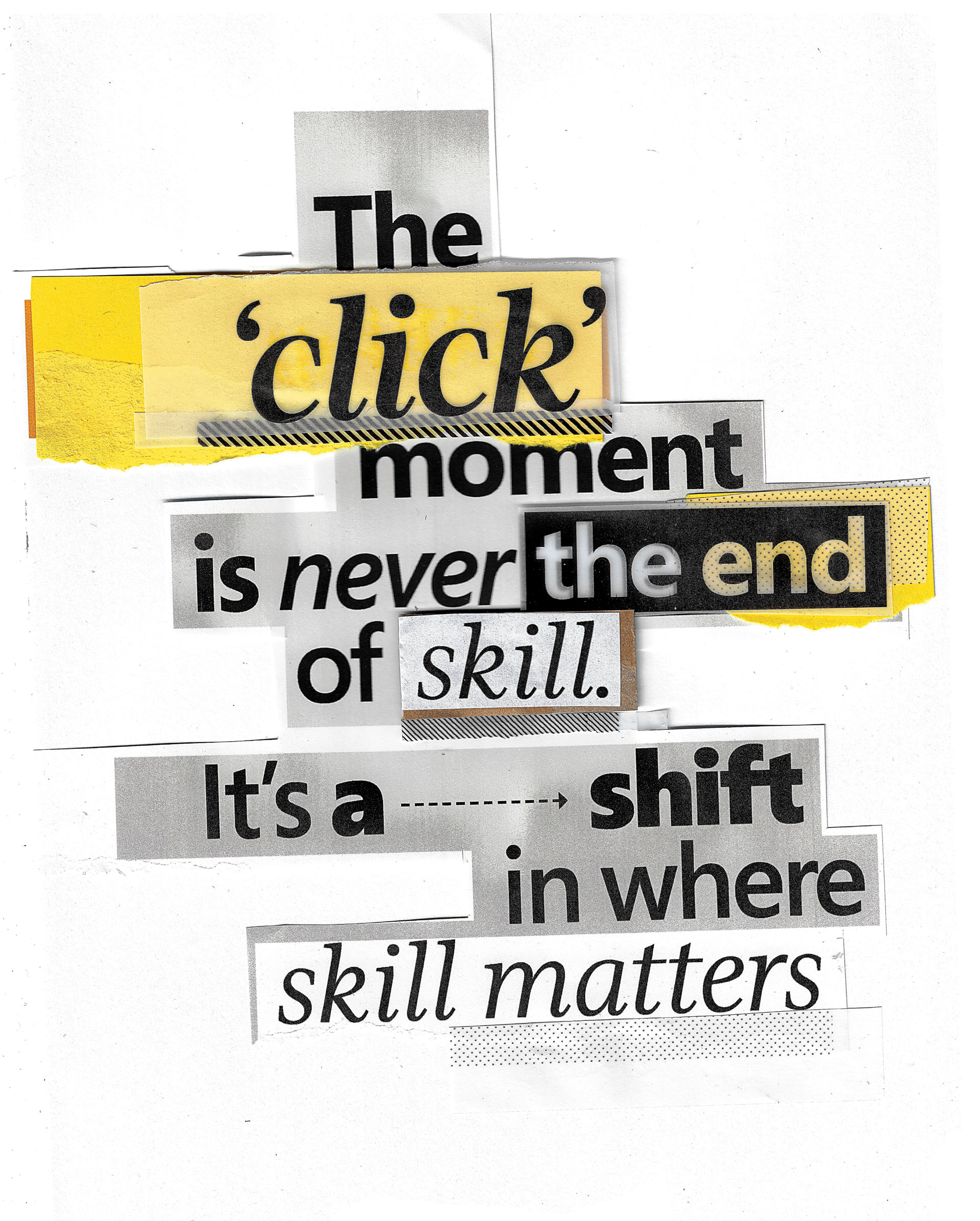
The “click” moment is never the end of skill. It’s a shift in where skill matters.

When the typewriter made writing faster, the advantage moved to those who had something worth saying. When spreadsheets removed manual calculation, the advantage shifted to framing the right problem and interpreting the results. When search engines made information abundant, the advantage moved to asking better questions and discerning better answers. Each time, the tool lowered one barrier and raised another.

AI tools are doing the same – just faster, and more visibly.

They reduce the friction of starting. They give more people access to capabilities that used to be specialized. They make it easy to generate output at scale.

And in doing so, they make it easier than ever to confuse output with understanding, fluency with mastery, speed with insight. Because when everything is easier to produce, the differentiator shifts again – to judgment. To taste. To context. To knowing what matters, what’s true, and what’s worth acting on.

Those qualities are harder to see, harder to measure – and harder to fake over time. They’re also where the real work increasingly sits.

So the question for leaders isn’t whether or not to use these tools. That answer is already clear.

The question is how to ensure that the “click” moment becomes the beginning of capability, not a substitute for it. How to build organizations – and cultures – that understand where the value has moved. How to develop the habits and expectations that turn easy output into real advantage.

That’s what this issue of Signal is about: not tools themselves, but how we adapt to them.

How we learn to use them well.

And how we make sure that as the tools get better – accurate and light in Heaney’s words – we do too.

Welcome to Signal 5.

Frank X. Shaw, Chief Communications Officer, Microsoft

A mostly black image with a speckled gray strip at the bottom, resembling a rough surface. In the top right corner, there are six small horizontal color bars in red, blue, green, yellow, gray, and white. Collaged text reads: "The 'click' moment is never the end of skill. It’s a shift in where skill matters." Backgrounds use yellow, gray, and white paper strips.

Field of dreams

The Microsoft Excel World Championship is a burgeoning e-sport tournament with a Las Vegas final, a $100,000 prize fund and thousands of competitors worldwide. Signal magazine heads to Amsterdam for the European Open qualifier – and finds the world’s most reliable office tool whipping up a showbiz frenzy.

A large gaming event features rows of players at computer stations, colorful lights, and a big screen at the front showing game action while spectators and staff move around. The Excel Esports European Open 2026 saw competitive spreadsheeters from 30 different countries gather in the Netherlands to face off across multiple categories

The Disc of Luck is spinning. Enthroned in gaming chairs on illuminated panels either side of a giant monitor on a darkened stage, ten competitors are building a Wheel of Fortune simulator inside a Microsoft Excel spreadsheet, toggling furiously between multiple tabs and fiendishly tricky data sets. They have 30 minutes to crack the “case”, or themed exercise. A crowd of several hundred people is watching in near-silence, broken only by the explanatory patter of the commentators – one of whom, U.S. Excel expert Oz du Soleil, sports a scarlet mohawk – and the occasional gasp of admiration or despair. A player completes Level 6 and the crowd cheers. Comments like “this is going to be a mad finish” flood the live-streamed coverage on the Excel Esports YouTube channel, which has nearly 60,000 subscribers. Nobody moves.

Welcome to Purmerend, an orderly satellite town 20 minutes north of Amsterdam, where the canals are tranquil and children play agreeably in the bright May sunshine outside the H20 Esports Campus – a black-walled arena that has appeared in the middle of this Dutch suburb like a spaceship. Inside, the floor of the stage gleams like a game show set, so shiny that competitors occasionally slip, like Bambi on the ice, as they are introduced by the MC. One confident player backflips en route to his desk. Hype music pounds in a loop. The audience is engrossed.

I have come to the European Open, notebook in hand, as a spreadsheet layperson. I am not alone in my Excel inexpertness, according to Andrew Grigolyunovich, the calm and smiley 44-year-old founder of the Microsoft Excel World Championship of which this European Open is part. “In job applications, people claim to be good at Excel, then it turns out they can’t make a VLOOKUP function,” he says, “let alone an index-match or XLOOKUP.” I try to look very disapproving indeed.

Competitive Excel has existed in various forms for two decades, but Grigolyunovich’s gladiatorial tournament is the version to put it on the global map. The format is deceptively simple. Competitors receive a spreadsheet “case”: a fiendish, themed puzzle built inside an Excel file, with jumbled or misleading data sets (Roman numerals, anyone?) and seven levels of increasing difficulty, plus bonus questions for the bold. This weekend alone, the cases include a floristry-themed case (Amsterdam is the spiritual home of Big Tulip, after all) an ice hockey-themed case (blame Heated Rivalry) and, for the final, a fictional Dutch art collection case requiring curation for maximum profit.

Players may bring their own keyboard and pre-loaded custom formulas, and they may not use AI or phones or talk to one another, except for during team events. The best players earn ranking points, prize money and – if they are good enough – a place at the World Championship finals in Las Vegas in December, where the winner receives a wrestling-style belt and the kind of renown that is niche, for now, but unmistakably growing.

Grigolyunovich became a CFO in his native Latvia at the age of 21, tasked with the financial future of a 70-location retail chain. Realizing Microsoft Excel was going to be indispensable for crunching the numbers, and with nobody to learn from, he taught himself to use the program by “pressing F1” and scrutinizing every formula description. Similarly, he built this competition from a standing start in 2020, after a previous Excel championship folded. He saw the potential for more frequent events, better rankings and more, well, hoopla. “I had to invent everything,” he says. His competition now runs annually and culminates at the HyperX Esports Arena in Las Vegas, which offers a $100,000 prize fund and is broadcast on ESPN. In a corner of the arena, academics from Utrecht University are conducting interviews with participants, investigating whether competitive Excel creates professional opportunities. Judging from the number of competitors whose employer is namechecked on their lanyard, the answer, broadly, is yes.

The reigning world champion, with the extravagant winner’s belt to prove it, is Diarmuid “Dim” Early. Early, 38, is originally from Cork in Ireland and now lives in New York with his wife and two young sons, one of whom told him before he left for Amsterdam, “Dada, you have to win. Losing is not acceptable. You cannot come home until you win.” Early has a PhD in computer science and spent years at Deutsche Bank and Boston Consulting Group. As a student, he used Microsoft Excel as a substitute for expensive mathematical software during summer holidays, making it do things it wasn’t designed to. “If you’re creative,” he says, “you can find workarounds for a lot of things.”


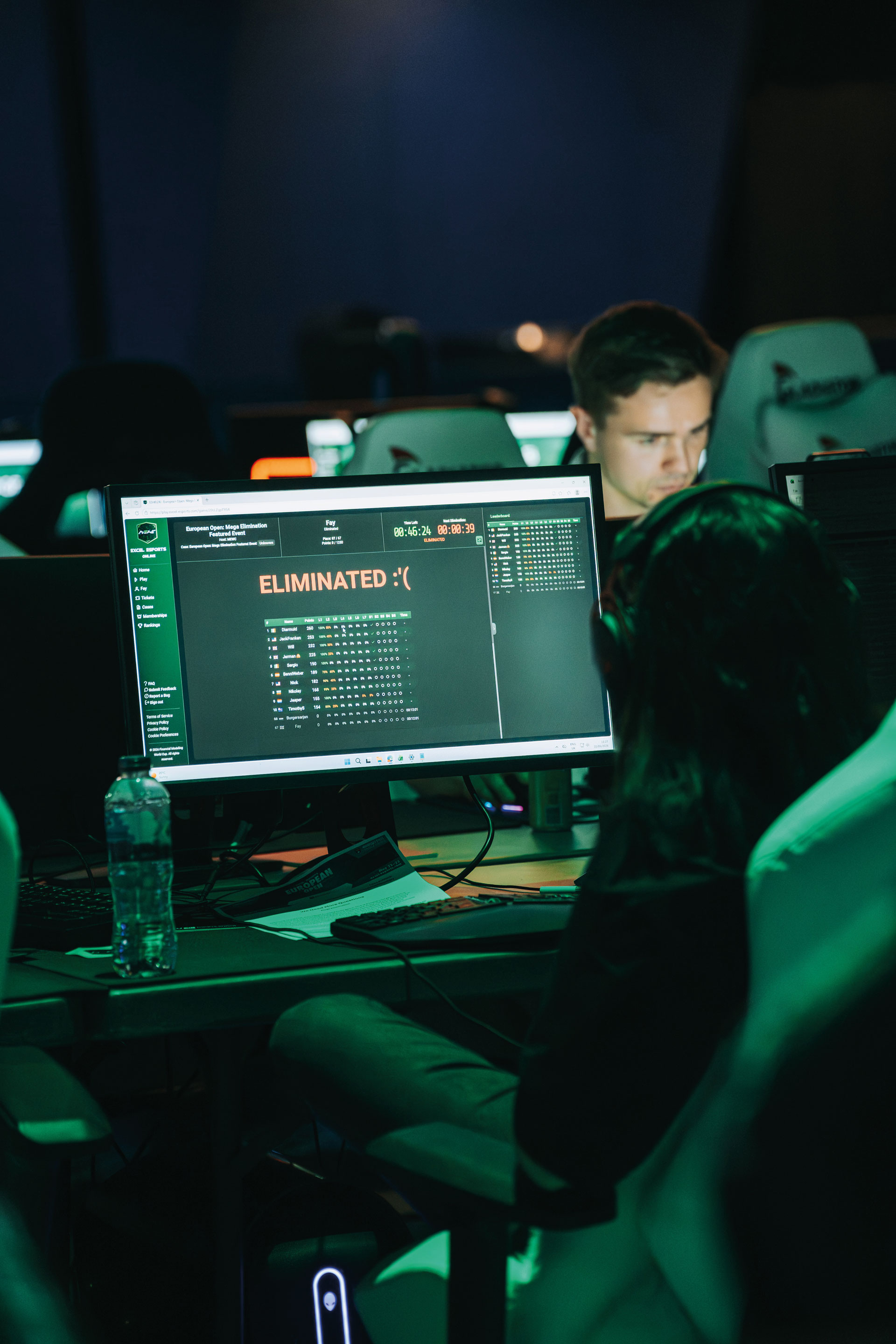
A person sits at a desk in front of a computer screen displaying the word "ELIMINATED" in a gaming environment, with another person visible in the background.

His preparation for competitive Excel involves making videos. He records and posts all his “live solves” to YouTube – talking his audience through every strategic decision as he makes it, explaining in real time why he favors one formula over another. It is, he explains, a technique borrowed from programming: developers are advised to keep a toy duck on their desk and narrate their thinking aloud to it. The YouTube audience is, in effect, a very large rubber mallard: “If there’s more going on in my head than I can vocalize, I just cut it off and move on,” he says, meaning that when his brain outruns his words mid-solve, he simply stops talking and keeps typing. Unusually, he competes without noise-canceling headphones, his “strong audio filter” he notes wryly, having been honed by parenthood.

Across the arena, Ha Dang, 37, is adjusting his headphones. The Scunthorpe-based accountant came to Britain from his native Vietnam a decade ago to do a master’s at the University of Lincoln and subsequently obtained citizenship. He won the UK Excel Championship seven months after seeing a promotional video at a conference and thinking, “I can do that.” He is the kind of person who likes things in rows and columns, neatly put in boxes. “Not always possible in life,” he acknowledges with a broad smile that suggests he has made peace with this.

His team’s name in the ice-hockey themed Relays round, in which competitors answer ever more abstruse questions about the goals accrued during a faux season of the sport, is Lambda Hope and Glory – a pun that’s a nod to both a patriotic British song and a powerful Excel function. His team came together after the members happened to be on the same flight home from the Las Vegas final in 2025. “When they announced the European Open,” he says, “it was kind of a natural progression. What do we have to lose?”

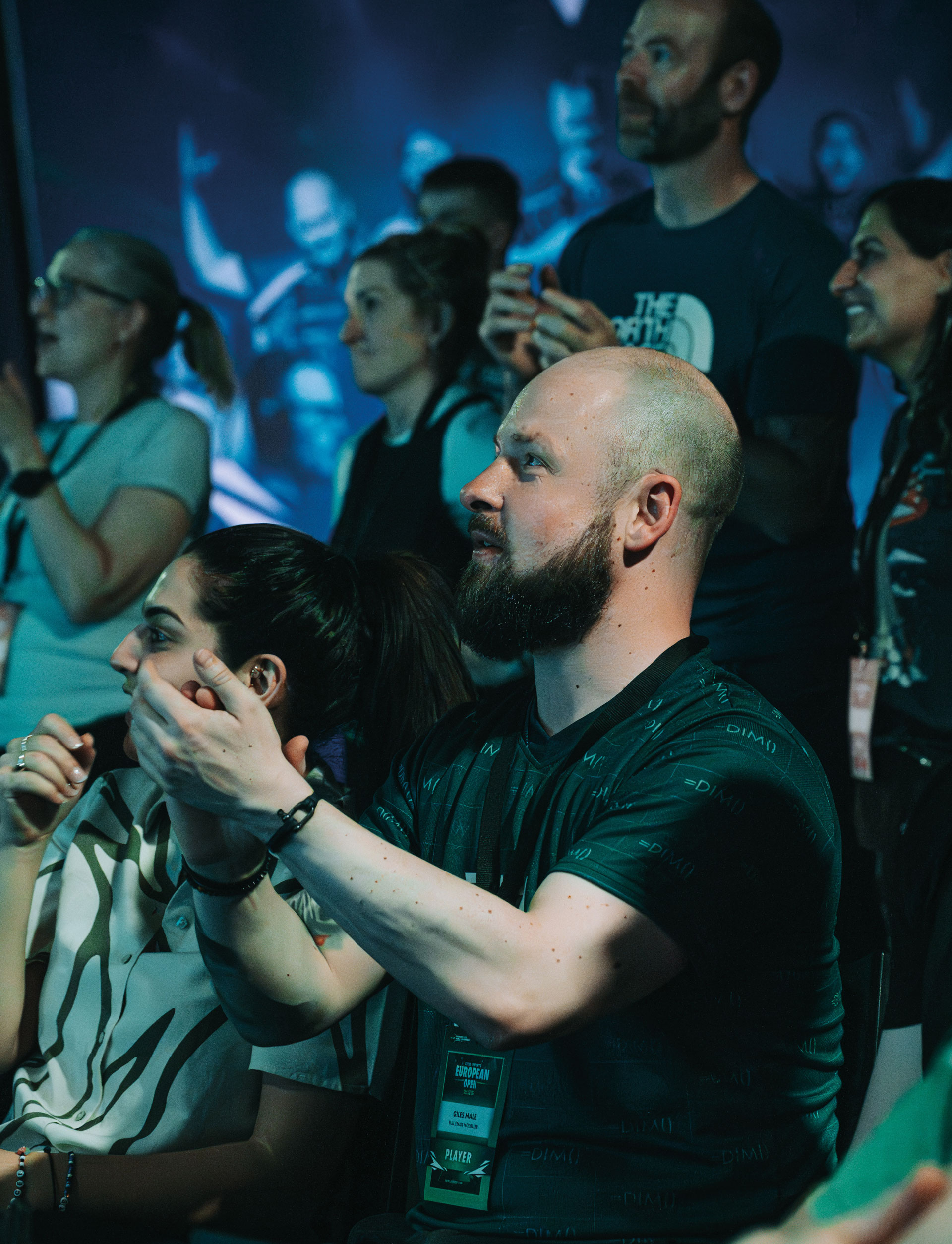
Ha is collared for some social media fun by Giles Male, a Microsoft MVP (Most Valuable Professional) who has commentated at the World Championship, co-written its theme song and who, with his partner Fay Bordbar, travels Britain giving free Microsoft Excel masterclasses to university students. Their Excel on the Road initiative is driven by a shared concern that core business skills risk waning if youngsters rely too heavily on AI. “We see it all the time,” says Male. “Ninety percent of people in the workplace are so bad at the basics. If students can get into the top five percent of Excel users, that’s the idea.” Bordbar, who trains in both Microsoft Excel and Microsoft Copilot, puts it more bluntly: “A lot of people are building models from scratch with AI, and then they can’t troubleshoot them; they can’t see where the risks are. To use AI effectively, you need to know more about Excel – not less.”

Ashleigh Roberts, from the United States, works in portfolio strategy for an energy company and plays competitive Excel with the same focused intensity she once brought to her beloved college soccer, where she competed at the NCAA Division III level. She describes everyday life with her ADHD as “37 radio stations playing simultaneously, all demanding attention,” whereas her brain on Excel is hyper-focused: “One radio station, one channel. I control the volume.” Her boss first sent her a link to a livestream of a competition on a Saturday morning in 2021. Her initial reaction, she says, was “what a bunch of nerds.” Then she saw someone list their favorite function on screen. It was index-match – a formula that can look up data in any direction: left, right, up, down, like a queen on a chessboard. “And I went: ‘Wait. That’s my favorite function too.’” She kept watching.

Roberts entered her first competition at $25 early-bird pricing, told herself that if she learned one thing it would be worth it and finished in the top 30 – a very respectable result. “The only time,” she adds, “that I have beaten both [2024 world champion] Michael Jarman and Diarmuid Early in the same competition.” Now, Roberts is Early’s partner in today’s mixed doubles category – a first for the esport, in which pairs work on the same case simultaneously but from separate computers, each tackling different sections of the puzzle in a race to maximize their combined score.

She compares the pairing up for this inaugural doubles’ partnership to a high school dance. “It’s a mad scramble because of the disparity in the number of women versus men, but somehow I got that call,” Roberts tells me. At this level, men outnumber women by a ratio of 10:1. But in common with so many people I speak to, Roberts finds the Excel community supremely supportive, across lines of gender, ability and nationality. “There’s a lot of knowledge-sharing that goes on, and not a lot of resource-guarding. I think that sets us apart from other e-sports,” she says.

The crowd around the main stage is beginning to thicken for the finals. Eighty-two competitors have been whittled, via yesterday’s ‘Mega Elimination’ round, down to 40, then to ten, and these ten – drawn from Ireland, the United States, Italy, Germany, the Netherlands and the UK – are now grappling with ‘The Rijksmuseum Case,’ a puzzle written by Grigolyunovich himself and involving 1,000 fictional Dutch paintings spanning the 13th to 19th centuries. The task, across seven levels of increasing difficulty, is to curate the collection for maximum market value.

A group of people at an indoor event watch something off-camera, appearing engaged and clapping. The focus is on a bearded man in the front row, with other attendees visible in the background.

What makes the final gripping is Jasper van Merle, a Dutch player who has barely registered in the leaderboard narrative until now, and who is doing something none of the other nine competitors are doing. He is not writing Excel formulas. He is writing Python – a programming language that can now be run inside Microsoft Excel. This function, introduced relatively recently, is still, in competitive terms, an unknown quantity. From the audience, it is not immediately legible: his screen shows code where everyone else shows cells, and the commentators are having to recalibrate in real time. “The way he does it,” Giles Male had told me earlier, discussing the question of AI in the sport, “it just looks different.” Van Merle storms through the early levels. The crowd stirs. Are we witnessing the arrival of a new Dutch Master?

Not so fast. Jasper gets stuck on Bonus One: the first and conventionally the mildest bonus question. Crowd members exchange glances. Python, it turns out, is extraordinary at many things but helpless in front of whatever Bonus 1 contains.

Early, meanwhile, is doing what he does best. He finishes levels one through six at 100 percent completion. He collects all four available bonus points and soars to the top of the leaderboard, where he remains, except for when the Italian Sergio Triletti sensationally leapfrogs him in the last minute – but only for eight or nine seconds. Early closes The Rijksmuseum Case victorious, with 1,050 points, a whopping 30 clear of second place.

The final standings flash up on the big screen. Jasper van Merle finishes sixth. Ha Dang is eighth, a creditable result from a player who admits he takes his time to “acclimatize” to a case; every player here knows exactly what kind of competitor they are. The winner today gets €2,000 and, far more valuably, automatic qualification to the Vegas semi-finals. No online qualifiers, no elimination round. Straight to the precipice of world domination.

In the second row of the audience, seven members of a Canadian family split between Toronto and Vancouver but united in spreadsheet obsession are packing up to leave. Elena Thai, 18, who fell just outside the all-important top nine in yesterday’s student qualifiers, is a mathematical finance undergrad who got into competitive Excel because her father’s trip to last year’s Las Vegas final looked cool on Instagram. She had grown up tracking trick-or-treaters in a spreadsheet (“So we know how much candy to buy for the next year, and what kind”) with her dad, James, a chief investment officer, who is philosophical about finishing last in his semifinal group and jubilant about the trip. “We’ve had a great time visiting the Netherlands,” he says, “all because of Excel.” His beaming mother has been holding a hand-illustrated banner: LIKE FATHER LIKE DAUGHTER, WE EXCEL.

Appearing somewhat baffled by the razzmatazz, Early delivers a gracious and funny acceptance speech as the crowd chants “Dim, Dim, Dim.” Having watched in awe over two days, I can fully see why he’s universally known as “the LeBron James of Excel.” Jasper van Merle has six months to train his Python for the World Championships in Vegas.

Roberts, who flew here from the US to “run around Europe playing with spreadsheets,” explains the appeal of competitive Excel better than anyone else I spoke to. “It’s one of the most intoxicating things,” she says, “to be in a room full of people where I will never be the smartest person in the room. And I love that, because I’m constantly learning.” She didn’t make it into the top 40 of the Mega Elimination event this weekend, but she and Dim placed a respectable fifth in the Mixed Doubles. She’s looking forward to the World Championships in Vegas. “Competing there is our big game, our Super Bowl, our World Cup, our Olympics,” she says. “It’s the culmination of an entire year’s worth of work that, because it’s sudden death-style play, can end in an instant; lose and you’re done.”

A person wearing headphones sits at a gaming desk with a large monitor, illuminated keyboard, and mouse, focused on playing a video game in a brightly lit esports arena.

Growth industries

Can AI be used to help farmers protect their crops, optimize their yield potentials and respond quickly to threats? Signal magazine meets the team at Land O’Lakes, who are seeking to do just that.

A green tractor pulls farming equipment across a vast, golden brown field under bright sunlight, creating parallel lines in the soil.

The weather was already turning when the call came in. The grower needed advice quickly from his local agricultural retailer – a business that supplies farmers with essential items such as seeds and fertilizers – about his crops before high winds moved through later in the day. There wasn’t time to pore through books or search online for information – and the wrong call could potentially impact the entire growing season.

That kind of urgency has become typical in U.S. agriculture. Growers are under immense pressure, facing soaring input costs, depressed commodity prices and ever-thinner margins. Retail agronomists, crop advisors who work for local agricultural suppliers, are also feeling the squeeze. They’re being asked to cover more farms while delivering precise, trustworthy guidance in a high-stakes environment where timing is critical.

Those challenges are what prompted Land O’Lakes, a farmer-owned agricultural and dairy cooperative based in Minnesota, to create an AI-powered digital assistant named Oz. The tool was designed to help deliver accurate, relevant answers to growers as quickly as possible, says Leah Anderson, senior vice president of Land O’Lakes and president of WinField United, an agricultural input and agronomy services company owned by Land O’Lakes.

“When farmers are spending money on their farms, they need to know that every decision they’re making is going to [make sense] financially for them. And they need confidence in that more so than ever right now,” Anderson says. “So we said, how can we help with that? How can we help relieve some of that pressure and give them more confidence that when they’re making a recommendation, in the case of an agronomist, or when they’re making that purchase, in the case of the grower, that it’s going to yield the best result for the farm?”

Agronomists and agricultural retailers have long relied on the WinField United Crop Protection Guide, an exhaustive, 800-plus page technical manual, to help growers navigate complex decisions throughout the growing season. Often referred to within the industry as “the bible,” the guide draws on decades of applied research, including work conducted at nearly 200 test fields across the country on how crops, seeds and farm inputs perform in real-world growing conditions.

Updated annually, the guide contains product information, application guidelines, crop-specific recommendations, regulatory details and other resources. In its current form, it is built on roughly 20 years of data and millions of data points that agronomists depend on to inform their recommendations. The issue Land O’Lakes sought to address wasn’t about the quality or credibility of this information – it was how to help users find the relevant details quickly, at the moment they are most needed.

“A farmer is calling that agronomist and saying, ‘I have a problem – help me,’” Anderson says. “In the old days, you would literally [go] through hundreds of pages of material.”

“If you’re a farmer, a lot of what happens is determined by Mother Nature,” she adds. “You may know that it’s going to be 35-mile-an-hour winds or it’s going to rain really hard in 12 hours. So you’ve got a problem or an opportunity, and you need a decision quickly.”

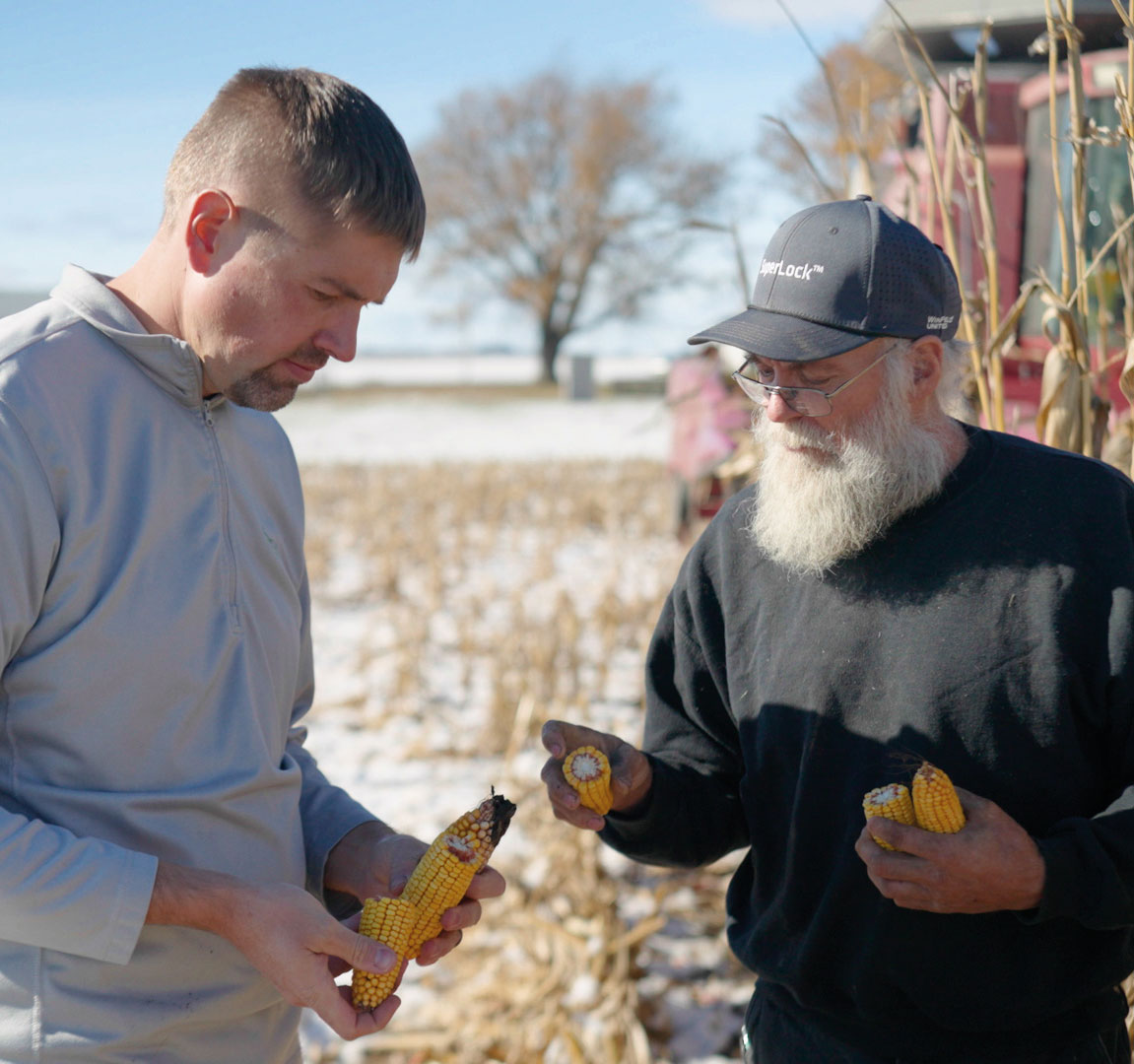
Tyler Steinkamp understands that as well as anyone. A technical agronomist for WinField United, he supports agricultural retailers across Missouri, Iowa, northern Illinois and Wisconsin. During the growing season, his days are a hectic mix of training sessions, problem-solving calls and urgent questions from retailers. “In season, sellers get really busy,” Steinkamp says. “They’re getting questions constantly from farmers – ‘Can I apply Steinkamp pauses to hold up a dog-eared copy of the crop protection guide. “I’m confident I can find the information in this book,” he says. “But it takes me time to do so. And time is the one thing you don’t have in season.”

this right now?’ ‘I’ve got this weed out in my field, what can I do?’ ‘The corn’s already up, now what can we spray?’” In theory, those questions can be answered by consulting the guide. In practice, time is the limiting factor.”


A black background with a yellow and black diagonal striped warning pattern along the bottom edge of the image. Two men standing in a cornfield examine ears of corn together. The man on the left wears a gray shirt, and the man on the right wears a cap and glasses. Some snow is visible on the ground and in the background. Technical agronomist Tyler Steinkamp supports agricultural retailers

When agricultural retailers – who often have agronomy backgrounds themselves – can’t quickly locate the right information, the default is often to call Steinkamp. That can create bottlenecks, especially during peak periods when everyone is racing against the same weather events and crop stages. “There are certain times of year when I just have a backlog of calls,” he says. “And a lot of this stuff is very time sensitive.”

Oz was built to help ease that friction. It’s part of a broader multiyear digital transformation at Land O’Lakes, anchored by a strategic alliance struck with Microsoft in 2020 and renewed in 2025. The collaboration focuses on using data, cloud infrastructure and AI to deliver practical insights to farmers. Oz, Anderson says, reflects Land O’Lakes’ focus on investing in technology that solves real, day-to-day problems for the cooperative’s retail owners and the farmers they serve.

“When it comes to AI, we’re going to make sure that the solutions we’re designing are built with a real understanding of who has a problem – and that we’re actually solving that problem, not adding complexity,” says Anderson.

As Land O’Lakes thought about how to build its AI-powered digital assistant, Anderson says, leaders made a commitment to involve three key groups in the process – internal agronomists, technologists and the retail agronomists who would ultimately use Oz. Understanding not just what questions sellers would ask, but how they would ask them, proved critical.

Through that process, the team learned that agronomists might use slang terms for products, and that terminology can vary from region to region – the word “pre-emerge,” for example, can mean before weeds emerge from the ground or before crops do.

“The training process was really important,” Anderson says. “We probably have more differential data and insights than almost anybody out there. But it was training us to understand how agronomists reach in and ask questions of that data [that] was the magic to get to the point where we could count on the answers.”

Oz runs on Microsoft’s cloud, using Azure-based AI tools to turn Land O’Lakes’ agronomic data into a secure, custom copilot. Although the tool draws from the same trusted sources that underpin the crop protection guide – rather than a new or untested dataset – Anderson and Steinkamp concentrated on whether it could consistently deliver accurate answers or account for the nuance that experienced agronomists bring to their work.

They knew that for Oz to be effective it couldn’t simply deliver static answers, because agronomy is inherently contextual. Geography, soil type, tillage practices, crop stage and weather conditions all factor into what is safe, effective and economically sound. A recommendation that works in Ohio could damage a crop in western Kansas. As Steinkamp likes to say, his most common answer to any agronomic question is, “It depends.”

“My major focus was the accuracy of the information,” he says. “We wanted to make sure that when Oz gave an answer, it was relying on the guide and giving a relevant answer.”

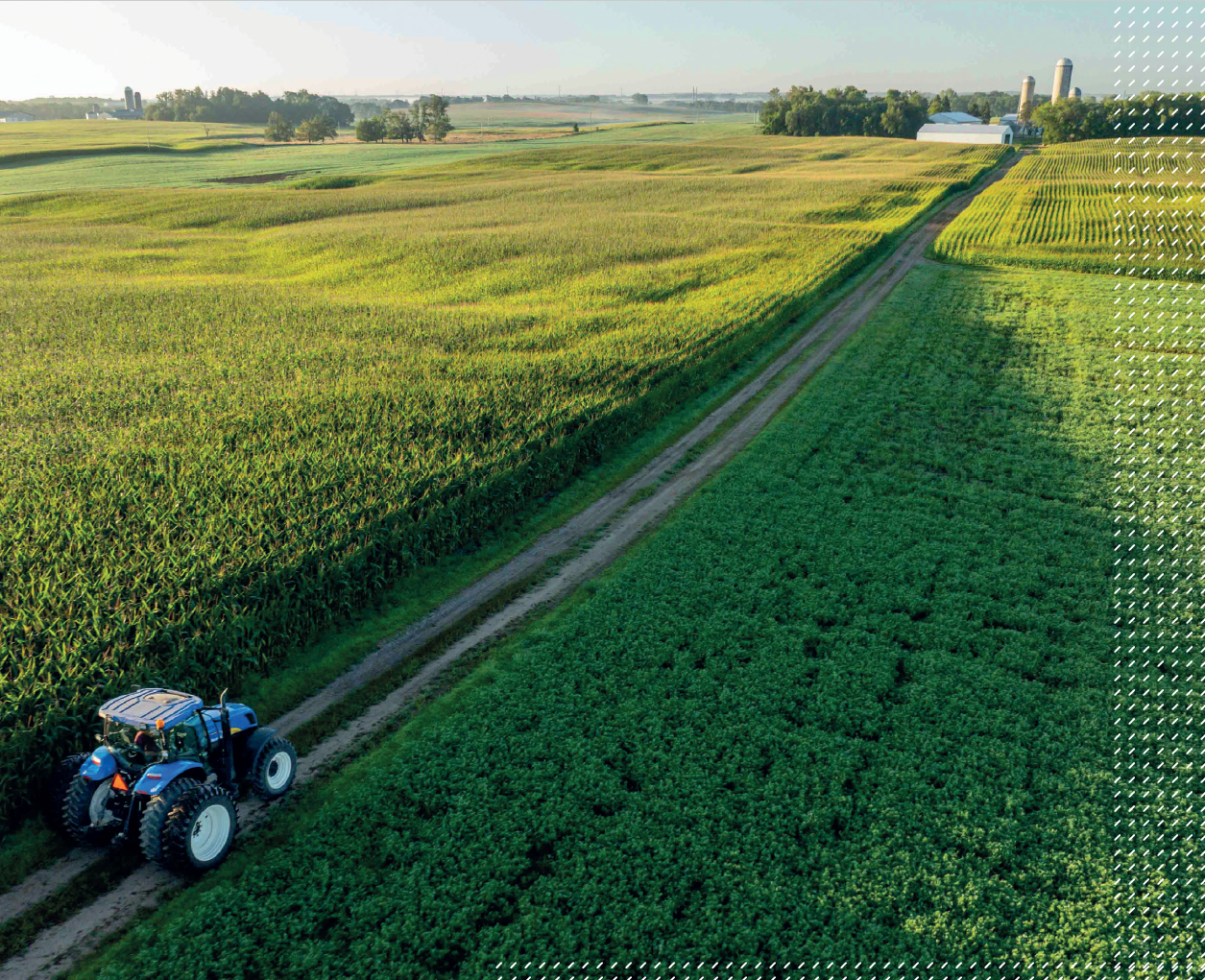
A completely black image with no visible objects, patterns, or distinguishable features. A blue tractor drives along a dirt road through expansive green fields, with farmland and silos visible in the distance under a clear sky.

In the rural communities Land O’Lakes serves, agronomy is built on longstanding personal relationships. The farmer an agronomist advises in a crisis might have children in the same school and shop at the same grocery store. A wrong recommendation can cost money – and damage trust that took years to build. “These are small communities,” Anderson says. “Their kids probably play baseball together. There’s so much emotion built in that relationship, and that agronomist takes so much pride in doing the right thing every time for that farmer.”

The development process underscored the need to design Oz for precision and accuracy. For Anderson, who describes herself as “an action-oriented person,” that meant accepting a slower timeline than expected. “What we learned was that we had to slow down and prioritize accuracy over speed, because those relationships are so important,” she says.

That thinking shaped Oz’s design. Instead of delivering one-size-fits-all responses, the assistant asks follow-up questions – about location, crop rotation, nutrient levels and conditions – to build context before offering guidance. “Oz really is a thought partner,” Anderson says. “It’s pressure-testing the decision with you.”

Steinkamp sees it the same way, emphasizing the importance of keeping a knowledgeable human in the loop. “It’s really no different than us handing them a paper copy of the crop protection guide,” he says. “The agronomist that’s using it is going to be really, really critical.”

Given the stakes, Land O’Lakes avoided rushing Oz to market, opting instead for a phased rollout. Internal agronomists tested the tool first, followed by a small group of retail agronomists. After more than a year of refinement, Land O’Lakes began expanding Oz across its U.S. retail network in April 2026. By early May, Land O’ Lakes had already reached 20% of its target active user goal, with users averaging five questions per session, and the company expected usage to grow quickly as the season moved beyond planting and growers navigated the real-time challenges of a growing season.

Early feedback has been encouraging, Anderson says, particularly around in-season decision-making and pre-season farm planning. “There’s that heat-of-the-moment situation with weather,” she says. “But Oz also helps retail agronomists prepare for planning conversations with growers, making sure they’ve thought of the key elements that need to be in the farm plan.”

Some agronomists initially worried that Oz could replace them, Anderson says. Bringing them into the tool’s design and training process, both to test it and shape how it would be used, helped alleviate those concerns. “That gave them a sense of ownership,” she says. “As we’ve worked on it, they’re realizing, this thing’s actually pretty darn right – and that it’s here to help me.”

Oz is already changing how information flows through the agronomy ecosystem. For Steinkamp, it saves time by pulling together information from multiple sections of the guide into a single response he can screenshot and share with sellers. “It makes me more efficient with my time, which for me is a big deal,” he says.

It’s also helping Land O’Lakes to learn. By analyzing the questions users ask most often, the company can identify training gaps, emerging agronomic challenges and even gaps in its product portfolio. “It’s become a bi-directional feedback loop, which has been really powerful,” Anderson says. “We’re getting a point of view on things that we maybe didn’t see before.”

For now, Oz is focused primarily on crop protection, but Land O’Lakes is exploring ways to also incorporate seed performance data and insights from WinField United’s research. Ultimately, Anderson says, Oz is about giving agronomists the confidence to provide recommendations that help farmers succeed and maintain trust. “At the end of the day, we’re in farming,” Anderson says. “Everything we’re doing is about helping the farmer make the best decision possible.”

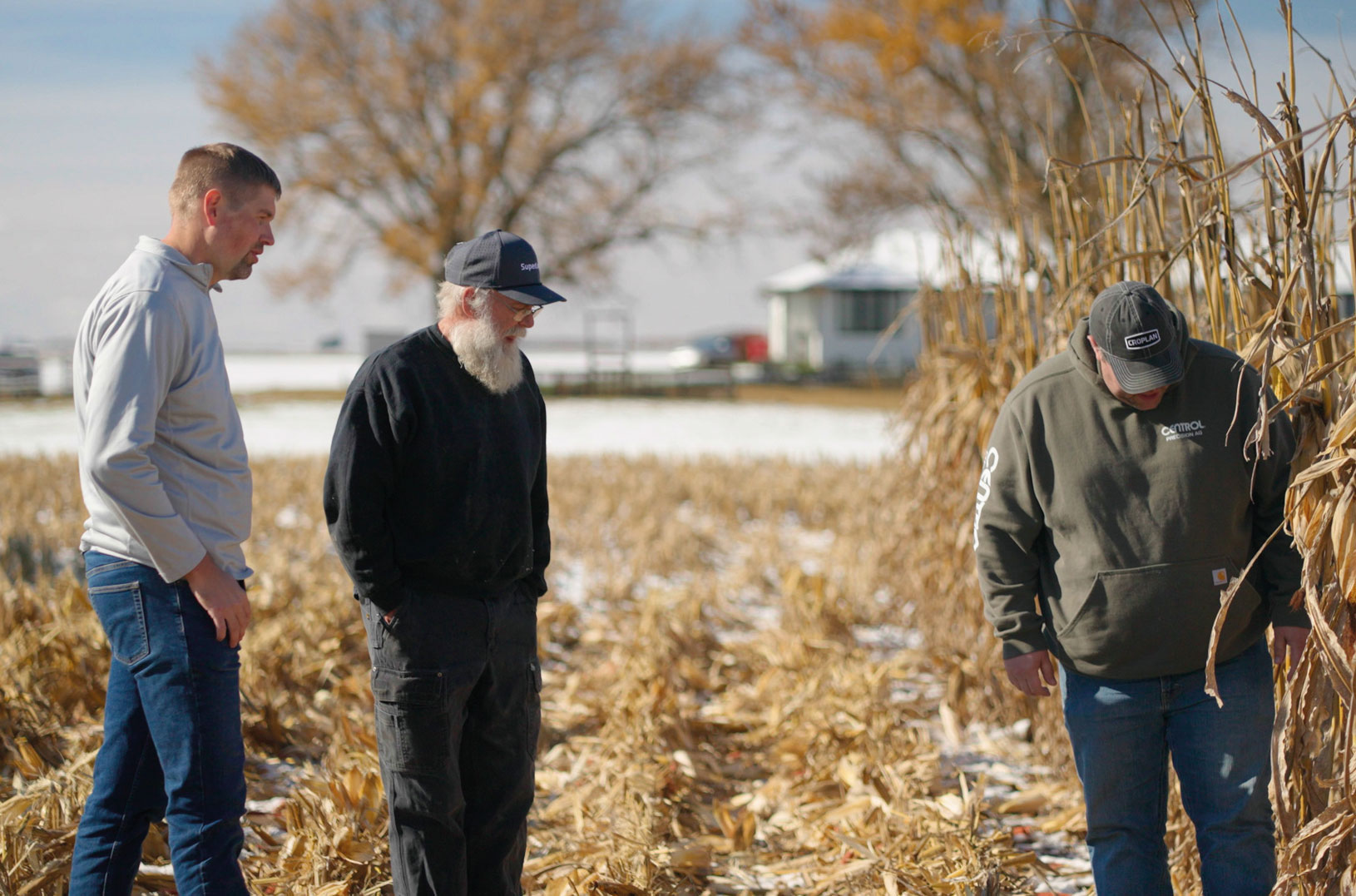
A mostly black image with a speckled gray strip at the bottom, resembling a rough surface. In the top right corner, there are six small horizontal color bars in red, blue, green, yellow, gray, and white. Three men stand in a harvested cornfield with dried stalks, examining the ground on a sunny day. A house and leafless trees are visible in the background.

“AI-powered healthcare innovations are being developed at an incredible pace”

Peter Lee, President, Microsoft Science, gives us a briefing on the important new roles that artificial intelligence has begun to play in healthcare.

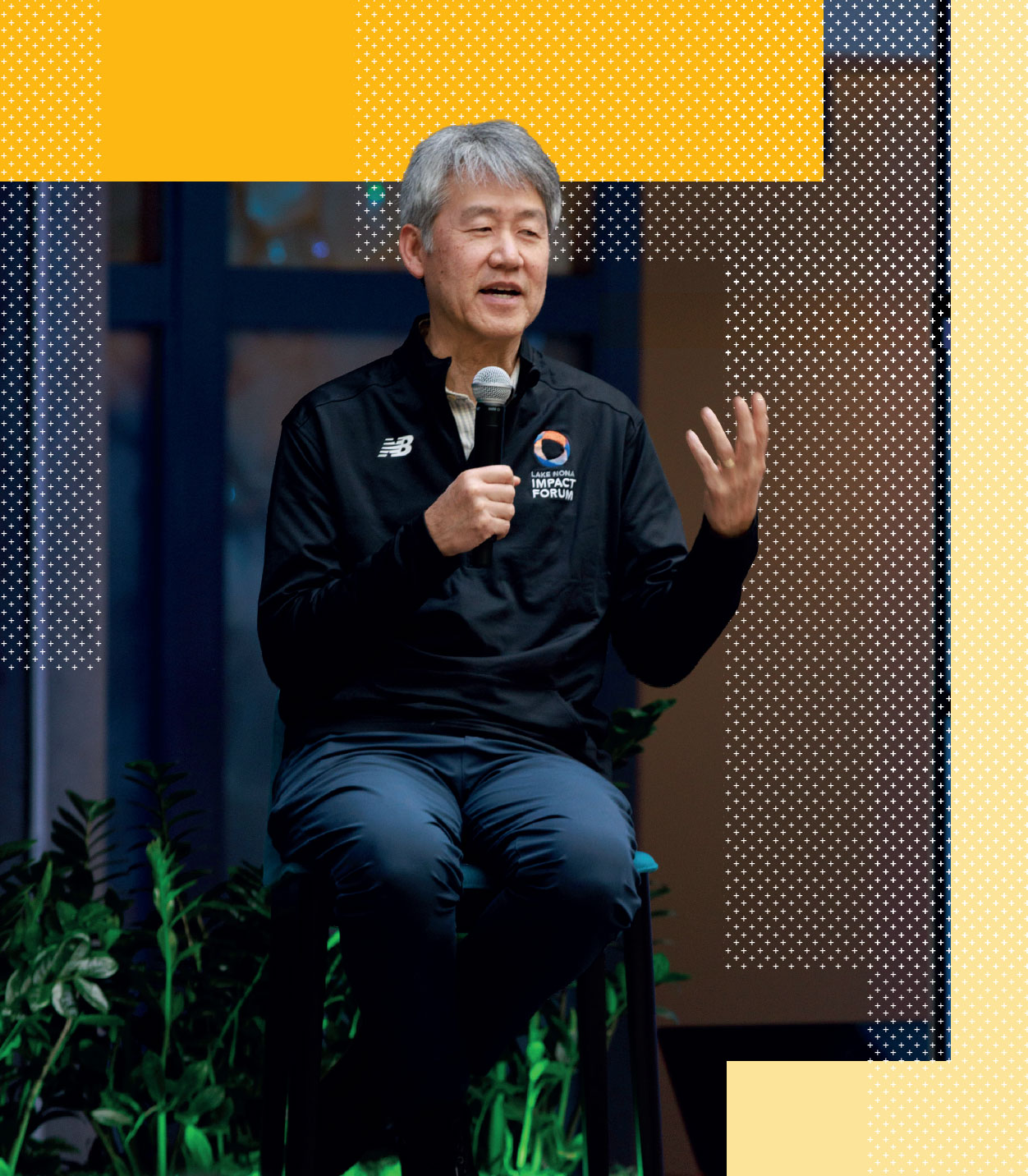
An older man with gray hair, wearing a black jacket, sits on a stool holding a microphone and speaking, with abstract yellow and dotted patterns in the background. Peter Lee, President, Microsoft Science

Signal: What was your journey to working at the crossover point of AI and healthcare?

Peter: Being involved in healthcare has been a big accident! I was a computer scientist by training and then spent a couple of years in government service at DARPA [the Defense Advanced Research Projects Agency] and then was recruited to join Microsoft, where I had the great fortune to work my way up and eventually become the head of Microsoft Research. And then for reasons that I still don’t quite understand, Satya Nadella, our CEO, asked me to take on a small skunkworks team that he had formed to try to rethink healthcare technology in the age of cloud computing, machine learning and AI. Honestly, my first reaction was that I was being punished for some reason! But it was, in fact, an extremely important thing, because the world of medicine and healthcare in 2016 was very obviously going to be changing a lot, and Microsoft had to be participating and contributing to that.

Signal: Where did you start?

Peter: Everyone has contact with the healthcare system so that makes it very personal for us all. But it also creates the problem that we all think we know more about it than we really do, and I was very guilty of that. It took some time to really engage with CEOs of big healthcare systems, with medical researchers, patient advocacy groups and so on, to get immersed in the world of healthcare. I learned a lot and had the fortune to get appointed to the board of a medical school, so I took the trouble to go through the pre-clinical curriculum and learn something about medicine. And miraculously, by 2020, I got elected to the National Academy of Medicine, which I think is less a statement about me and more a statement about how from 2016 to 2020, technology had become just so central and crucial. I just happened to be in the right place at the right time to be recognized as one person able to contribute in that way.

Signal: Tell us about an interesting and important project you’ve worked on in that time.

Peter: One project, conceived by [former Microsoft Research corporate vice president and managing director] Desney Tan, was called EmpowerMD. The vision was to have an AI that would watch doctors and nurses in their jobs and then try to help them. The first application for EmpowerMD was in an outpatient setting, in the exam room, where you have it listen to the doctor-patient conversation and then automatically write the clinical notes that go into the electronic health record system. We ended up collaborating with Joe Petro, now Microsoft’s corporate vice president of health and life sciences, and his team at a company called Nuance [which developed Dragon dictation software]. Eventually the project became so important that Microsoft made the decision to acquire Nuance, and Dragon Copilot is now used by more than 150,000 doctors, writing millions of clinical notes every month.

Signal: Is there an active component to Dragon Copilot as well? Is it making suggestions to medical professionals?

Peter: There are a number of companies, including Microsoft, that have the technology ready to be able to do more administrative things like ordering lab tests, writing prescriptions and referral letters, but also things to reduce medical errors and help in diagnosis and the development of treatment options. All of those will take a few more years before we see them in practice because they are in regulated areas where the Food and Drug Administration in the US and their counterparts in other parts of the world have a say in whether they are safe to deploy. But there’s no doubt that these things are coming soon. And in the meantime, they are starting to catch errors. So, for example, if you’re in that exam room and the doctor decides, “Okay, we’re going to prescribe this medication for you,” the system in Dragon Copilot will be able to issue an alert to the doctor saying, “Wait a minute, this patient is already on this other medication and there’s a bad interaction with that medication.” So it will stop short of the regulatory line of actually suggesting an alternative, but it will tell the doctor that something wrong might be about to happen. And even that, I think, is going to be pretty transformational.

Signal: So the tech can work with hospital records – but presumably I would also want it to use information from wearables and ideally to have genetic and family information. Is that the next step?

Peter: Yes, and in fact, you may even want to go beyond that. You may want some understanding of how your nutrition is going. And there are systems now that are, with your consent, able to track your grocery items and so on. One big question today is whether the tech will take the form of consumer applications. Microsoft is one of the companies making a big bid on this with Copilot Health [see page 72], which is our consumer solution that brings your health questions, wearable data and health records together in a single place, for guidance that’s personal and private. Let’s say you suffer from asthma but over the course of 25 years you’ve learned with the help of a healthcare system how to manage it successfully. With a personal health application like Copilot Health, AI can help piece together the specifics and patterns of your personal history with asthma, as well as offer proactive and actionable insights so you can better understand what’s going on, what to do next and how best to prepare for your next doctor’s appointment. I think that combining that AI treasure trove of data and experience over your life with the latest medical science makes too much sense not to come true. And of course, there are a lot of very smart people in organizations really going after this.

Signal: How can AI help doctors with diagnoses?

Peter: Today in a medical school curriculum, when you’re trained as a doctor and you’re trying to diagnose someone, especially someone with a rare disease, you’re trained to be a little bit of a detective, in forms of deductive reasoning, sources of information and how to piece together the puzzle. And that’s a very important skill. But what is happening now is that the same architecture that makes ChatGPT a next-word prediction model can be trained to predict the next medical event in a person’s healthcare journey. And in our case, we’ve been collaborating with Epic and Yale University Medicine to train a large next-medical-event model on millions of de-identified patient records and more than 100 billion medical events that are in the Epic system. So, instead of being a detective or a sleuth, you can instead say, “Okay, here’s this patient I have; the patient has presented in this way; here’s their medical history. Find me 500 patients just like this one and summarize how they were diagnosed and treated and what their outcomes were.” That’s a very data-driven way that I think, at a minimum, will augment the kind of detective sleuthing approach to medicine that humans are currently trained in. And that combination is, I think, going to be just incredibly powerful.

Signal: How might AI help in the discovery of novel drug compounds?

Peter: I have no doubt that AI is going to completely transform how things are discovered in the sciences. We are having AI systems learn human languages by being trained on next-word prediction, and the same can happen by looking at protein or biomolecular structures and then trying to predict the next configuration or shape of those things. Or if you have two proteins that are in proximity and they’re going to interact with each other, what is the next step? Think of it as a movie, frame by frame. Can you predict the next frame of the interaction of these things? By doing that, you’re in essence learning the language of proteins and small molecules. And if you’re thinking about drug discovery, that is so essential. If you identify some protein which is associated with a disease, some infectious agent, and you identify a target that, if inhibited, will defeat the infectious agent, then the question is, can you design a small molecule that’s easy to make that will bind very effectively to that target? Being able to come up with a design and predicting whether it will bind, are examples of what we could do if we learn the languages of nature.

Signal: How else can AI help researchers?

Peter: During the process of research, you have to come up with a hypothesis, then design and run an experiment. You get a bunch of data and analyze it to see if it supports the hypothesis. If the experiment was mis-designed, you have to redesign it, and then you keep going around that loop – you revise your hypotheses, you redesign your experiments, and that whole cycle of discovery is just full of opportunities for AI to make things better. It can help you write a clearer, better grant application; to reduce the amount of time it takes to review and assess whether the grant application is worthwhile; and to help you design the experiment. It can then use AI to program robotic lab equipment to help run some of that experiment, to start analyzing the data and correlate to the extent to which it supports the hypotheses and then to revise the hypotheses and go around that cycle. That is, in fact, something that a part of Microsoft called Microsoft Discovery is building to provide as a platform that scientists could use. So learning the languages of nature and managing the discovery loop are two dimensions of discovery and both, I think, are just going to create a huge acceleration. Chris Bishop, the founder of Microsoft Research AI for Science, believes that in research, we may be able to compress what would normally take 250 years to discover down to 25.

Signal: Is there also a potential for democratization in healthcare?

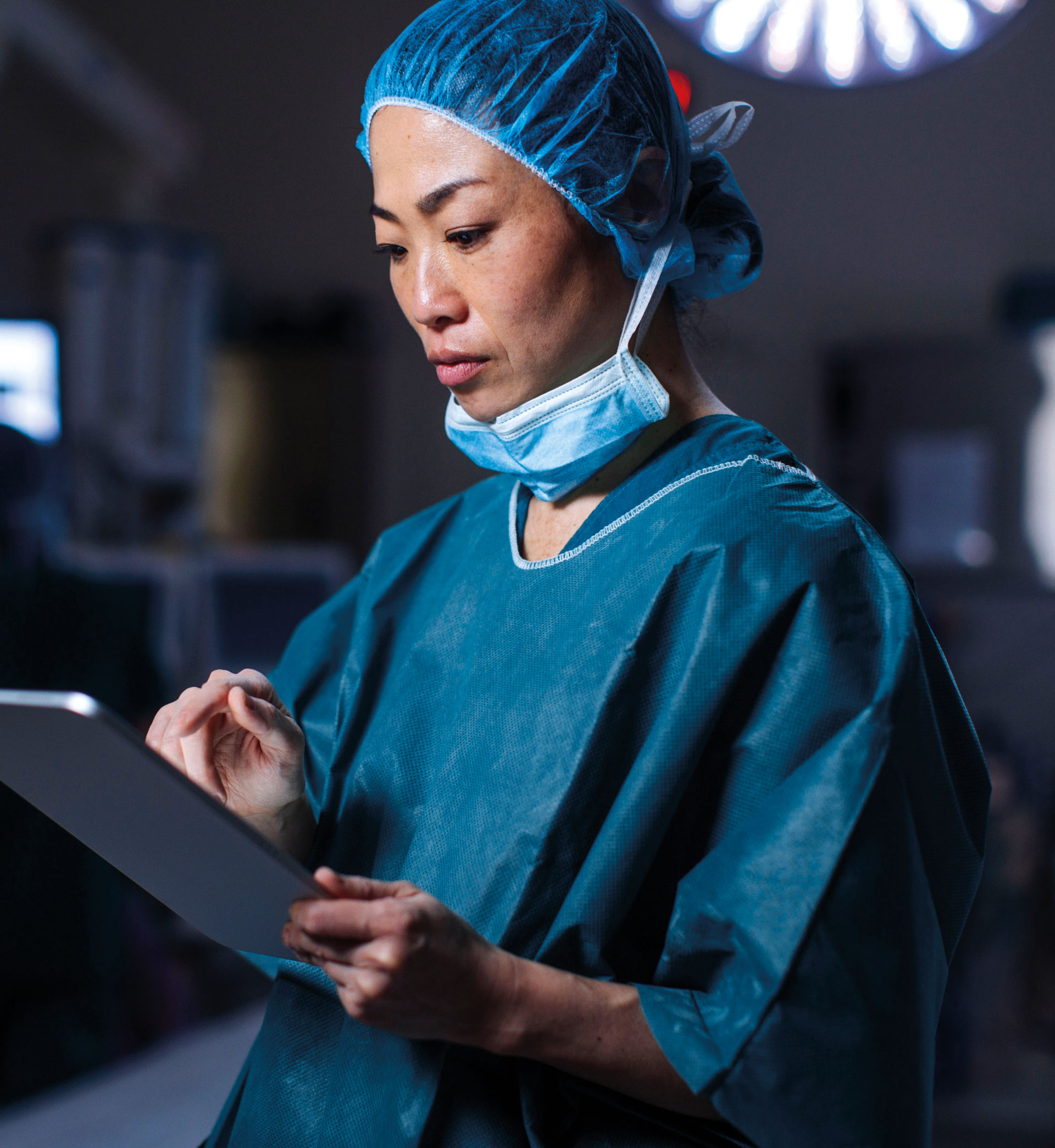
A mostly black image with a speckled gray strip at the bottom, resembling a rough surface. In the top right corner, there are six small horizontal color bars in red, blue, green, yellow, gray, and white. A medical professional in blue scrubs, a hair cover, and a mask pulled down is using a tablet in a clinical setting, possibly preparing for or reviewing a procedure.

Peter: I think so. The magical thing about AI is that you can get access to it through a low-cost mobile device, and those mobile devices are increasingly available to every corner of the world. And then through that, you have access to an AI that has medical knowledge that scores in the 95th percentile of human test takers of the US medical licensing exam. The other thing to say about this is that it is underappreciated that generative AI models have this remarkable ability to adjust themselves to context. And so, if you tell an AI “I’m a doctor in Rwanda” or “I am a doctor in Paris, France,” it will adjust its answers to the norm of the medical practices in those parts of the world. And there are some great efforts going on. OpenAI and the Gates Foundation, for example, have just announced a partnership to experiment with this kind of approach by funding several AI-powered clinics in parts of Africa.

Signal: Where is AI going in terms of targeting cancer?

Peter: This is an incredibly active area around the world and there are great laboratories doing amazing things. We have been working very hard on it at Microsoft, and especially in Microsoft Research. One effort within our labs that I would like to brag about is in the area of digital pathology. If we just focus on cancer for a moment, pathologists may take a sample of a tissue sample from a tumor in your body. And they will make a very high-quality slide that has the resolution that allows them to see the inside of cells. These are multi-terabyte images, extremely high resolution, and the amount of information is extreme. And so pathologists have to try to look at these images just using their eyes and their training to try to understand – do you have cancer? How far advanced is it? What type is it? And what is the microenvironment around the tumor cells that would give us hints about how best to treat it? The challenge, though, is that these pathology slides are assessed by a single human brain, even a brain with decades of experience. And equipping those human brains with AI assistance that can absorb the entirety of that information is something that we’ve worked very hard on in collaboration with some great places like the Providence Health System and the University of Washington. We’ve published several models in open source – one’s called GigaPath; another, with a partner company, is called Virchow. And what we found is that these models not only can be very good at understanding these digital pathology slides, but they are foundational, meaning that with a very small amount of fine-tuning or post-training they can be trained for lots of different pathology tasks so they have a kind of general-purpose nature that is very powerful.

Signal: And what about cancer treatments?

Peter: One of the hottest areas in cancer treatment is in the area of immunotherapies. These are therapies that reprogram your immune system to try to attack your particular cancer. Everyone’s cancer is genetically unique and has this horrible ability to hide itself from your immune system. But if we can analyze the genetics of your cancer and then reprogram your immune system to be smart about that, then we can have your own natural immune system cure your cancer. The problem is, how do you know whether a particular way of reprogramming the immune system will work? In practice, the main immunotherapies that are available only work about 30 percent of the time because they get mis-targeted. But there are new technologies, one of which is immunofluorescence, which is able to look at your particular tumor microenvironment and more than double the precise targeting to elevate from 30 to more than 60 percent the chances that a particular immunotherapy will work. The problem is that only a few dozen places in the United States have immunofluorescence capabilities. And so what we’ve done at Microsoft Research in work led by Hoifung Poon [general manager, Microsoft Research] is to develop a technology called GigaTIME, an AI that has learned how to get immunofluorescence conclusions from just looking at digital pathology. And if that ends up becoming medical practice – and there are a lot of hoops, because it has to go through regulatory approvals – it would democratize access to immunofluorescence, and it would basically have the effect of doubling the effectiveness of immunotherapies for cancer treatments. What’s more, the personalization of cancer treatment is already starting to bleed into the treatment of other diseases.

Signal: Is healthcare blazing a trail in terms of AI?

Peter: The world of healthcare has a reputation for being slow-moving. But within 18 months of the release of GPT-4, the American Medical Association, the National Academy of Medicine and the World Health Organization all issued guidelines for the use of AI. They’ve done this well ahead of the legal profession, well ahead of [the world of] finance – they’re moving fast. And I think it’s because healthcare is the area where we see the most obvious potential benefits as well as risks. There are potential biases and hallucination risks and medical errors. And as a society, we don’t have the norms established to know who to blame and who’s responsible when things go wrong. So I have no doubt that there will be issues; but overall, what gives me optimism is that the entire medical community is taking this so seriously and really putting a lot of thought into how best to harness this technology.

Signal: Are you optimistic about the future?

Peter: Yes! If you go around the world to great labs everywhere, AI-powered healthcare innovations are being developed at an incredible pace. It’s just impossible if you’re sitting where I’m sitting to look at all of that and not be incredibly optimistic about the future.

Text graphic on a yellow background reads: "I have no doubt that AI is going to completely transform how things are discovered in the sciences.

“AI helps us learn at a very high scale and complexity”

Project Ex Vivo begins with a simple premise: cancer cannot be understood through mutations alone. Ava Amini, its co-lead at Microsoft Research, explains how the combination of AI and experimental biology is helping researchers to model tumors outside the body and understand the cell states that can shape cancers and their response to treatment.

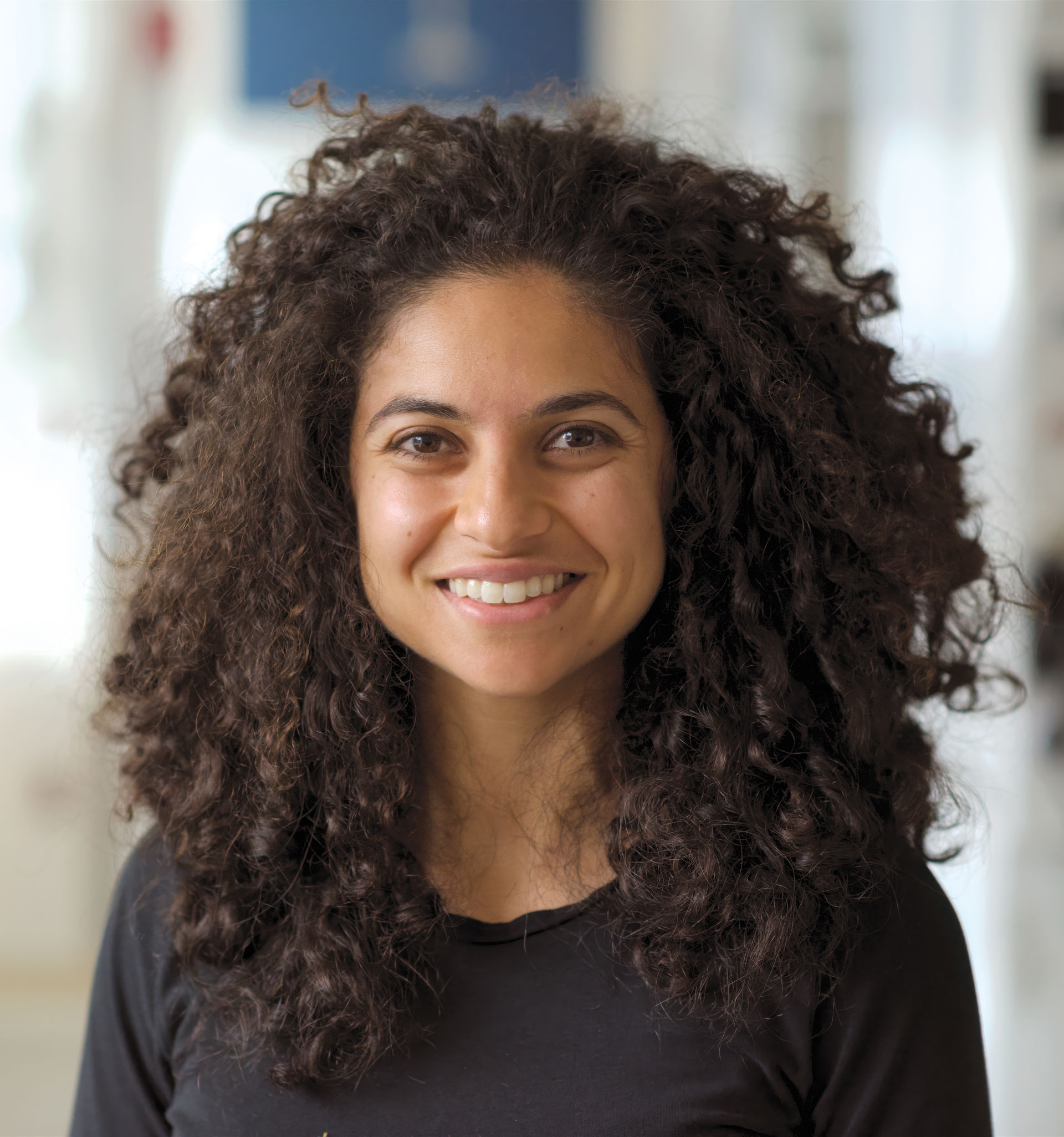
A woman with curly brown hair and a black shirt smiles at the camera in a bright indoor setting. Ava Amini, principal researcher at Microsoft Research in Cambridge, MA

On the office wall behind Ava Amini, a whiteboard is covered with a dense sprawl of graphs, equations and mathematical symbols. It’s the kind of background detail a film director might use to establish, at a glance, that the scene belongs to a scientist working at the far edges of human understanding.

The impression is not entirely misleading. As principal researcher at Microsoft Research in Cambridge, MA, and co-lead of Project Ex Vivo, Amini works at the meeting point of artificial intelligence, machine learning, cancer biology and biophysics. But if the science behind this role is complex, her manner is the opposite: patient, friendly and generous with attempts to translate the unfamiliar.

That approach matters, because Project Ex Vivo starts with a simple question: what if cancer cannot be understood through mutations alone? For decades, precision cancer medicine has often centered on identifying mutations and other molecular changes that drive a tumor, then matching patients with targeted drugs. That approach has produced important advances and changed outcomes for many patients. But it only captures part of what makes cancer so difficult to treat.

Project Ex Vivo, a collaboration between Microsoft and MIT-Harvard biomedical research center, the Broad Institute – with support from the Dana-Farber Cancer Institute – grew from the idea that cancer should be understood as a dynamic system. It is a disease shaped not only by DNA mutations, but by how cancer cells behave, change and respond to their environment.

Amini describes the project as a shift from binary signals to more continuous forms of measurement. A mutation is often treated as present or absent, on or off. But cancer cells are constantly changing based on input from many biological signals. “If we expand toward more continuous measurements, we can look at how different genes or programs in the cancer are changing,” she says. “AI then helps us learn from this data at very high scale and complexity.”

When Amini joined Microsoft five years ago, Project Ex Vivo was still a “very tiny seed” of an idea around modeling cancer outside the body. Together with her colleagues, Microsoft’s Lorin Crawford, Peter Winter from the Broad Institute and Srivatsan Raghavan at the Dana-Farber Cancer Institute and Broad Institute, the team began asking where they could challenge the traditional approach to mutation-based therapy and use their combined expertise to imagine something different.

Expanding the model

The project’s name points to the practical challenge at the heart of that idea. Ex vivo comes from the Latin for “out of the living” and refers, in biomedical research, to studying cells or tissues outside the body they came from. But if cancer lives in the body, why look at it somewhere else? The answer is both practical and ethical: researchers cannot test thousands of possible drugs directly in patients, and cancer studies have therefore long depended on lab models.

Part of the quest for Amini and her colleagues has been to make those lab models more representative of the tumor biology they are meant to represent. Traditionally, cancer cells are often grown in a 2D layer on a plastic dish. Project Ex Vivo builds on approaches that grow cancer cells in groups or clusters, creating more complex 3D models that better preserve aspects of the biology they would have in the body. The result is a fuller picture of cancer where mutations matter, but do not explain everything. “We know that there’s so much more at play,” Amini says. “The cancer cells interact with immune cells and other cells in the tissue. They interact with each other, they respond to signals from their environment. There are all these dynamic changes that are not reflected in DNA changes.”

Scientists use the term “cell state” to describe this more fluid picture, and Amini uses a simple analogy to illustrate the point. “Think of a cancer cell system like a vending machine,” she says. “There is a state that exists, and when you put money in, you choose which state you transition to next.”

In this analogy, the money can be understood as the input, and the selected item as the output. In cancer, the inputs might be drugs, signals from neighboring cells, immune activity or the physical conditions around the tumor. What follows is the cancer cell’s response. “When we think of cancer cell state, it’s really capturing how the cancer is changing in response to things around it, whether that’s drugs, other cells, signals or shape in the body,” Amini says. “You can think about this input-output response, and state captures both of those.”

The difference is not academic. A lab model can preserve the mutations found in a patient’s tumor, while losing the behaviors that shape how the tumor responds to treatment. In pancreatic cancer, for example, standard lab models can carry the same mutations as patient tumors, making them appear accurate. But when Broad researchers and collaborators looked at how those cells were Researchers at work at the Broad Institute behaving, in a 2021 study published in Cell, a different picture emerged: important cell states seen in patient tumors could be missing from some 2D lab models.

Those missing states can affect how tumors respond to treatment. In some cases, the drug response seen in lab models can be very different from what happens in patients. Project Ex Vivo is working to build more reliable and scalable models by preserving, or restoring, the cell states that matter, giving researchers a better testing ground for potential therapies.

Put another way: a model can look genetically right but behave biologically wrongly.

Connecting the dots

Once researchers have a model that behaves more like cancer in a patient, they can use it to test possible treatments. And this is where the scale of the problem starts to look very different. A lab might be able to check tens, or perhaps hundreds, of possible treatments. But AI allows researchers to computationally screen thousands of possibilities before deciding what to validate experimentally.

“We can give information to our AI model about the pancreatic cancer, use the AI itself to screen thousands of different compounds in silico, and then it nominates a shortlist to test in the lab,” Amini says. “To do that experiment in the lab [without AI] would take years and millions of dollars. But we can do this in a matter of days.” She is quick to clarify, however, that AI does not replace experiments, but rather helps researchers decide which ones are worth doing first. This narrows a vast field of possible treatments into a smaller set that scientists can test in the lab.

It has also reinforced another important lesson: that in biology, scale alone is not enough. AI models need the right biological signals, not just more information. Amini says Project Ex Vivo has produced learnings about “what data is most important” and how to generate “the right type of data to give good signal to the models” about cancer biology. Recent work from the Ex Vivo team has explored the same question from the AI side, looking at how the composition, size, diversity and handling of underrepresented cell states in training data can shape how well models perform.

The emphasis on useful biological signals extends beyond Project Ex Vivo. Across Microsoft’s healthcare and life sciences research, AI is being applied to cancer from pathology images to chemistry and drug discovery. One strand of that work focuses on finding richer ways to see and interpret tumors. The Virchow family of pathology foundation models, developed by Microsoft Research in collaboration with Paige, enable accurate detection of both common and rare cancers as well as a variety of downstream tasks, such as determining a cancer’s subtype. GigaTIME approaches pathology from another angle, using AI to translate routinely available pathology slides into virtual multiplex immunofluorescence images – essentially richer virtual images – that can help researchers study the tumor immune microenvironment, including how tumors and immune cells interact inside tissue.

This connects with Amini’s broader view of cancer modeling. “Our vision is to think about how all these different kinds of data connect,” she says. Pathology and microscopy, she adds, are all “different ways to view cancer.” In foundational AI models the team is developing, “we can connect those imaging modalities, like pathology, to measurements of cancer cell state.” The goal, she says, is to “learn a landscape” of the tissue, including “what the spatial organization of a tumor looks like.”

If Virchow and GigaTIME point to how AI can help researchers see tumors more clearly, other Microsoft research explores how biological insight might be turned toward treatment. Amini points to TamGen, a Microsoft model focused on target-aware molecule generation, as one example of how different strands of AI research could eventually connect.

“At Microsoft, we have research in chemistry, and we have research in biology, like in Ex Vivo, but the ultimate goal is to bridge the two,” she says.

For Amini, that link between chemistry and biology is central: how a potential therapy might affect a particular cancer cell state, or how researchers might work backwards from a desired change in cancer behavior toward a possible treatment. She says new AI models the Microsoft team is developing are aimed at exploring these relationships, connecting questions about cancer cell state with questions about potential therapies. RetroChimera, another Microsoft initiative, explores a different part of the same broad challenge by helping chemists think through how a promising drug-like molecule might actually be made.

Taken together, it’s clear that the path forward in cancer research cannot depend on any single view of the disease. These projects reflect a broader Microsoft approach, also outlined in a recent Cell perspective paper by Microsoft researchers, co-authored by Crawford, Amini, and Microsoft colleagues: connecting cell state, pathology, chemistry and drug discovery to build a more integrated understanding of how cancer behaves and how it might be treated.

Pathways to patients

For all the promise of connecting these strands of research, the route from discovery to patient care is still hard. Promising findings must pass through a maze of preclinical validation, clinical trials, regulatory review, manufacturing, cost constraints and the realities of health care delivery. The use of AI adds its own complications, particularly around data access, provenance and privacy, as progress relies on connecting biological, chemical and clinical data without weakening the protections around them.

For Amini, the challenge is knowing which boundaries should be respected, and which silos may be slowing progress unnecessarily. “Where do barriers exist for real reasons that should be respected,” she asks, “versus how can we potentially break down some of those silos to enable effective translation?”

Nevertheless, she is excited by AI’s potential to accelerate discovery. “AI can be a tool for experimental scientists,” she says, helping them move toward possible treatments “more effectively and with higher confidence.” Too many drugs fail in what the industry calls the “valley of death,” she says, and “if we can build AI models that help us traverse that valley, that’s really powerful.”

Amini’s excitement about the work goes back to an early fascination with biology and nature. She recalls being “super obsessed” by the living world from a young age, “trying to understand why nature operates in the way it does.” Watching wildlife presenters such as Jack Hanna and Steve Irwin as a girl, she started asking deeper questions about biology and came to see math and physics as powerful ways to understand the world. Later in her education, computer science, machine learning and AI opened up another way to interrogate biology. “These are powerful tools that we can leverage to discover the fundamental underpinnings of life, design new therapies and engineer biology in an intelligent way.”

By the time she was a PhD student, she says, one of her main goals was clear: to translate research into real-world impact for human health. “I worked in a very translational lab where it was all about preclinical development, looking at how this could make a difference in the life of a patient. So that aspect is super important to me.”

That focus on impact makes her cautious about overpromising. AI models will not become the doctor or replace human-led lab experiments. “We’re developing these methods thoughtfully and collaboratively, and through partnerships where we can complement other forms of research,” she says. “It’s really about enablement more than anything.”

Asked whether she is both amazed by the possibilities of her work and overwhelmed by the deluge of data and parameters at play, she laughs in agreement. “Yes, but I’m also motivated 100 percent of the time by the possibilities of what we’re working toward.”


 

A mostly black image with a speckled gray strip at the bottom, resembling a rough surface. In the top right corner, there are six small horizontal color bars in red, blue, green, yellow, gray, and white. Yellow background with bold black text: "AI allows researchers to computationally screen thousands of possibilities before deciding what to validate experimentally." Emphasized words in italics or bold.

Giant Leaps

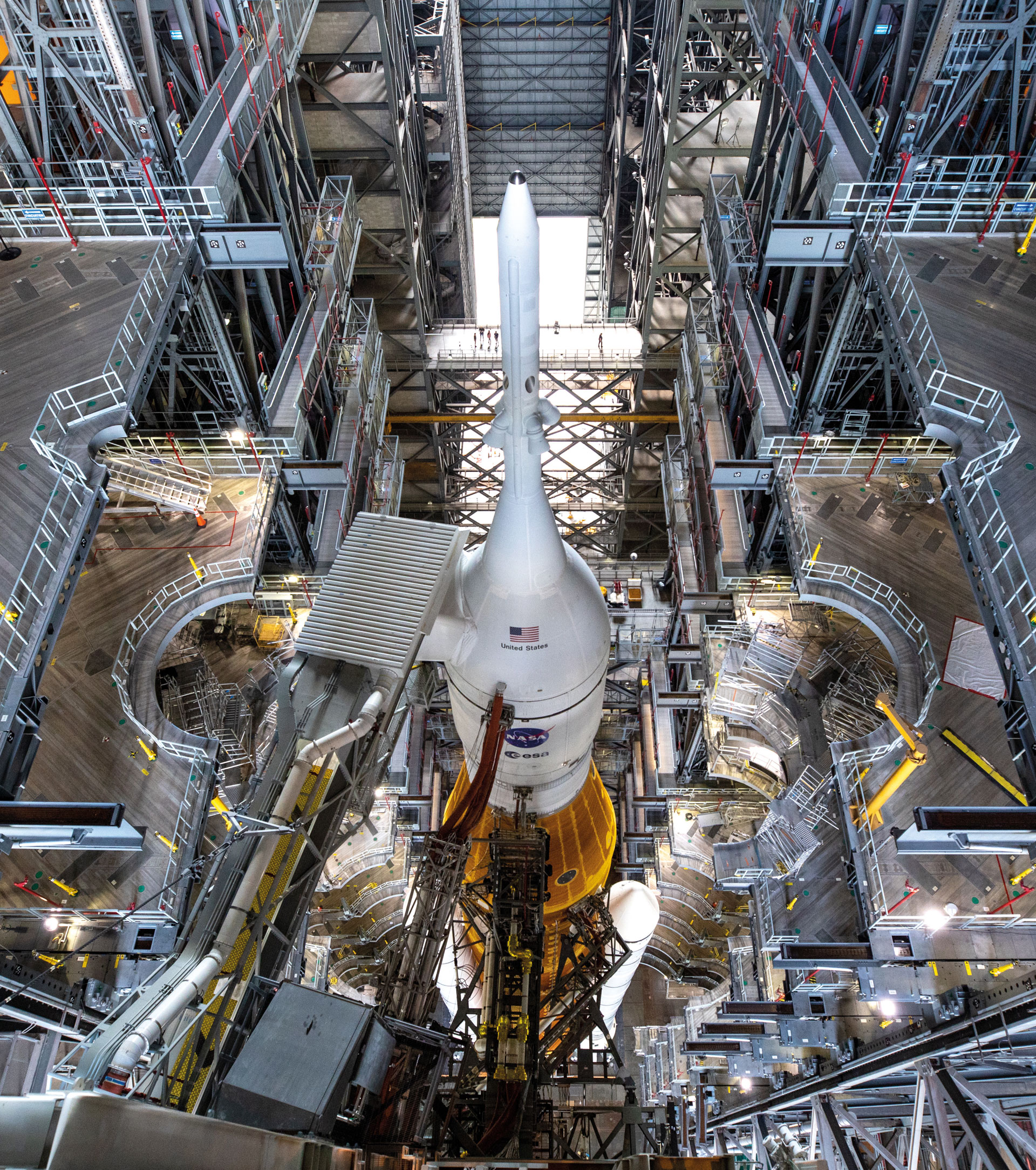
In April 2026, the Artemis II mission saw the first crewed space flight to leave low Earth orbit and fly by the moon since Apollo 17 in 1972. To celebrate, Signal magazine asked Brian Odom, NASA’s chief historian, about the key US space missions of the past 50 years and how they laid the path for the next generation of technological innovation. Images: NASA.

A large NASA rocket stands vertically inside an industrial launch tower, surrounded by platforms, walkways, and scaffolding inside a tall, brightly lit building. The Artemis I Space Launch System and Orion spacecraft on the launch pad at NASA's Kennedy Space Center in Florida. Images: NASA

Brian Odom isn’t a scientist, yet he is one of the most important people at NASA. As the space agency’s chief historian, it’s his job to archive and preserve the almost bewildering amount of science and innovation that NASA is responsible for creating, much of which eventually percolates from complex and highly technical research into our everyday lives. A key part of his role is the translation of complicated and dense science into something that people can understand. “As a historian there are certain analytical tools that you bring to the table, where you place things in a proper context, and you look at change across time,” says Odom.

He believes that the special ingredient in his job is storytelling. “You need to understand what’s happening in front of you,” he says. But without the ability to translate that into an understandable and relatable narrative, he believes, NASA’s important work can sometimes get lost. While there are dozens of active NASA missions at any one time, none revived memories of the 1960s and 1970s golden age of space exploration quite like the recent Artemis II mission, and the flyby close to the moon; an exhilarating reminder that it has been well over five decades since NASA has sent humans to the lunar surface. Odom believes that we may be on the cusp of a new age of space exploration. But the next giant leap forward will be built upon the trials and errors of the missions that preceded it, going all the way back to NASA’s very first human space flight.

Project Mercury and Project Gemini (1958-1966)

In 1957, the Soviets shocked the U.S. by launching Sputniks 1 and 2. It proved to then-U.S. president Dwight D. Eisenhower that the Russians were aiming for human space flight. NASA was formed the following year, and Project Mercury was put into action to catch up in the space race. “[Project] Mercury was that step of lifting humans into space,” says Odom. “Launching human beings from Earth to low Earth orbit. That’s kind of where you have to get [for sending humanity into deep space].” It was, according to Odom, uncharted territory. After World War II, missile technology was all about explosives. “Now we’re saying, well, what if we replace the payload, the bomb, with a human being? Then you have to think, how do you keep a human being alive?” he says. In 1961 – only 23 days after Yuri Gagarin became the first person in space – Project Mercury sent Alan Shepard on a 15-minute suborbital flight. The next race was to the moon, but to do that, NASA had to learn how people could successfully operate in space over an extended period of time. “That’s where Project Gemini comes in,” says Odom about Mercury’s successor, which had the goal of preparing astronauts for future lunar landings and included the first U.S. spacewalk and missions lasting up to two weeks in orbit. “Living and working in space, operating in space, docking, rendezvous… all important things that you’re going to have to do to accomplish that goal.” Shepard’s successful flight, and the Gemini missions that followed, convinced newly elected president John F. Kennedy “to put money into Apollo to really give it the edge over the Soviets.”

Project Apollo (1962-1972)

The U.S. committed vast resources to the Apollo missions, perhaps NASA’s greatest accomplishment to date. For Odom, Apollo revolutionized how humanity understood its relationship with planet Earth. Before he was assassinated in 1963, President Kennedy had set an incredibly ambitious target of landing an astronaut on the moon by the end of the decade, which – spoiler alert – NASA achieved in 1969 with Apollo 11. It has often been characterized as the most successful scientific experiment in history. But there was no guarantee of success. Everything, says Odom, had to be made from scratch. “We needed new testing, new materials, new alloys, new welding, new manufacturing and new computing,” he says. The mission led to the development of thousands of spin-off products in everyday life, from freeze-dried food to cordless drills. But the issue of how to get all the humans and equipment to the moon was the greatest development challenge of them all. “Saturn V, the vehicle that got us there, needed 7.5 million pounds of thrust in the first stage, an incredible increase compared to what Mercury and Gemini needed.” Surprisingly, it was surfing that held the key to getting Saturn V off the ground, especially solving a particularly vexing problem: how to insulate fuel tanks that need to be kept at two different temperatures. “You had surfers out in California who were working as engineers,” Odom says. They realized that the same honeycomb pattern inside a surfboard could be used to solve the fuel tank problem. “Where does innovation come from? It’s unpredictable,” says Odom. “A lot of challenges are solved at water coolers.”

A helicopter hovers over the ocean, lowering a person on a cable toward a floating space capsule. The scene is surrounded by blue water under a partly cloudy sky. A U.S. Marine Corps helicopter recovers Project Mercury astronaut Alan B. Shepard, Jr. after his 15-minute suborbital flight on 5th May 1961, which made him the second human to travel into space

Skylab (1973-1979) and the International Space Station (1998-)

After the high of 1969, the 1970s brought about a re-evaluation of NASA’s space program – which was losing popularity in the U.S. “People were seeing the civil rights movement, social unrest, the Vietnam War in their living rooms,” explains Odom about the country’s disillusionment with the billions spent on the space program when there were such pressing problems on Earth. Funding was cut, but NASA innovated again: shifting away from sending people to the moon toward a different idea – space stations in orbit as a launchpad for further space exploration. “Science fiction had always provided this cultural anticipation that things would eventually get to a certain point, that we would live in orbit and it would become very routine,” says Odom. “We would become a space-faring species. Now we were going to take the next step, to establish a presence in low Earth orbit of humans working and living. And that’s what Skylab was.” Launched by the last Saturn V rocket in 1973, Skylab hosted three separate missions before falling back to Earth in 1979. Skylab was damaged on launch, necessitating complicated space walks to repair it. It proved that humans could live and work in space for extended periods, more than 80 days, and set the foundations for the International Space Station (ISS), which is still orbiting Earth today. “We see astronauts go outside of the ISS to make repairs,” says Odom. “One of the things that Skylab did is show that it’s possible [to make repairs in space], that humans are so important to doing that.”

The Space Shuttle program (1981-2011)

With humans living for extended periods in space, the issue of logistics and supply lines became critical. The Space Shuttle program was designed to solve that. “The shuttle program was designed as a truck to low Earth orbit,” says Odom. The plan was “to have 80 [reusable] flights a year, one right after the other.” While that plan proved overly ambitious, Odom believes the program represented a significant shift. “You began to see this turn to long-term living and working in space.” The shuttle flew 135 flights carrying more than 350 astronauts, to build the ISS, launch satellites and perform maintenance. It was also the first program to integrate digital technology, leading to more innovations felt on Earth. “I don’t think NASA can take credit for the invention of the laptop!” says Odom. “But if you look back at the early 1960s, having a big IBM system is going to take up quite a bit of space. During the Space Shuttle program, they were doing science, miniaturizing electronics. We had these practical requirements that were helping to drive these advancements.”


An astronaut in a white spacesuit floats outside a spacecraft above Earth, holding onto a gold safety tether with one hand, with the planet visible in the background. Jack R. Lousma, with the Earth reflected in his visor, carries out repairs on Skylab 3, 6th August 1973. Skylab was NASA's first space station program

Mars Exploration Program (1996-)

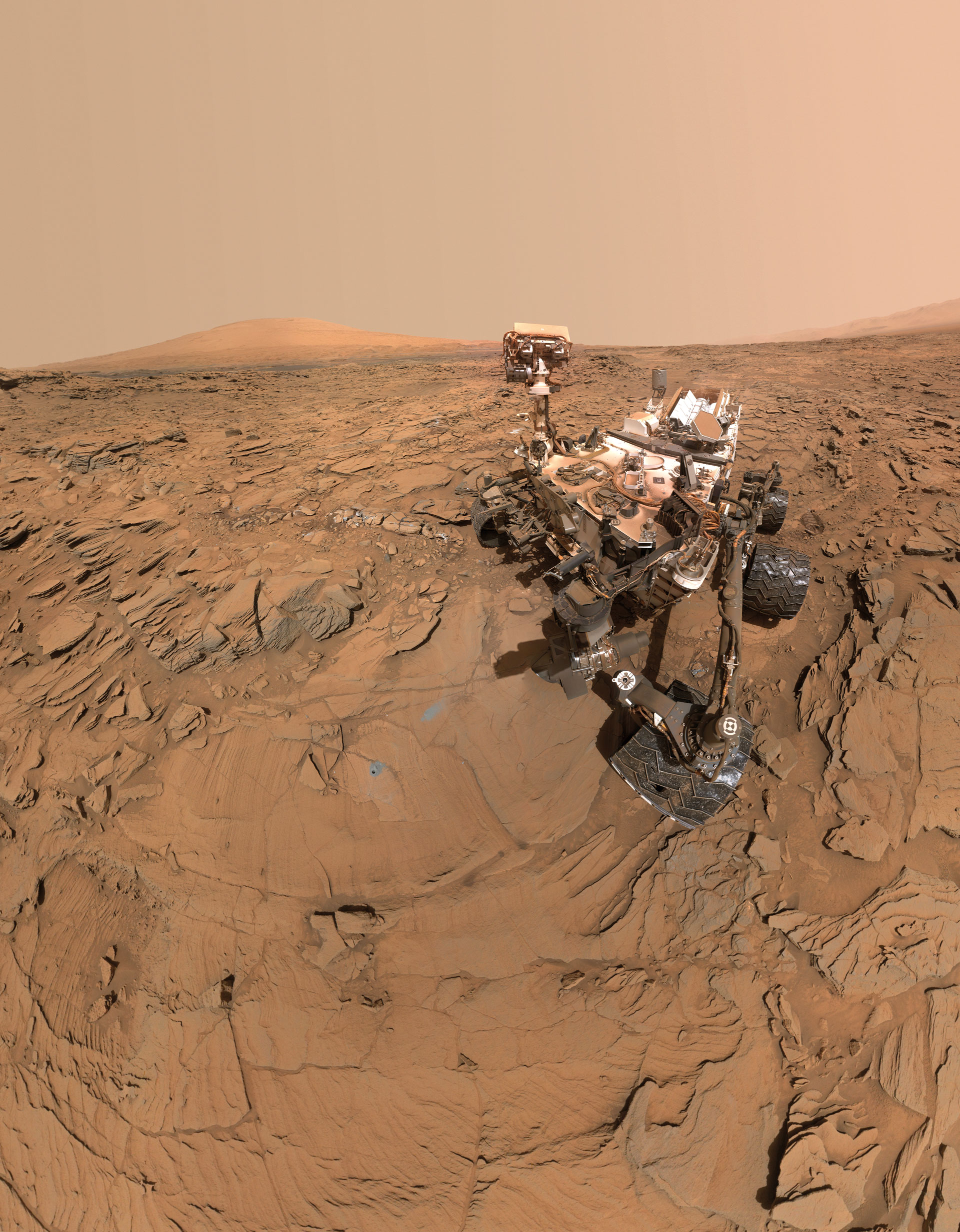
If it weren’t for President Richard Nixon, we might be on Mars already. “NASA has been considering Mars for a long time,” says Odom. “Post Apollo, the plans that NASA put on the table, that the Nixon White House rejected, were to land human beings on Mars by 1983. That was put forward in 1969; it would only take 14 years and we’d be standing on the planet.” Instead, NASA and the U.S. government went down a different path. The Mars Exploration Program (MEP) has been examining the red planet for 30 years, using probes, satellites and surface rovers, looking for signs of life and planning for humans to visit. The Curiosity rover has been traveling across the Martian surface since August 2012 while the Perseverance rover has been sending back panoramic images of the surface since 2021. It also launched Ingenuity, an autonomous helicopter attached to the underside of Perseverance that proved flight was possible in Mars’ thin atmosphere. “It’s a pathway for human exploration,” says Odom. “If that is the goal, to land human beings on Mars, everything in that process is incremental when it comes to understanding the environment.”

Artemis program (2012-)

Odom says that the recent Artemis moon mission – on which astronauts used Microsoft Surface Pro devices – has reignited an interest in space exploration in a new era in which NASA hopes to build permanent bases on the moon. Before, under the Mercury, Gemini and Apollo programs, there was the space race between east and west. “Now it’s an entirely different paradigm,” he says. “Previously, you had the Soviets and the U.S. competing to see who would land on the moon first. Now, you’re looking at international collaboration and ways of leveraging private industry to do things. It’s a bigger coalition of folks participating in this, and that makes it quite different.” Here, says Odom, is a key lesson that can be learned from the program by everyone, especially CEOs – that collaborative work pays off. “Leadership is something we talk about at NASA all the time; you’ve got to be bold, you’ve got to be technically competent, you have to know what you’re talking about,” he says. “I think scientists are very good at that. Scientists can build coalitions to amazing levels. Business can be more of a zero sum game. If I’m a CEO and I’m looking at the agency, I might look in the science world and say: ‘How do they build those coalitions that make great things happen?’ That’s a great lesson to learn.”

Black background with diagonal black and white stripes along the bottom edge. The top portion is solid black, and the striped pattern adds a visual border to the lowest part of the image. Mars rover on rocky, reddish Martian terrain under a dusty sky. The rover's camera arm is extended, capturing detailed images of the surface and surrounding landscape. The Curiosity rover takes a selfie on the Naukluft Plateau of lower Mount Sharp on 13th June 2016. The rover landed on Mars in 2012 and, despite only being expected to be operational for two years, continues to explore the planet
English (United States)
Your Privacy Choices Opt-Out Icon Your Privacy Choices
Consumer Health Privacy Sitemap Contact Microsoft Privacy Manage cookies Terms of use Trademarks Safety & eco Recycling About our ads