


From classrooms to shelters, new grants help 25 nonprofits make a bigger difference in people’s lives
- 25 nonprofits will receive grants for work they’re doing in their communities.
- The funding will help with specific needs including access to food, neighborhood safety, educational programs, sustainability efforts and more.
- The grants are the first round of a $1 million program in Washington, Microsoft’s home state.
In the Pacific Northwest, it’s Coho salmon season.
That means spawning activities are in full swing at the Washington state-run Issaquah Salmon Hatchery, including egg picking — sorting bad ones so the rest can remain healthy. Elementary and middle school kids take tours to learn about stewardship of the environment and the fragile ecosystem of salmon that define the region. It’s part of the educational programming run by the Friends of the Issaquah Salmon Hatchery, or FISH.
Though a visit has been out of reach for some schools, a new grant will help FISH bring the experience to dozens of classrooms instead. The organization is among 25 nonprofits in Washington State’s King County to receive $20,000 each in the first round of Microsoft’s Community-First Grants that will bring $1 million in funding to projects in the company’s home state.
“This is something that we’ve been wanting to do for a while,” says Christian Kwon, who handles AI strategy and grant management for FISH. “Some schools can’t afford the transportation costs to get their students to us. That’s been a big gap for us, so we’ve long been trying to figure out how we can close that gap and increase our capacity and access for these schools. This is going to be a major milestone for us being able to unlock that ability.”
The grants are aimed at helping nonprofits reach more people with essential services and opportunities — and complete projects that make that work possible — across education, basic needs, civic life and sustainability. Jane Broom, senior director of Community Affairs at Microsoft, says these organizations “are the glue that make communities work” at a time when many people are struggling.
“Nonprofits, just like families, are experiencing higher costs. Maybe they haven’t been able to find the one-time funding to get a project done or to address a clearly defined need,” Broom says. “We wanted to have a flexible, responsive grant program to give the community what it needs right now.”
Building confidence and independence
“Everything is 10 times as competitive as it’s ever been in past years because funding is difficult,” says Jilyne Jarvis, founder and executive director of the Bellevue-based ZGIRLS, a nonprofit that helps girls build confidence through mentoring by women athletes. “It puts a lot of pressure on foundations and corporations to show up and provide that funding deficit and the funding that’s needed to serve our communities. These kinds of grants make the world of difference because it does feed back into the community.”
ZGIRLS launched a pilot program in October of “Confidence Kits” that provide confidence-building activities for leaders, volunteers and coaches to teach to middle school girls, giving the $500 kits to 22 of their King County partners including sports teams, groups and schools. The grant will pay for 40 more kits for others who requested them.
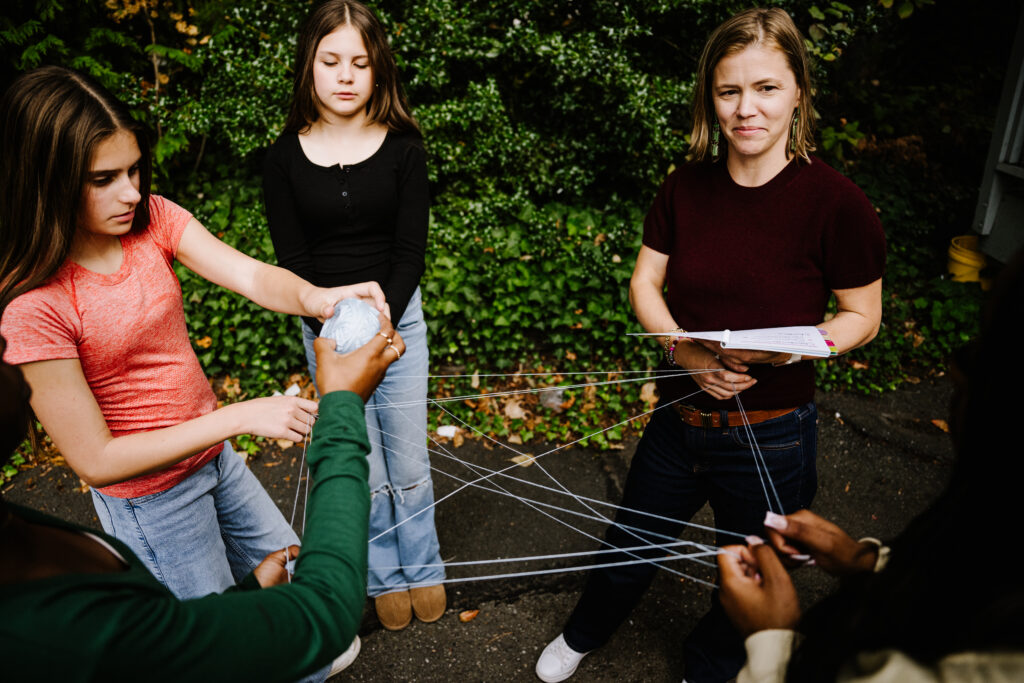


Girls participate in Confidence Kit activities. (Photos by JaneG. Photography for ZGIRLS)
“We had so many organizations reach out to us to say, we want to teach the girls at our organization, at soccer practice, at Girl Scouts,” says Jarvis, a former professional skier. “We listened. Let us come to you and you teach it.”
At The Lighthouse for the Blind, Inc., the grant fills an ongoing need: upgrading their computers, assistive technology and tools for their computer training programs.
“We are super excited and we’re honored to be part of the first cohort,” says Shawn Dobbs, senior vice president of administration and communications for the Seattle-based organization, pointing out that having a diverse set of tools allows the Lighthouse to adapt to varying levels of vision and hearing impairment. “We are so thankful for Microsoft’s support throughout the years and are thrilled to expand our partnership in this way to increase independence and opportunities for individuals who are blind and DeafBlind.”
Microsoft’s employee giving program and volunteers support the Lighthouse, and this direct infusion of funds will go toward wireless keyboards, headsets and mouses, as well as new PCs, braille displays and a braille label maker.
Ensuring safety and connecting with young people
In the Snoqualmie Valley east of Seattle, an emergency shelter located on 10 acres provides a home, resources and structure for up to seven families fleeing domestic violence and sex trafficking: Mamma’s Hands. Safety is paramount for their residents, so they’ve relocated their entry gate, installed cameras, intercoms and an access-code system so that staff can screen every visitor remotely. Their grant will help pay for the electrical service and data connection that power the updated system.
“It’s for safety,” says Star Lalario, the executive director. “At times, abusers have attempted to locate the women staying with us. That can be triggering for the mother and puts the other families living here at risk. Now our staff can see who’s at the gate before anyone opens the door.”
Microsoft’s employee giving program and volunteers support the Lighthouse, and this direct infusion of funds will go toward wireless keyboards, headsets and mouses, as well as new PCs, braille displays and a braille label maker.
Ensuring that secure environment gives the families the best foundation for starting over, she says.
“I’m very excited about the project and Microsoft helping us get over the finish line,” Lalario says. “It also adds credibility and reassurance to other funders.”
For the Rainier Valley Food Bank, a garden is more than a source of food — it’s also a way to engage with young people, says Executive Director Gloria Hatcher-Mays. The nonprofit’s garden is on its Seattle property as a welcoming place where neighbors can develop new strategies around how they can grow food for themselves and their families.
For young people in particular, hands-on gardening helps them experiment with activities that restore a sense of calm in their lives and give them a meaningful way to explore culturally relevant food while practicing teamwork and leadership, Hatcher-Mays says.


Volunteers and staff tend to garden beds at the Rainier Valley Food Bank. (Photos by Julia Smiljanic)
The grant will create a workshop space within the garden where kids can learn about agriculture and then implement what they’ve learned in additional garden beds. The organization also plans to buy more gardening supplies and educational materials that were created in partnership with two nearby schools.
“We’ve had a few school groups come and interact with the garden. We knew we wanted to do more,” Hatcher-Mays says. “Our peers and partners in this work are all kind of in the same boat, trying to strategize and respond to continue to meet the needs of the community. We’re all seeing that our programs are exploding and we’re trying to find ways in which we can continue to grow and offer services.”
Here are the other 20 nonprofits to receive Microsoft Community-First grants and their plans:
- The FeelFit Foundation, which brings people together through free runs, hikes, trail restorations and park cleanups, is creating a Bike Hub where kids will learn how to repair a bike for others before earning their own.
- The 60-year-old Byrd Barr Place provides safety-net services to low-income families in central Seattle and will expand their supply of diapers and related products.
- The Lake Washington High School Band and Jazz Boosters, which revived its marching band last year after a 40-year absence, will buy 150 full uniforms in inclusive sizes to replace capes from 1981.
- Essentials First provides hygiene supplies to working parents and will launch an Eastside mobile trailer with private showers, a washer and dryer.
- In partnership with Mercer International Middle School, Marvin Thomas Memorial Fund will launch the Mustang Garden Project, a volunteer-led garden and outdoor classroom that will supplement an in-school pantry with fresh produce that reflects the diversity of the students’ cultures.
- Bloodworks Northwest, which supplies blood to local hospitals, is expanding to a larger facility to accommodate increased demand, with the potential to collect 10,000 more donations annually.
- Community Lunch on Capitol Hill, which provides donated food to unhoused people, will close gaps in infrastructure with stair-climbing hand trucks, sturdy carts, expanded commercial refrigeration and freezer storage.
- Casa Latina, which has a workforce development program, will be able to develop a hands-on training facility to strengthen the practical application of vocational skills.
- Responding to requests from their students’ families, Concord International Elementary PTA will establish free after-school programs focused on building and coding LEGO models to solve science challenges and separately, sewing.
- Empowering Youth and Families Outreach, which provides year-round, culturally responsive educational and youth development programs serving South Seattle, will add a passenger van that will expand access to enrichment activities, career exploration and college visits.
- The Christ Community Free Clinic will be able to expand clinic space to provide more free dental and medical care to the most marginalized residents in Puget Sound.
- Operation Nightwatch offers services to those living on Seattle’s streets and will provide a safe and trusted space where people can learn about resources, have a hot meal and find shelter.
- Junior Achievement of Washington — which gives students real-world learning experiences that connect classroom education with career, financial and life skills — will upgrade lighting and replace audio-visual equipment at its Auburn Experiential Learning Center.
- Friends of KEXP, the nonprofit representing listener-powered radio station KEXP 90.3 FM, will update its Gathering Space, where visitors can hear live broadcasts, attend free concerts and explore an art gallery for free.
- Communities In Schools of Greater King County, which supports students so they stay in school, will establish food pantries at eight schools across three districts.
- The Seattle Youth Symphony Orchestra provides free and pay-what-you-can training for South King County families through Music Youth Southeast and will apply the funds to tuition, instruments and private lessons.
- Jubilee REACH distributes food at its Groceries for Families market and needs to replace an aging, unreliable van that staff and volunteers use for weekly food-rescue pickups from more than 20 local grocery stores and businesses.
- The Pike Market Senior Center & Food Bank, which welcomes 150 senior adults per day for free meals, fitness and social activities, plans to upgrade its washrooms and activity room with new sinks, countertops, lighting and paint.
- Ahead of its 50th anniversary in 2030, the Seattle Children’s Museum is renovating its play-based, hands-on exhibits, starting with a veterinary clinic aimed at fostering empathy, respect for animals and community connections.
- Mentoring Urban Students & Teens, which provides a mentoring space for young Black men, will transform a welcome room to a wellness and learning hub.
This story was published on Nov. 10, 2026.
Lead image: Emilie Rea, an intern with FISH, talks to students about the salmon life cycle and ecosystem while visiting the Washington state-run Issaquah Salmon Hatchery. (Photo by Dan DeLong for Microsoft).
For more than a decade, Athima Chansanchai has covered people, projects and products throughout Microsoft. Previously, Athima wrote news and feature stories for MSNBC.com, The Seattle Post-Intelligencer, The Baltimore Sun and The Village Voice. You can contact Athima on LinkedIn.


