Socrates was worried
Not about war, or politics, or even the gods. He was worried about writing…
In Plato’s Phaedrus, Socrates tells the story of the Egyptian god Theuth presenting writing to King Thamus as an “elixir of memory and wisdom.” Thamus isn’t impressed. He argues that writing will “produce forgetfulness” because people will stop practicing memory and start trusting an external record; worse, they’ll gain the appearance of wisdom without its reality.
Two thousand years later, it’s hard not to smile at that anxiety — mostly because it feels so familiar. Every major shift in how humans handle information triggers the same fear: This new tool will make us weaker. It will dull attention. It will hollow out thinking. It will create “fake” expertise.
And yet writing didn’t destroy thinking. It expanded it. It changed what we had to practice. Memorization didn’t disappear; it became less central than synthesis, interpretation, and argument. If anything, writing raised the premium on discernment.
That pattern repeats.
When the printing press accelerated access to texts, many elites treated it as a threat to the foundations of authority. If scripture, pamphlets and polemics could circulate cheaply in the vernacular, then priests, princes and universities could no longer assume they were the exclusive channel between knowledge and the public. In that sense, the press didn’t just spread information, it seemed to unplug the old gatekeepers.
And yes, there was real turbulence: the Reformation, propaganda wars, censorship regimes and violent conflict. But the long-run story wasn’t a permanent collapse of legitimacy. Authority reconstituted itself: new institutions formed, new norms emerged, and credibility shifted from inherited status toward things like printed argument, reference and repeatable citation. The press was seen as massively destabilizing — and it was — but “destabilizing” turned out to mean “forcing a renegotiation,” not “ending authority.”
The same fear showed up again, in a more minor key, with Massive Open Online Courses (MOOCs): if elite instruction could be duplicated and distributed at near-zero cost, what would happen to the authority and economics of universities?
In the early 2010s, the story was maximalist: online courses would scale the best teaching to everyone and, in the process, hollow out traditional institutions. Some predictions went as far as “only a handful of universities will remain.” But what followed looked less like replacement and more like a stress test of what education actually requires beyond content: structure, feedback, community and accountability.
What survived wasn’t the apocalypse — it was MOOCs and online learning as infrastructure: a powerful distribution layer that works best when paired with human guidance and well-designed practice. That brings us to AI and work, the next, faster iteration of the same pattern.
We’re living through another cognitive-tool moment — bigger than MOOCs, closer to writing and more consequential than either in how quickly it can spread. Like writing, AI can act as a form of “reminding” — an externalized cognitive scaffold. Like print, it can disrupt who gets access to expertise and how authority is established. And like MOOCs, it risks creating a two-tier world: people who learn to use it well — and those who are merely exposed to it.
The doomers’ take is straightforward: AI will make us lazier, less capable, more replaceable. It will flatten skills. It will cheapen creative work. It will “automate” what makes people valuable.
I don’t dismiss those fears. But history suggests a more useful question: what do humans adapt into, when a tool takes over the old center of gravity?
When writing reduced the need to memorize, the advantage moved to those who could interpret and persuade. When print expanded distribution, the advantage moved to those who could navigate competing claims and build credibility at scale. When MOOCs widened access to content, the advantage moved to those who could structure learning, sustain attention and apply knowledge in context.
AI will do the same. It won’t end work. But it will reprice certain tasks and raise the value of others.
That’s what the underlying theme of Signal (and the particular theme of this issue’s Spotlight dossier starting on p64) is about: AI and work — not as science fiction, not as panic, but as the practical choices leaders can make to help their organizations adapt with confidence.
We won’t get everything right on the first try. But we have done this before again and again and the evidence is pretty clear: humans don’t stop thinking when tools improve. We change what thinking is for.
Welcome to Signal issue 4.
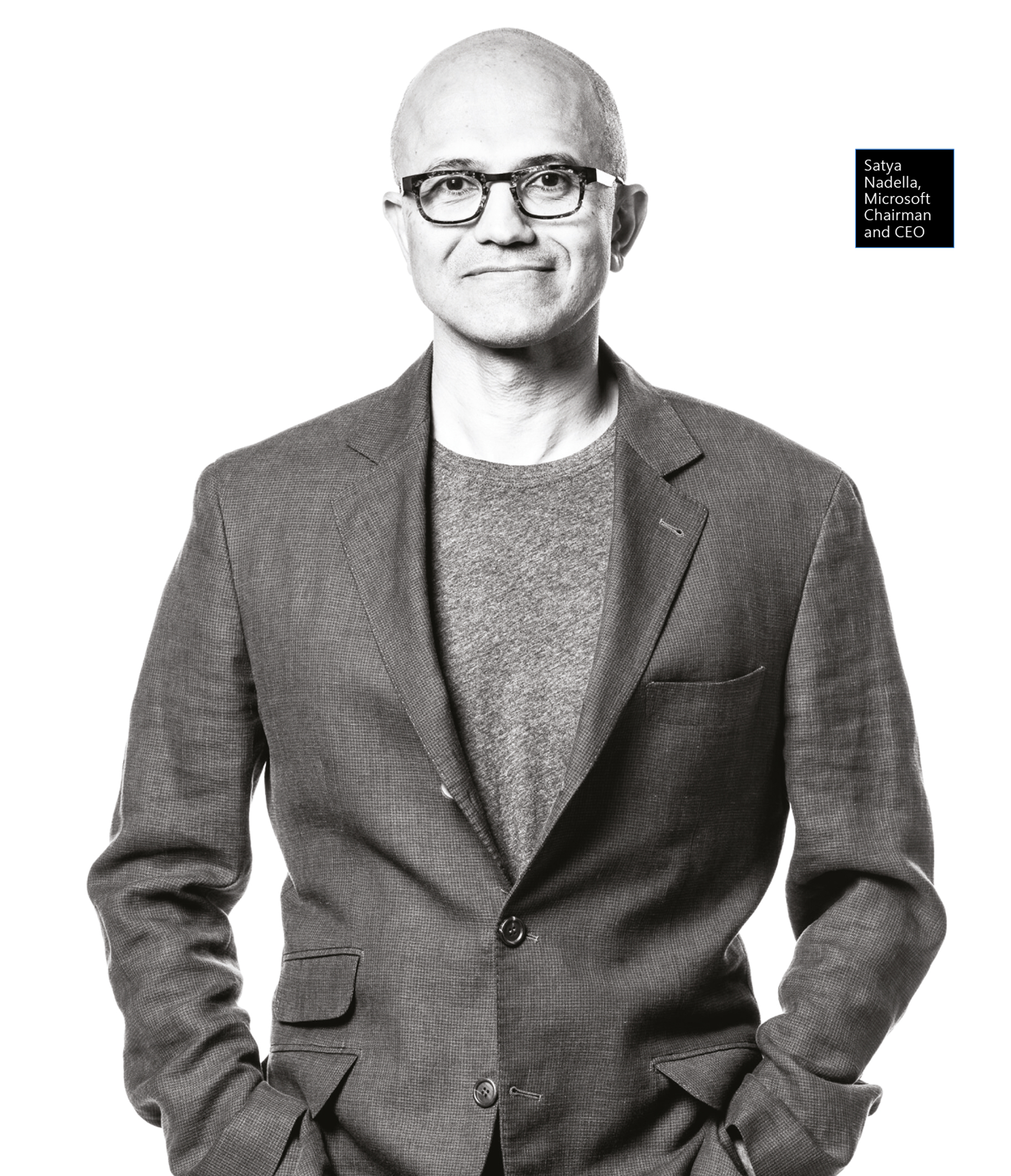
Frank X. Shaw,
Chief Communications Officer,
Microsoft
This is a digital version of the opening letter from Issue 4 of Signal magazine. To explore the full issue, view the complete flip book here.
We need to be prepared
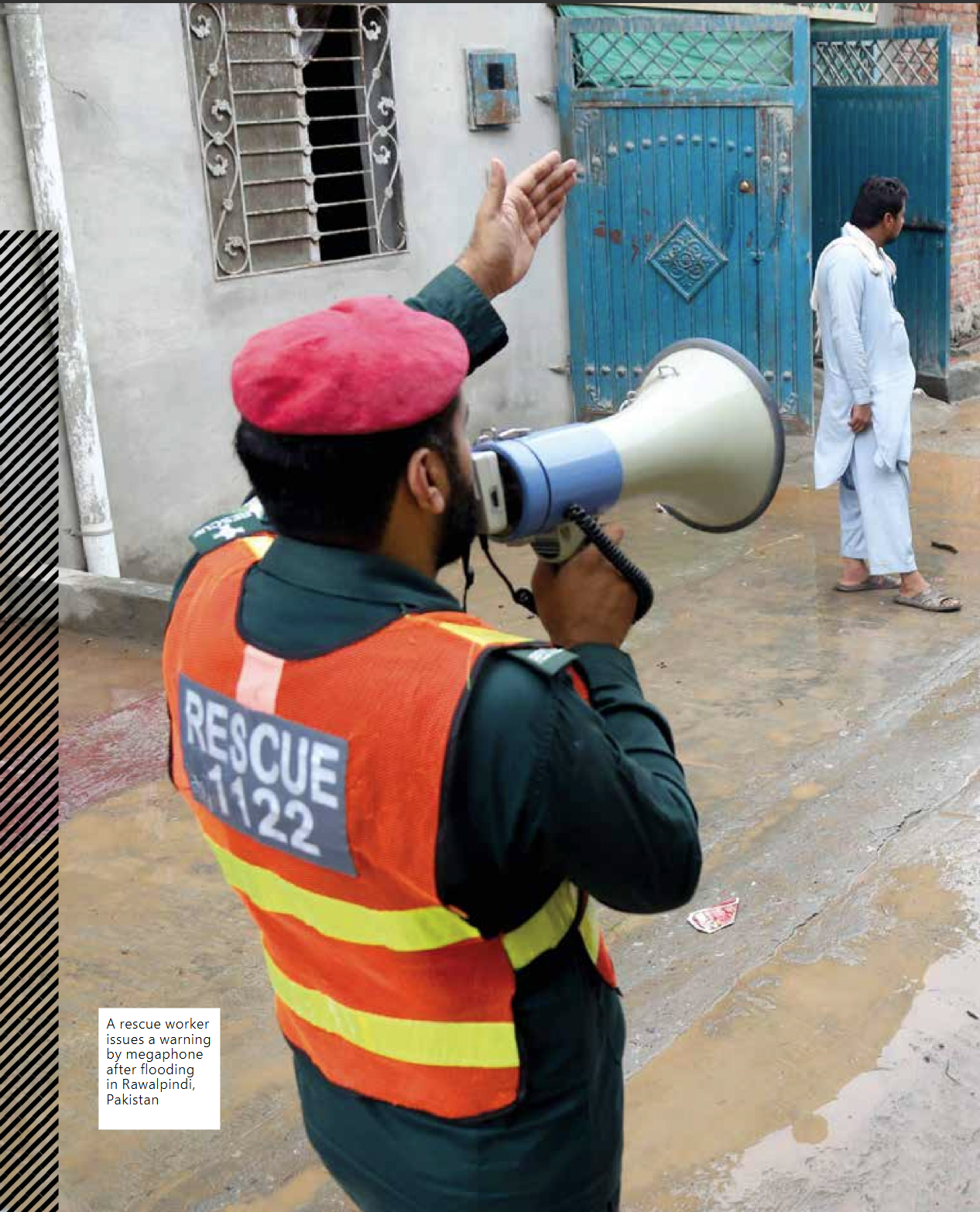
The Early Warnings for All initiative hopes to apply technology to prevent extreme weather events, such as hurricanes, droughts and floods, from turning into disasters. Signal travels to Geneva to meet those responsible for protecting the planet.
In 2025, NASA released new data showing a dramatic rise in the intensity of weather events, such as droughts and floods, since the start of the decade. The study showed that such natural hazards are becoming more frequent, longer lasting and more severe, with 2024’s figures twice that of the 2003-2020 average. A separate report from the University of Reading in the UK, published in February 2026, made for equally sobering reading. It projected that over the next decade, the number of hurricanes in the Atlantic could more than double compared to 1970s levels, while East Pacific storm activity could increase by more than a third.
“We have to accept that we are going to live in a world with more natural hazards,” says Jagan Chapagain, Secretary General of the International Federation of Red Cross and Red Crescent Societies (IFRC). The IFRC is the world’s largest humanitarian network, operating in 191 countries, and in 2024 it mobilized over 17 million volunteers to help more than 160 million people, including 26.5 million affected by disasters and crises. “What we need to do for such a world is to try to separate rising natural hazards from rising disasters,” he says. “A complete uncoupling may not be possible, but we can definitely significantly reduce that relationship, so hazards don’t have to be disasters. To do this, we need to be prepared.”
In an effort to make sure the world is ready, a new system is being created which implements technology to identify places at risk of natural disasters, predict when and where they will hit, warn people that danger is approaching and take steps to save lives and minimize damage. Launched by the UN Secretary General António Guterres in 2022, the Early Warnings for All initiative (EW4A) has an ambitious goal: “By 2027, every person on Earth will be protected by lifesaving, multi-hazard early warning systems.” But how do you set the equivalent of a meteorological safety net around the planet?
Step one: Understand the terrain
The UN based the Early Warnings for All initiative on four pillars, each of which has a different lead organization. The first of these, “disaster risk knowledge”, falls to the UN’s Office for Disaster Risk Reduction (UNDRR). “It’s a big job,” concedes Kamal Kishore, Head of the UNDRR. “It’s foundational, because it helps you determine who is at risk, where they are and why they are vulnerable. If you don’t know this, then you don’t know how to target the warning.”
According to Kishore, who is leading the drive for countries to gather, organize and analyze the data surrounding exposure and vulnerability to natural hazards, understanding the needs of different communities is key. “If the risk knowledge tells you that this is a place where there is no farming, it’s all fishing communities, then the needs are completely different,” he explains. “Fishing communities need to know what is going to happen at sea, not just on land. That knowledge can determine whether they go out fishing or not, or if they are already at sea, if it’s better for them to stay there rather than come back potentially through the path of the storm. When it comes to warnings, everything has to be very targeted.”
Kishore says that accurate data is vital not just for saving lives, but also livelihoods. “It is not just about risk; it is about resilience,” he says. “We need farmers not just to save their lives, but to save their crops. We need to plan for how we can speed up recovery. Do you have seeds, banks, fertilizer and extra agricultural implements stored away in a safe place so that after the hazard has passed, you can quickly move into your recovery strategy?” Kishore cites 2008’s Cyclone Nargis in Myanmar, where he was on the ground providing aid, as an example of the importance of this approach. “I saw that for every week’s delay in getting farmers back to the land, you require several months of additional food assistance. If you want to send farmers back to the farm quickly, you have to prepare well in advance. The same is true for infrastructure. In some countries, like India, they have reduced the power outage time by 67 percent, not necessarily by hardening the infrastructure, but just by storing extra electricity poles and wires and having a roster of workers ready to surge quickly after a hazard has brought down electricity lines to get them back up again.”
Kishore and I are speaking in his office in Geneva. The Swiss city is the spiritual home of the early warnings initiative, with all four lead organizations based there. “The four pillars approach is absolutely critical. Without that it is not a system,” says Kishore. Ten years ago, 56 out of 193 member states of the UN said that they had multi-hazard early warning systems. “That’s a really small number,” Kishore continues. “Since then it has doubled, but we cannot accept anything less than every country on Earth.”
Kishore is keen to emphasize that while agencies are leading the four pillars, the success of the initiative is dependent on the involvement of private companies such as Microsoft, who became involved in 2023. “Microsoft has been a wonderful partner for several reasons,” he says. “They are quite willing to experiment, to put something out on a pilot basis but then scale quickly if it works. The risk contexts are so varied across the world that you need that kind of nimbleness, that willingness to go into uncharted territory. They are also open and generous about sharing those technologies and methods with others for the greater good, and they bring a balcony view of the whole thing. They can bring a systems approach to it, because Microsoft has always been a systems builder and this [Early Warnings for All] is one of the most important systems there is.”
Kishore is optimistic that the involvement of technology companies and the emergence of AI means that it is possible for everyone to be covered by an early warning system by 2027. “Using satellite imagery and artificial intelligence, we can now generate dynamic digital models and use those to see how different kinds of hazard events will play out,” he says. “You can use historic events to train the models to see what future scenarios will be so we can plan our next step.”
He warns that it won’t be easy, though, pointing out the complexities of forecasting so many different types of threat. “For some hazards, such as hurricanes, we have made great progress, but not so much with, say, flash floods, where there is less lead time and greater uncertainty,” he says. “The other thing is that now you see many more cascading hazards. Say a glacial lake outburst, which causes a flash flood, which causes a landslide. The nature of hazards is changing very rapidly.” All of which means it’s not just risk knowledge that needs to evolve for early warning systems to be effective, but weather prediction, too.
Step two: Detect the threat
“Every economic decision and every action we take anywhere in the world is dependent on the weather,” says Professor Celeste Saulo, Secretary General of the World Meteorological Organization (WMO). “We take for granted that you can pick up your phone and see what the weather is going to do, but few people realize that it relies on the collective efforts of 193 national meteorological services, supported by the WMO, that are taking observations over minutes, hours and days and sharing it on the fly. They’re all putting that data in to be ingested in the global system and then the global centers are sharing it back with all the people.”
The WMO leads the second pillar of Early Warnings for All, which is about the detection, monitoring and forecasting of hazards. It is a difficult task and one that Saulo believes is under-resourced. “For most governments, meteorological services are seen as a low-level office, with small budgets,” she says. “Many governments, particularly now, are investing more and more in security, but nothing can keep you more secure than knowing what is coming from the weather. In the last 50 years, more than two million people died because of weather-, water- and climate-related events. That is the reality. The other reality is that these extreme events are increasing in intensity and in frequency.”
While clearly frustrated with the situation, the Secretary General is far from despondent and points to new tools which are helping to predict extreme weather events with increased accuracy. “I am excited by new observing system tools such as nanosatellites, radars or lidars [laser scanning tools],” she says. “Meteorology and medicine are a lot alike. With medicine, if you have a patient with a stomach ache it could mean lots of different things, so you ask for a blood test, X-ray or whatever to understand what is happening to the patient and to make a good diagnosis. The weather is exactly the same. How do you diagnose the weather? By observing the systems: satellite data, ocean temperatures and so on.”
Like Kishore, Saulo is optimistic about the role AI-powered forecasting systems are starting to play. She recalls how at a recent WMO meeting a “forecast in a box” system was unveiled which is capable of simulating weather patterns in a fraction of the time traditionally taken. “When I started at university it took days to run a simulation,” she says. “And this system runs in seconds. This is a revolution. It is really exciting to see how they [large language models] bring together data sets that have been compiled by the WMO community for decades. Because they have strong and robust data, they can train really good models that can make a big difference.”
Some have highlighted the inherent difficulty in machine learning models, which are trained on historical data, being able to predict “freak” incidents which are, by their nature, anomalies. “In the end, you will always need a human being, a person, that needs to say ‘This is what we are expecting,’” says Saulo. “It’s about understanding the limitations [of machine learning], the degrees of certainty and mixing those with traditional approaches to have the best product possible diagnosis. Because a good diagnosis leads to a good prognosis.”
Step three: Spread the word
If the WMO’s job is coming up with an accurate diagnosis, then it is the responsibility of the International Telecommunication Union (ITU) to deliver it in time to take action. “If this is going to be effective, an alert has to reach people in time and in a way they can understand and react,” says Doreen Bogdan-Martin, Secretary General of the ITU. “Our pillar is all about closing the gap between a warning and an action.”
To bridge this gap, the ITU has spearheaded the use of the Common Alerting Protocol. An authorized agency enters the essential details of a threat, what the hazard is, where it is likely to impact, when people must act, into a simple digital template. Once published, that alert cascades across every available channel at once and is automatically translated into multiple languages. “We need the communications on disaster warnings to happen quickly and at scale,” says Bogdan-Martin. “It’s not just about an alert on your cell phone. It’s about radio, television, social media and sirens. And so we’re trying to advance this multi-channel communications approach to everyone, everywhere, quickly.”
Together with the Microsoft AI for Good Lab, Planet Labs and the University of Washington, the ITU is running the Early Warning Disaster Connectivity Map, employing AI to draw together multiple map layers on population density, cell phone signals and risk information. These maps can show how many people within a certain area are unlikely to receive warnings, meaning work can be taken ahead of a natural hazard event to make sure everyone knows what is coming. These methods can be high-tech, such as messages beamed from nanosatellites, or as simple as a volunteer on a bicycle with a bullhorn: the important thing is that the warning reaches everyone. The AI-powered map technology can also be used after a hazard has hit to identify areas in need of extra connectivity.
“These maps help us, help governments and help responders,” says Bogdan-Martin. “They can provide almost real time visibility on network outages and connectivity gaps.”
While Bogdan-Martin stresses that great progress has been made since the launch of the initiative, she warns that not every country is adequately covered yet. “There are a lot of different factors, including the state of the network and the status of connectivity in countries,” she says. “There are 45 countries that have a cell broadcast or a location-based SMS system which allows the sending of emergency messages to all phones in a specific area at once in place. We’re pushing to have many more adopt this. We live in a world where 2.2 billion people are not connected to the internet, and that’s why it’s so important that we also look at other communication channels, so that we ensure that someone who might have just a 2G phone or who is listening to the radio can still get a life-saving alert.”
Step four: React
The initiative’s fourth and final pillar, “preparedness and response capabilities”, is the responsibility of the IFRC. According to Chapagain, the biggest obstacle to hitting next year’s deadline is financing. “The original estimate was that we need around $3.1 billion [over five years] to make it happen,” he says. “I think we have raised less than $300 million of that funding. So there is still a gap.” At present, the cash is coming through a patchwork of voluntary contributions from governments, UN agencies and private donors.
Like Kishore, Chapagain stresses that the four organizations responsible for the pillars cannot create and maintain this system on their own and need the assistance of governments and private sector companies. He believes everyone will benefit from a well-funded system. “Even the most conservative estimates say that for every $1 spent on early warning systems, you save $10 [on the financial impact of hazards]. I believe that ratio is much higher,” he says. “The interdependence of the global supply chain is so massive that if we can minimize the impact of hazards so that those impacted could recover rapidly, then the supply chain can be restored much more quickly. This system saves your people, it saves your economy, the recovery becomes much quicker and faster, it maintains the global supply chain. There’s a very simple logic there.”
The key, Chapagain says, is bringing together the experience and technology of private companies with people with on-the-ground experience of responding to natural disasters, pointing out that technology only works if warnings reach people. “One of the most powerful tools in this is a volunteer on a bicycle with a bullhorn,” he says. “It’s very simple but very effective. These volunteers are part of the community, people listen to them and as a result, lives are saved. The question is how do we turn AI weather modeling into a bicycle and bullhorn? And this is where I believe that the private sector and the humanitarian organizations need to come together. The private sector can bring the satellites, and we’ll bring the sandbags.”
“The future isn’t a linear extension of the past”
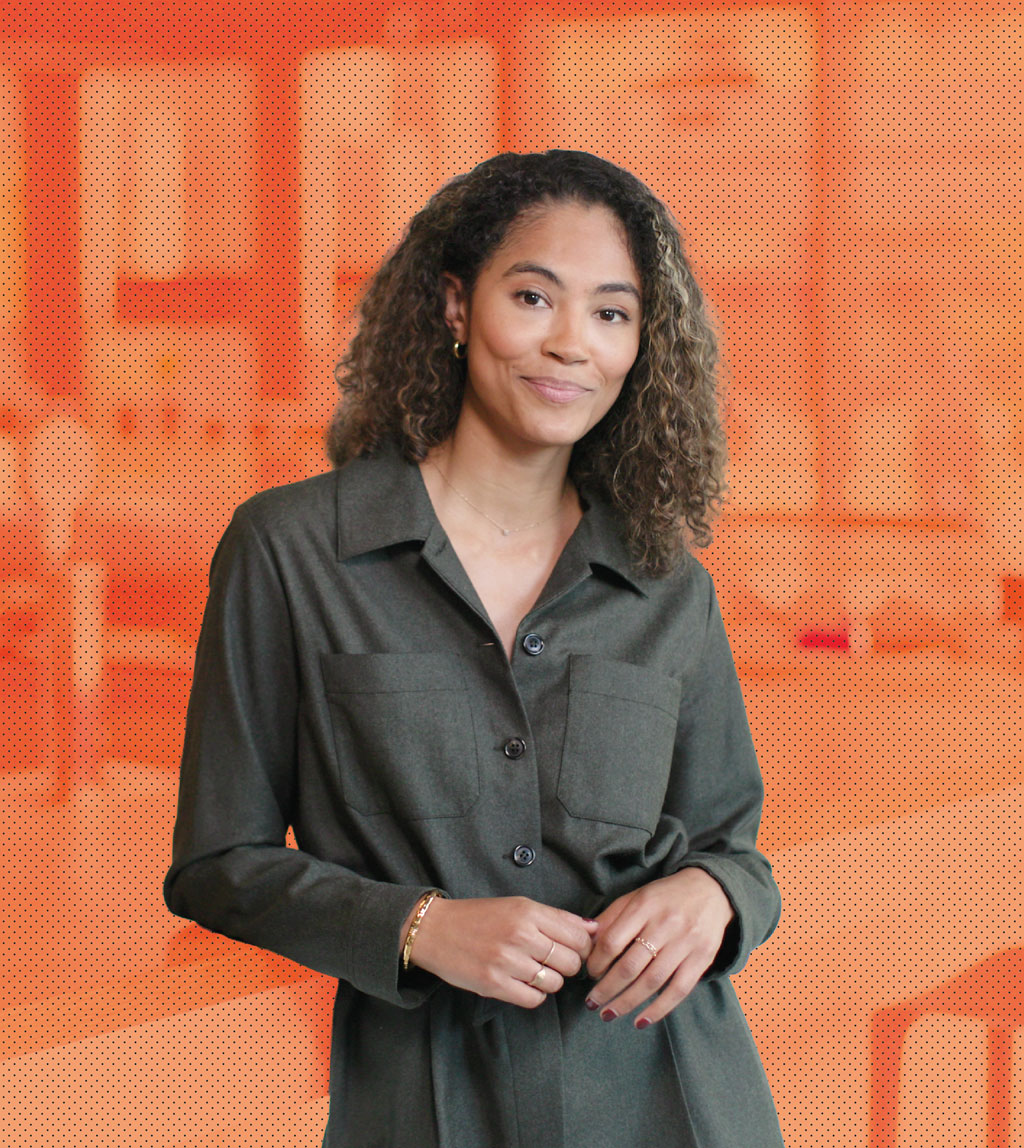
Canadian futurist and author Sinead Bovell shares her thoughts about the rise of AI, interpreting the signals all around us and seven trends she can see ahead
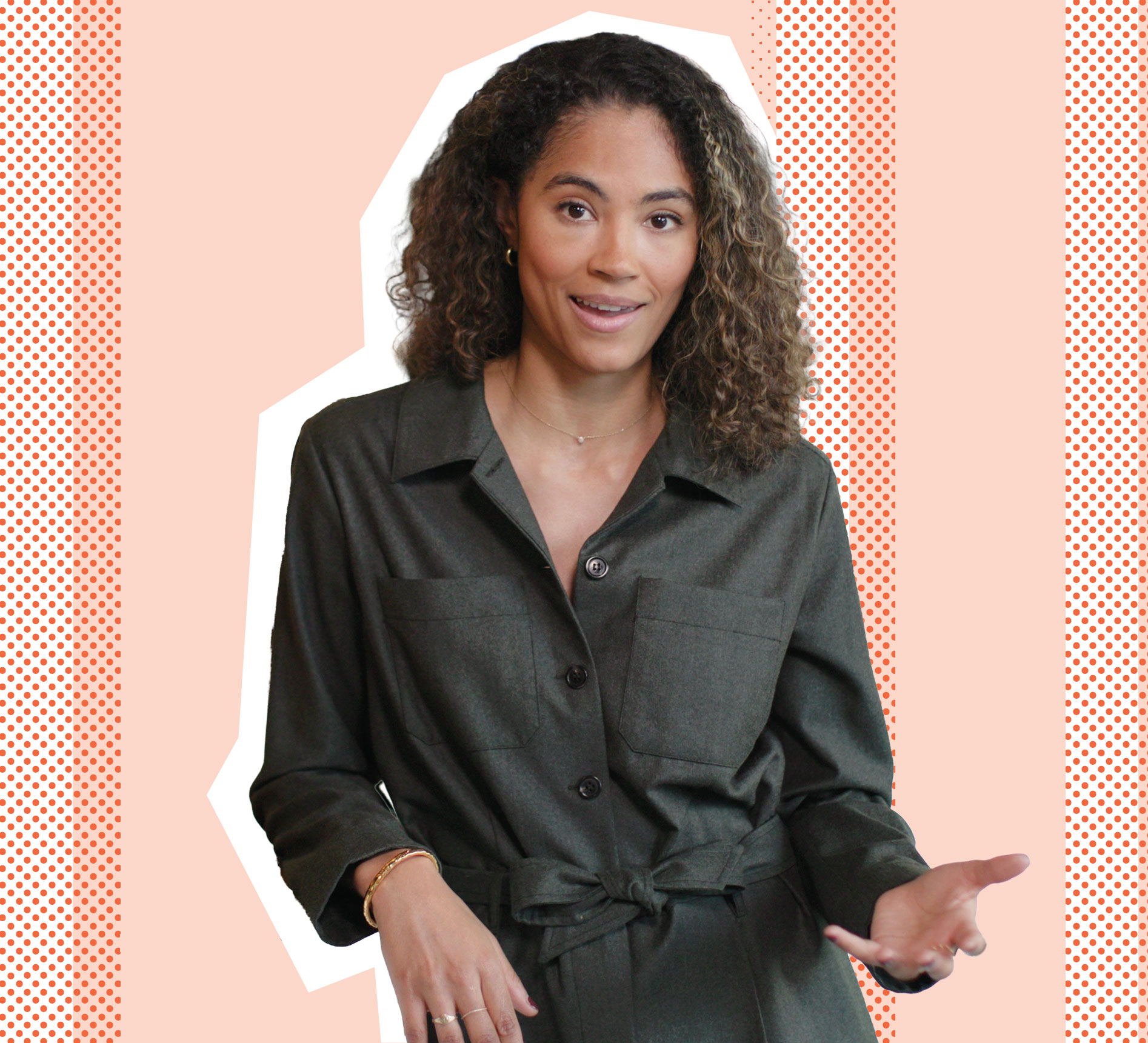
Sinead Bovell is having a moment. Over the past year, the futurist and tech entrepreneur, who is the CEO and founder of WAYE — a tech startup dedicated to preparing young people for the AI revolution — has become a leading voice helping to decode the rapid technological changes that are happening in the world. She has built a powerful platform on social media, with more than half a million followers on Instagram and TikTok, and is now a regular on network television. She has also frequently spoken at the UN about the developments that futurists like her see coming down the track and, through her newly launched podcast I’ve Got Questions with Sinead Bovell, continues to engage audiences in thoughtful conversations about what lies ahead.
“The formal discipline is ‘strategic foresight,’” Bovell explains about her profession, which involves tracking the signals and data around us to help build pictures of possible future scenarios for governments and private business. “A lot of these signals are grounded in emerging technologies, geopolitics, economics and social trends. You then use that [information] to analyze, make forecasts and understand patterns of where the future could move. So, yes, for a living, I do study the future.”
Bovell is quick to point out a common misconception about her trade, however. “Futurists should not be in the business of making predictions. That’s important,” she says. “Nobody can really predict the future. When we try to predict the future, we’re attached to a bias of our preferred future.”
But that doesn’t mean that futurists don’t have an opinion on what might happen or, in Bovell’s words, how to “unpack different ways the future could evolve.” Her biggest goal is turning strategic foresight into a public good, especially when it comes to those who are skeptical of AI’s potential. “I think everybody should get a chance to understand where we’re moving [towards] because foresight is often a private sector advantage,” she says. “People should be able to prepare and understand that skills are evolving, that the general public can take part in the change and [benefit from] the new opportunities that exist.” So what are some of the signals Sinead Bovell is currently tracking?
1. AI is not a tool, it’s like electricity
“There’s a lot of doubt and skepticism around AI, although adoption has been huge,” says Bovell. “But there’s still a barrier people are trying to cross. Let’s say you tried an AI system today. It hallucinates. It doesn’t work properly. You think: ‘This is overblown.’ But general-purpose technologies don’t work on business or stock market cycles or quarter to quarter. These are foundational technologies that can take a decade or more [to develop]. So if you are only paying attention to the next year or two years, you’re going to think that this technology isn’t necessarily worth the hype. If you don’t zoom out and recognize what this technology actually is, I’m pretty certain that your business model is going to struggle. Because the future isn’t a linear extension of the past.
People tend to also see AI as just a digital tool, but general-purpose technologies are not tools, they’re foundational layers that get built on. With a tool, you have the ability to use it sometimes and not use it other times. A foundational layer is like electricity. You just build on top of it.”
2. Social media will look very different
“I ground my work so much in identifying non-linear patterns. We’re really concerned, and rightfully so, about deep fakes and what AI-generated content means for information ecosystems. It’s really important to get to the bottom of these challenges. But we’re also assuming that for the next three, five, six, seven years, we’re still going to be scrolling social media, opening a smartphone and encountering disinformation or AI-generated content.
The question to ask is: if social media and the creator economy are internet-first ecosystems, what comes next when AI is the ecosystem, when AI is the foundational layer? And so I think that’s probably one of the signals that I’m paying attention to. What does it mean to map that new ecosystem out?”
3. The cellphone is on its way out
“Cellphones have gotten smaller, they’ve gotten smarter and they have expanded in scope. We don’t even use the phone part; we rarely talk on it. It’s more just this portal to the world. The smartphone isn’t where it ends, just like pay phones and home phones weren’t where it ended. They will be replaced by something that becomes smaller, more capable.
What form could that take? A lot of people are betting on glasses. That’s one possibility. It could be a device that’s even smaller than glasses. I can’t say for sure what is going to win in the market because there are all of these different factors that have to come together for a certain interface to make sense at a certain time. But I can say for certain that smartphones will go away, the same way pagers went away.
There is no reason that this trend line suddenly stops. We can see some signals and a lot of patents being filed. But maybe it’s just an ecosystem of small devices that kind of connect to create this digital representation of you. We will not be on cellphones in a decade from now.”
4. The real world could become king again
“Another signal that I pay attention to is how people interact in the world. A company has all these AI tools to improve our customer experience, but customers automate their lives too. So is anybody interacting with anybody [online] at all?
I am totally okay with never having to call customer service about the fact that my wifi is down again. I am totally okay to delegate that to AI agents. But when it comes to economics, where do new areas of scarcity and abundance appear as a result of this technology? Well, it will be pretty scarce to be in a live environment with people, because AI is going to be everywhere. So then we might see an appreciation in value in live experiences that only happen in that moment.
Live experiences will be more participatory than social media is today because everyone’s there together in real time commenting on the same experience. They also become more exclusive as that moment never happens again. If we do feel like life has become too automated in one respect, something else becomes scarce and appreciates in value. Those are just the fundamentals of economics and human behavior. And then there are a lot of different opportunities to build and to create things that cater to this.”
5. Doctors may start to see you before you’re sick…
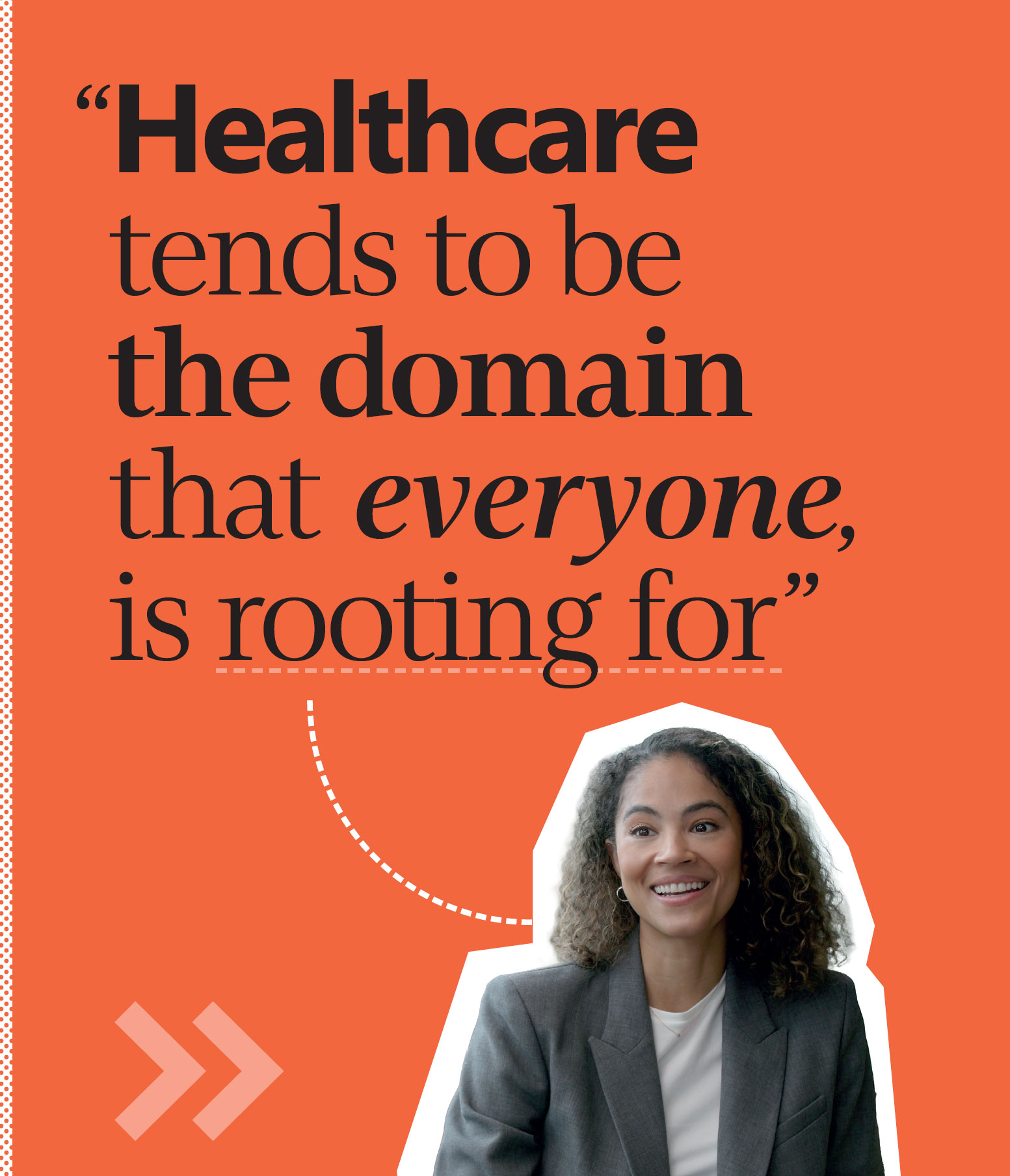
“Healthcare tends to be the domain that everyone, whether you’re skeptical or excited about AI, is rooting for. That’s something unanimous across the board, and it personally and deeply affects most people in some way.
So when you think about the tools and the technologies that are being developed that are linked to AI, they’re all grounded in personalization, in being predictive and proactive and spotting patterns that no single human ever could. I think when we say the doctor has to be a part of the care, we want a human touch point. But how much do we even need to interact or go to a hospital?
When we think about automation of some aspects of diagnostics people are thinking, ‘Well, I don’t want to get a diagnosis by talking to R2D2!’ But what if you get a notification on your device that says: ‘One of your cells is off. We recommend you up your vitamin C.’ Or ‘We’ll send a nanobot to fix it.’ Perhaps that [malfunctioning cell] would have turned into something disastrous five years later, when it would become a point of care. It’s a different way to think about the system.
Maybe diagnosis becomes a signal or pattern in a really micro piece of data that can help prevent an illness from transpiring at all. It’s not going to work for everything, of course, there will be acute, sudden accidents that happen. But maybe a lot of people won’t get sick in the first place.”
6. There could be a major increase in our lifespans
“I think we’re going to extend human lifespan quite dramatically. I think that’s coming. We already see cellular reprogramming, the idea of [Nobel Prize winner Professor Shinya] Yamanaka: how you reprogram a cell to its stem cell state. All of that will likely add decades to the human lifespan. That is going to be in this century. So the idea of living to 120, 130, 140, 150 is not going to be an anomaly.
And that’s fantastic. But it also creates a huge stress on the system. You have Supreme Court justices that have indefinite terms. What does it mean that someone is on the Supreme Court for 110 years? What does it mean for a basketball team when your prime is in your 50s? All of these create stress on the system in ways that we don’t think about.
There was a reason why evolution designed a system that has an expiration date and I think the science [of longevity] is probably going to turn out to be trickier than we think. But I think we’ll continue to push it, and alongside that work, science will also focus on extending healthspan. There’s fantastic data about synthetic biology over the next decade, which could see being 50 feel like being 35. And that is reachable; we can see those signals. That is all really exciting.”
7. People, especially young people, need to prepare if they are to seize the opportunities
“I think we know for certain we’re going to have a different market economy when it comes to skills — that’s quite an obvious next step. What does education need to look like for kids to be prepared, so they can adapt and pivot and have the core skills to think critically about the world around them? How does our information environment change when humans are no longer the sole actors within it? And how do you build robust environments that allow us to have trust in information? There are tons of different research groups that are thinking about this, but we just need to scale those types of initiatives and get behind them. I’d say that’s a way to build societal resilience and also inspire people about the future. The future isn’t just some distant state. It’s a bunch of collective decisions in the present that all of us are making, all the time.”
This is a digital version of a feature from Issue 4 of Signal magazine. To explore the full issue, view the complete flip book here.
Hunting the ghost nets
Abandoned commercial fishing equipment kills millions of marine animals every year, causing untold damage to underwater ecosystems and adding to the growing issue of plastic pollution. But there is hope that what was once seen as an insurmountable problem could be tackled by a combination of artificial intelligence and local knowledge
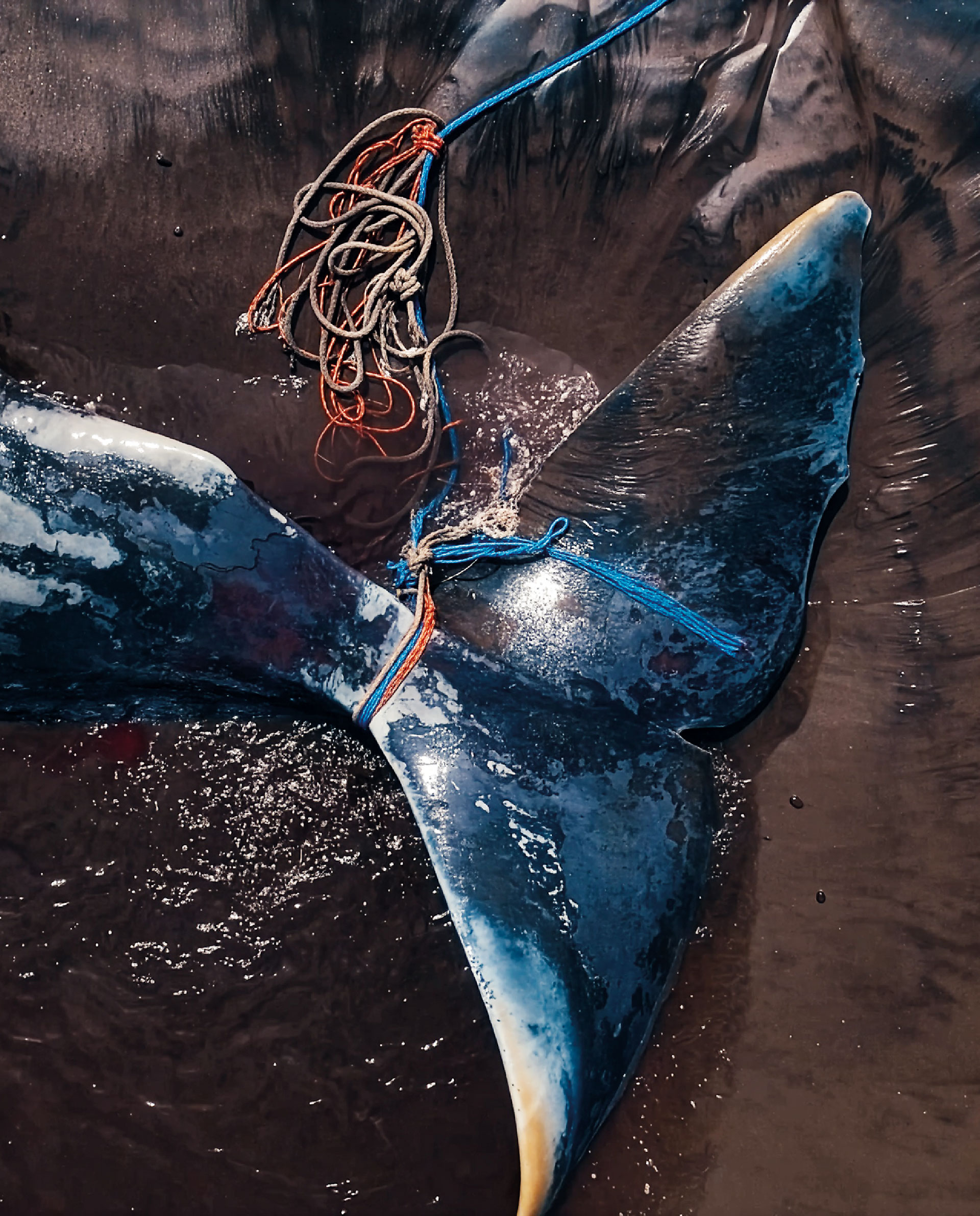
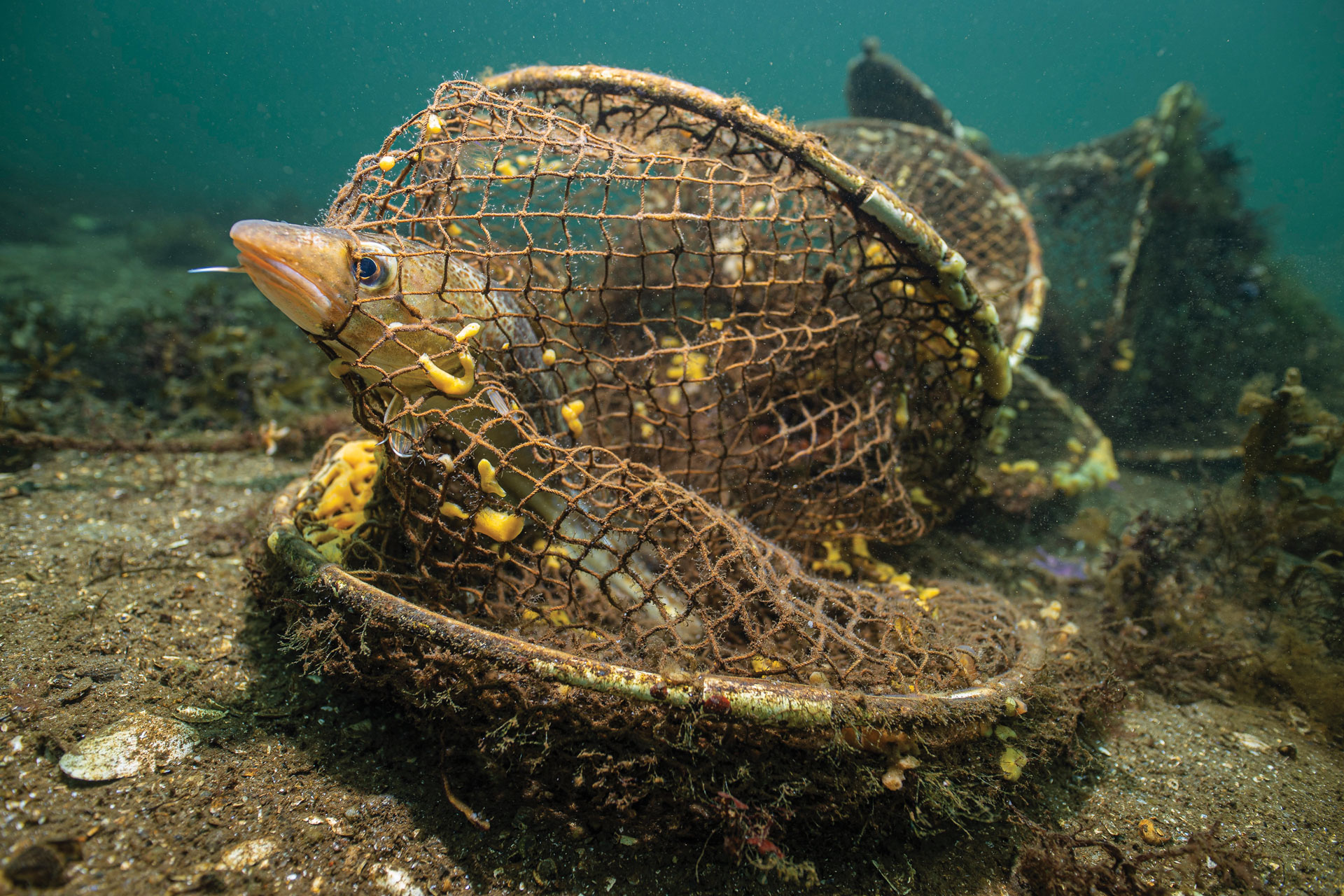
Deep within the ocean, a hidden enemy of all living things is lurking, threatening to destroy marine life by trapping it in an inescapable prison. More than 500 species, including turtles, whales, sharks and crabs have been impacted by this foe, known as “ghost nets” — the abandoned plastic fishing gear that litters our seas and oceans.
The industrial-grade plastics that make up fishing nets are manufactured to survive the harshest conditions. But one unintended consequence of commercial fishing is that such nets are frequently lost at sea, with thousands of square kilometers of nets being abandoned in the ocean every year. These nearly invisible traps silently drift through the water like ghosts, continuing to ensnare and kill marine life, with hundreds of thousands — and likely millions — of marine animals entangled every year.
Lost and discarded fishing gear also adds to the growing problem of marine plastic waste, decomposing into smaller pieces and fibers over centuries and exacerbating microplastic pollution in the oceans. Removing ghost nets is critical but it’s also incredibly difficult to find them. “Ghost nets endanger marine animals and ecosystems and make up a significant proportion of plastic waste in the ocean,” says Gabriele Dederer, a scientific diver and biologist with WWF Germany. “But they are invisible under the water surface and their detection is complex.” Imagine looking for a strand of hair in an Olympic-sized swimming pool, in which the water is pitch black and constantly shifting — and the hair is sinking. Cleaning up the nets may feel overwhelming and impossible, but a new project, GhostNetZero.ai, which uses AI to multiply expert knowledge, offers hope.
The ghost net whisperers
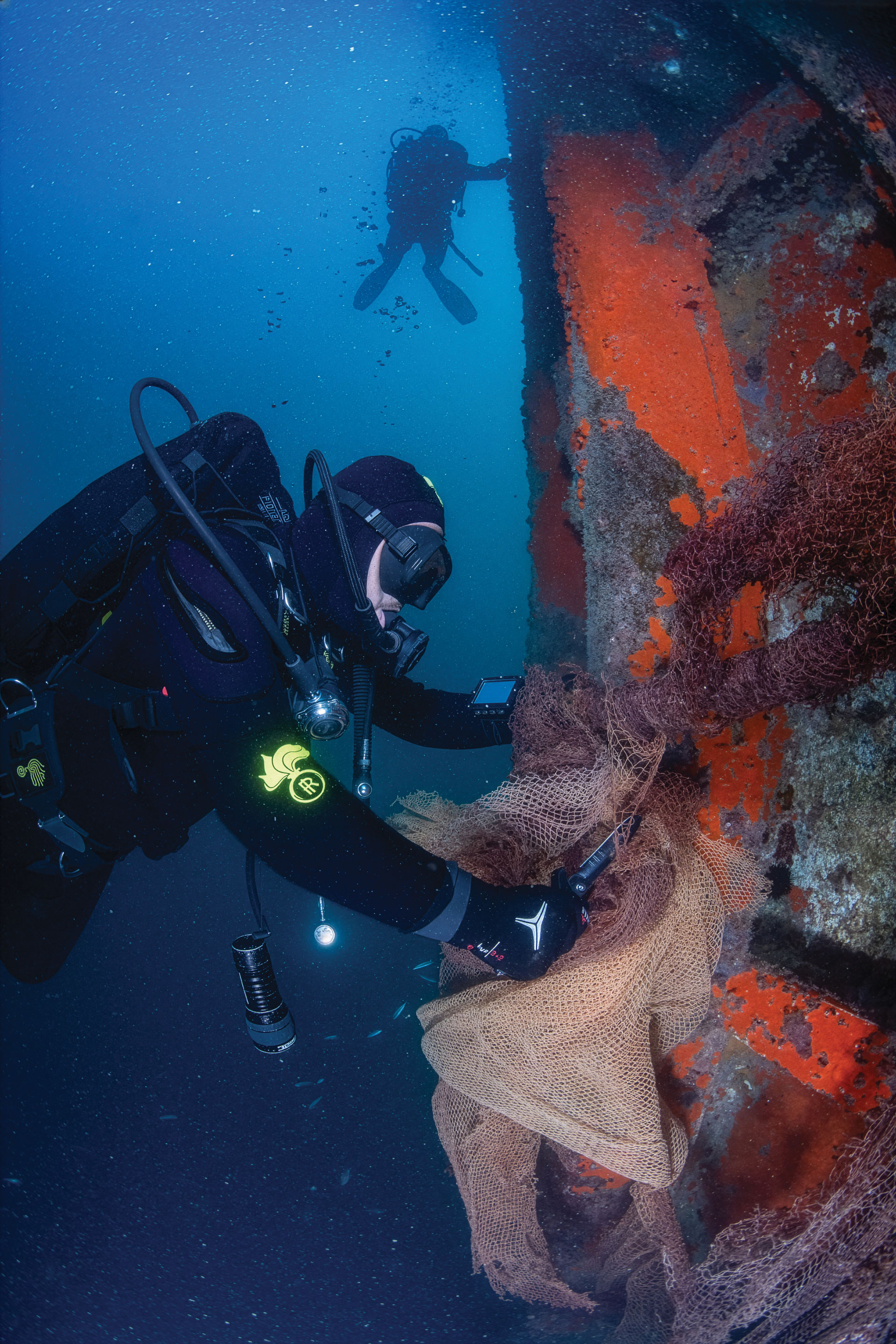
Crayton Fenn is an expert diver who can find ghost nets like a sea hawk spots prey. With more than 40 years of diving experience, he’s seen firsthand how abandoned fishing nets — which he calls “killing machines” — destroy marine life, fisheries and livelihoods.
Fenn started his career tracking down sunken objects around the globe and has become an expert in sonar. Through his company, Fenn Enterprises, he’s helped locate everything from a Japanese submarine to wreckage from the space shuttle Columbia — not to mention countless ships, planes and even trains. In recent years, he has also turned his skills to fine-tuning side-scan sonar systems — something rather like an ultrasound for the ocean floor — to locate and recover derelict nets. One of the most shocking finds? A huge gillnet off the coast of Point Roberts, Washington, which was silently wiping out tens of thousands of crabs on the seafloor. Gillnets are designed to hang in the water like a soccer net — and this one was 219 yards (200 meters) long, almost the length of two American football fields.
Dederer, a longtime friend and colleague of Fenn’s, approached him to ask whether he would consider mentoring scientists in Germany to teach them his ghost net detection methods. He leapt at the chance, eager to share his field knowledge about how to use side-scan sonar to locate the “killing machines.” His expertise has been instrumental in making ghost net searches more efficient, helping Dederer and her team set about cleaning up the Baltic Sea with the help of fishers, divers, scientists and local authorities across Germany, Estonia, Poland and Sweden.
But even after replacing slow, manual searches with data-driven sonar detection, the task remained daunting. Could the team go faster?
Detecting with AI
In 2025, WWF Germany unveiled a new AI-supported platform, GhostNetZero.ai. A collaboration with the Microsoft AI for Good Lab and technology consulting company Accenture, this initiative envisions a world in which oceans are free from ghost nets and marine life exists in a clean, safe environment.
GhostNetZero.ai uses high-resolution, side-scan sonar paired with machine learning to track down possible ghost nets automatically. Sonar scans of the sea are converted into images, which AI analyzes to pinpoint ghost net locations. Once the AI has identified a net, WWF experts review and validate the findings, before qualified divers begin retrieval, using an app to verify the net’s position.
Anyone with access to sonar or hydrographic data can contribute by uploading it to GhostNetZero.ai. The project’s leaders have approached offshore energy operators, research institutes, authorities and other organizations to share their sonar data. AI integration then turns this multi-source data into actionable insight, examining imagery to isolate likely ghost net locations with 94 percent accuracy. The boost in efficiency means that analysis that used to take hours of manual review can now be carried out in minutes, allowing WWF to cover larger marine areas in their search and focus its efforts where they will matter most.
“The combination of sonar search and AI-supported detection represents a quantum leap,” says Dederer. “The seabed is mapped all over the world, and there is a huge amount of data. If we can specifically check existing image data from heavily fished marine zones, this is a real game-changer in the search for ghost nets.”
Using sonar alone, WWF Germany has recovered more than 35 tons of ghost nets from the Baltic Sea since 2018. The hope is that GhostNetZero.ai will see this number increase enormously. The organization also believes the new platform will be crucial for operations in the Mediterranean, where fishing gear accounts for up to 89 percent of litter recorded at sea.
Over the last few years, WWF has been working with fishers, divers, scientists and local authorities in France, Italy and Croatia to map the area and send in targeted teams to retrieve more than seven tonnes of ghost nets from the Mediterranean.
All of this is only the beginning — worldwide efforts are in the works for areas with intense fishing activity like the Coral Triangle, the North Atlantic and the Indian Ocean. And because of AI, there is now hope that we can rid the world’s waters of ghost nets. “I need to be optimistic,” says Dederer. “I have two kids. I want them to see that we need to care for nature and the ocean.”
This is a digital version of a feature from Issue 4 of Signal magazine. To explore the full issue, view the complete flip book here.
“This is an exciting opportunity to redefine what work is”
With a workforce of more than 220,000 people around the world, Microsoft is one of the biggest employers in tech. But how do you keep a team of that size effective, empowered and engaged – particularly during a period of rapid change? Amy Coleman, Microsoft’s Executive Vice President and Chief People Officer, offers her five tips.
Amy Coleman is not one to shy away from a challenge. With more than 27 years of leadership under her belt, she has helped companies navigate periods of both intense growth and recession. Nothing, she believes, compares to the pace she has witnessed since 2020.
“It has been crazy,” she says with a smile. “The pandemic saw sweeping changes to many people’s jobs. Digital collaboration went from being this thing on the side to being mainstream. And now, with the rise of AI, we’re figuring out what work is all over again.”
The adoption of AI into companies of all sizes, Coleman believes, is going to require an even bigger shift in mindset than the move to hybrid working did. Naturally, she is undaunted by the task.
“What an incredible time to be in the people space,” she says. “It’s been challenging, but if I look back over the last five years, we successfully navigated a period of great change once. Now we’re going through all that uncertainty, that chaos, that potentiality again. This is an exciting opportunity to redefine what work is.”
Coleman sits on the Microsoft leadership team and reports directly to CEO Satya Nadella. With leaders looking for advice on how to handle the next wave of change, we asked her to share five tips for navigating the world ahead.
1. Have the difficult conversations
“The pandemic forced us to really look at how we connect as humans and ask ‘How do we do our work when something gets taken away? What fills that gap?’ We figured it out and adjusted but it took some time. With AI, it feels like the pace is much faster.
The role of HR right now is to help employees reimagine what their job looks like alongside AI – to ensure that learning, growth and mastery still happens as AI absorbs more execution. Our software engineers are spending less time coding and more time collaborating on big ideas, but change also brings fear and uncertainty. It can lead people to turn inwards and protect what they know, and that’s understandable: the success that got you here feels threatened for the first time.
Having conversations about this is important. Can we help people move through this transformation, relying on all the things that got us through prior ones, even though the context may be different? That’s trust, transparency, authenticity and vulnerability. We need context and conversations so that we can move through this transformation together.”
2. Learn from what’s gone before
“When I look back at the pandemic, I think about how we needed to help our teams with some of the human parts of work. We had to lean in to help managers show care for employees. How do you do that? It sounds basic, but you must ask questions that can help employees open up and say what they’re feeling.
The conversation is different now, but again we need to lean in and combat uncertainty by giving clarity where we can and being honest when we can’t. As leaders, you listen and build trust, so that when there are things like job changes and uncertainty, people can come and ask you about it. That also means admitting that sometimes we don’t have the answers.
That’s not easy. At Microsoft, we’re built by experts, by some of the smartest people in the world, and so having experts say, ‘I don’t know what the future is, but I’m here with you’ is going to be a learned skill. I would encourage all leaders to connect more than they ever have before.”
3. Hire for adaptability
“The hiring process for an AI world is still developing. What employers need to be looking for is less about domain expertise, which is still really viable in certain areas like AI science and AI research, and more about a generalist mindset – having adaptable employees that can do many things.
There’s currently a debate about EQ, emotional quotient, and IQ, intelligence quotient. That if intelligence is democratized with AI, and AI can carry out a set of tasks or can augment a job or change a role, it’s going to be my and other leaders’ jobs to figure out where we need humans to be a part of that.
If I take an AI mindset and say, ‘AI could do this whole thing,’ whatever the thing may be, it’s going to be important to figure out where humans need to add nuance, judgment and decision-making. Just like advances in the past, we don’t know all the jobs that are going to come from AI. Certain jobs may be mostly automated, but there are going to be other jobs that are invented because of this.”
4. Education remains key
“A lot of people ask me what my advice is to young people considering further education in the age of AI. I have four children – two that just graduated from college and two that are in college. My answer is that learning is the most important part, and this is something we’ve always known.
What did I learn at university? Of course, I learned in classes and seminars, but I really learned a lot about myself. So I would say to those in the next generation to make sure that you are a learner first and you are super curious.
AI fluency is going to matter, but so are emotional intelligence, grit, adaptability… That’s what I’d encourage them to not only learn, but to highlight and model when they discuss internships and meet with potential future employers.”
5. Retention is more important than ever
“During times of massive change like this, you have to rely on the backbone of the company. That means the people who have shown they can be successful in your organization are more valuable than ever.
I think all too often retention is probably too reactive. By the time that someone comes and says, ‘I’ve been in conversation with another company,’ or even worse, ‘I have an offer,’ it’s usually too late.
Again, it comes down to conversations, context and sharing what’s amazing about working at your company. In Microsoft’s case, what we’re relying on is our mission, our values and our strong leadership and culture. We’re relying on offering great career opportunities here, even in a time where jobs are changing tremendously. And we’ll take care of you and the people that you care about.
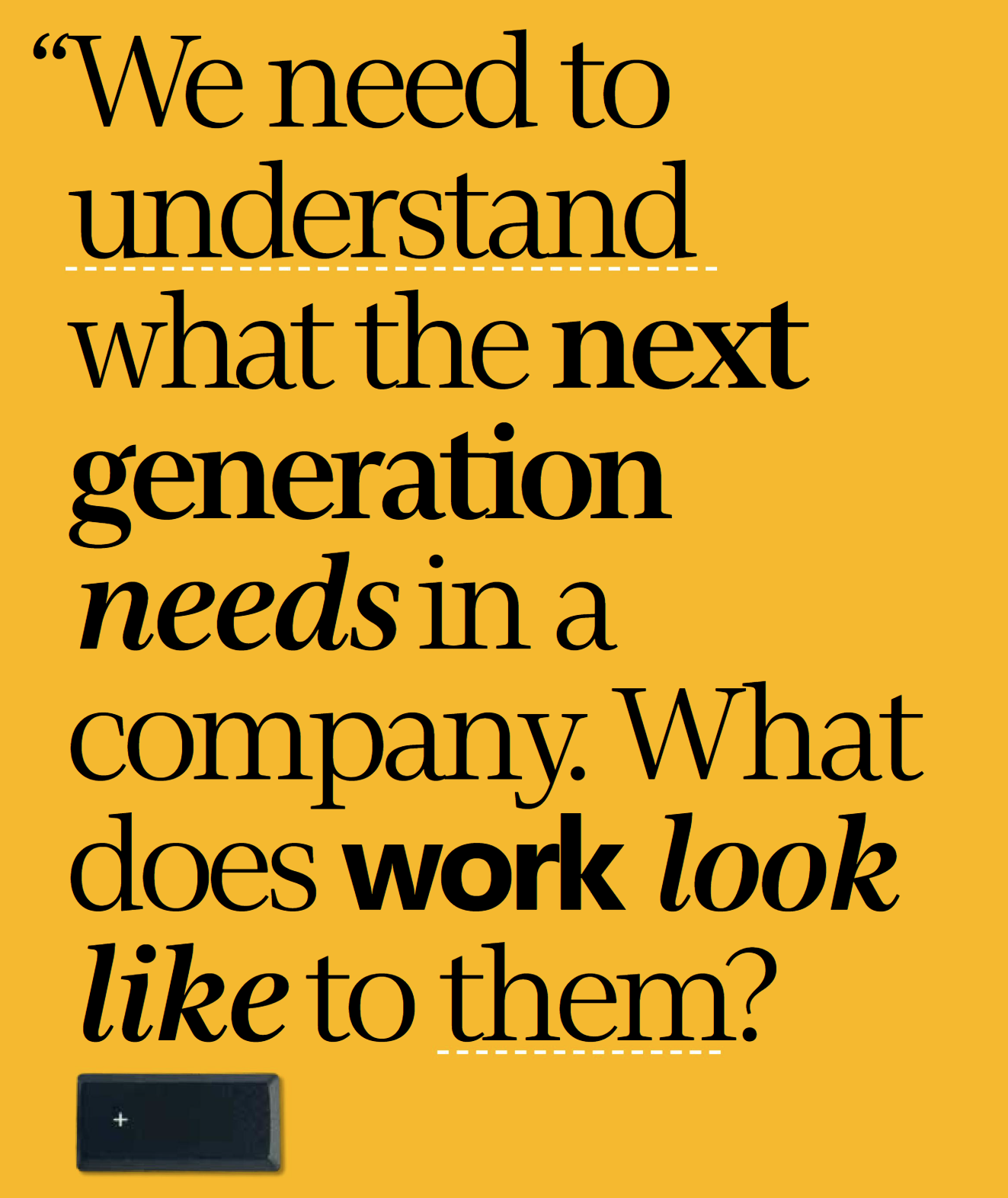
We also need to understand what the next generation needs in a company. What does loyalty mean to them? What do work and employment look like to them? How do we adapt to make sure that we get that next-gen talent? It all comes together in that retention conversation.
The other thing I’d say, and I learned this many years ago, is that retention doesn’t mean forever. Instead of thinking a person needs to stay here for the rest of their career, how do we help them do something amazing here and then go on and build another company? It all goes back to knowing your employees, caring about them and caring about what’s important to them – a lot of listening and being curious.”
The road ahead
Magnus Östberg, Chief Software Officer at Mercedes-Benz, has spent five years working on a new generation of ‘software-defined vehicles,’ equipped with systems designed to radically enhance drivers’ in-car productivity. As the first models featuring the new integrated software — including Teams and ChatGPT — begin rolling out onto the streets, he tells Signal what the process has taught him and what driving might look like for all of us in the near future…
The new advertisement for Mercedes’ 2026 CLA model features the car driving through a fantasy landscape of silk-draped skyscrapers and synchronized dancers, to a soundtrack by Eurythmics. The song? ‘Sweet dreams (Are made of this).’
The software fueling these dreams was brought into reality through the work of Magnus Östberg and his team. It was they who integrated ChatGPT into the CLA’s system through Microsoft’s Azure OpenAI Service, making it possible, with a quick ‘Hey, Mercedes!’ to chat with your car about your destination, get an overview of your day or request a briefing on the client you are about to meet. They also, for the first time ever, enabled use of the interior camera for Teams video calls, meaning you can dial in to meetings and be seen by your team as you cruise along the highway (your own screen shuts off as you begin driving, to avoid distraction).
In another unprecedented move, Mercedes integrated Microsoft’s Intune app and device-management tool to create “the ultimate secure workplace on wheels,” giving drivers access to the same range of programs and data that they have on their office devices. “These tools have been constantly helpful to me in my own productivity,” says Östberg. “So much so that I now find it difficult to drive the older generation vehicles without them. It’s a totally different type of experience.”
All of this is just a first step in a broader program that will see the boundaries between car and office broken down, creating what Östberg and his team refer to as ‘the third workspace.’
Microsoft 365 Copilot will be the next system to be integrated into Mercedes cars, enabling its customers to continue work seamlessly after they step into the driver’s seat, and opening up new horizons in productivity. Here’s what Östberg and his team have learned so far…
People want to talk with their car
“We were the first car manufacturer to have a beta version of ChatGPT in a vehicle, and we learned very quickly that people have a desire just to have a conversation with their car,” says Östberg. In beta testing at Mercedes, voice assistant usage surged by 600 percent among cars equipped with ChatGPT that were able to sustain a conversation. But that’s not all that drivers want. “They have a need to actually perform tasks in the real world,” says Östberg. “They want to say to the car, ‘Hey, find me a restaurant there!’ or ‘Find me the opening hours for this location!’ or ‘Take me to these activities!’ Our conclusion has been that there is not going to be just one AI solution or one model that can solve all the needs of humans. There is going to be a need for a collaboration and an orchestration of AI models in order to perform these different tasks.”
Constant feedback is the lifeblood of the new era
The Mercedes models equipped with the new technology that have hit the streets so far are the CLA, the GLB, the all-electric GLC and, soon, the flagship S-Class. “[The GLC] is one of the most exciting ones at the moment because it has enormous range and the reviews from the press have been amazing,” says Östberg. “So we’re all very excited and proud when we drive it. And we’re really looking forward to seeing how the entire customer base embraces this new digitally enhanced GLC.”
Live data from the cars themselves is crucial in shaping this new phase of development. “The biggest learning has been that rolling out these new technologies in cars is going to be a collaboration,” says Östberg, stressing that the most important partnership is with those driving the car. “We have put in place a constant feedback loop from our customers, to find out what they actually do with the technology versus what they say they want to do with it. Our work is really driven by customer usage data at the moment. If we see that there is an overwhelming majority that wants to have a certain capability — exploring the web through AI while driving, for example — then it needs to happen.”
Your car will be part of your digital ecosystem
So what’s different about stepping into one of these models? “What drivers will experience is that now they can fully bring their digital ecosystem into their vehicles,” says Östberg. “So for example, that means connecting to Microsoft Teams or to their social media or streaming accounts.” The question the team has always asked themselves, says Östberg, is “How can we give you access to all the types of features that you previously only had on mobile devices or your laptop?”
The new tools are being rolled out alongside autonomous driving components. “There’s a high cognitive load you have driving in an urban environment or trying to figure out which is your exit on the highway,” says Östberg. “By having this system that is lowering that stress level, you are basically giving a higher level of relief and comfort to the drivers.” AI messaging tools can help reduce stress further still. “You could imagine a lot of features. Say I’m late for my upcoming meeting, the AI could send a message of apology with my new ETA without me taking my eyes off the road,” says Östberg.
Hardware remains crucial
‘Software-defined vehicles’ are those in which features and performance are managed and updated primarily through software rather than hardware. When those vehicles are electric, hardware seems at first glance to be even less important, with no internal combustion engines or gear boxes to worry about. As manufacturers across the world put ever more resources into developing EVs, one might therefore assume that hardware would take a back seat and that software would become the main point of difference and battleground, particularly with the extraordinary new, AI-powered in-car tools that are now being made available.
Not so, says Östberg. “There are very important physical attributes that are no less important than the software,” he says. “For example, one of the biggest reasons why EVs are not being taken on today the way we thought a couple of years ago is because of what we call ‘range anxiety’ [drivers’ worry that their vehicle will run out of charge mid journey]. We can help mitigate that with software; for example we can inform them of the location of an available charging station, the charging speed and how many people have successfully charged there. There are intelligent driving modes to get the most range out of the battery. But it’s also a lot of physical research and investments that are going to mitigate that both on the infrastructure side as well as on the battery chemistry side.”
‘Software-defined vehicles’ bring upheaval
“In the past, every piece of software came to the manufacturing line as one unit, where it was then married together [permanently] with the hardware,” says Östberg. “But now we have separated this flow so you can continuously update the vehicle regardless of where it is — on its way to the dealers, in a customer’s hands or even in those of a second owner of the vehicle. That is the biggest thing about a software-defined vehicle, that separation. And this has meant the biggest change at Mercedes, to everything from the legal contracts with our partners to the factory layout. It’s a major transformation of the company.”
Going through this transformation took a lot of hard work and thought, says Östberg, reflecting on the lessons learned over the last five years of development in the run-up to the rollout of the new ‘software-defined vehicles.’ “I think having a common language that the company can get around is paramount,” he says. There were also major questions to be answered. “What are the new quality measures to be able to release software continuously in an organization?” says Östberg. “What does it mean for manufacturing? What does it mean to offer after-sales services?”
We’ve only just begun
The software-defined vehicles currently driving along a road near you are just the first wave, and Östberg and his team have got a grand roadmap for where things will go in future. “In a couple of years from now, not too far away, we’re definitely going to have multimodal inputs,” he says. “So, of course, we have been talking about the voice being the input and the output of the AI models, but you will also have the pictures from inside the vehicle looking at you as well as the video feeds outside, looking at the world around you.”
These inputs will open up new opportunities. “You can imagine that you could absolutely start to have a conversation where the AI models take input from what you are doing, your facial impression, what you are wearing and the context in the car. You could even hold up a picture and say, ‘Hey, take me here!’” says Östberg. “The AI model is going to take into account not only what you’re saying, but the context of what you see in front of you to generate curated visual cues that are going to help you make better decisions.” Things will go to the next level, Östberg believes, when you are able to deploy fully automated driving, opening up still more possibilities for in-car productivity.
Change has to be managed carefully
There is a temptation to bring in a huge raft of new updates to the in-car experience rapidly, but Östberg says this change has to be managed carefully so as not to overwhelm or disorientate drivers. “We’re making sure that this looks and feels like a Mercedes, a brand which our customer base enjoys and selects over other experiences,” he says. To emphasize the continuity with previous models, the phrase ‘Welcome home’ has been selected as one of Mercedes’s key brand messages — alongside the cue that sweet dreams are made of this. “A new brand that’s a greenfield can decide to go into extreme directions,” says Östberg. “But we are a 140-year-old company that has a brand reputation and experience to live up to. We are shaping this transformation into a Mercedes experience.”
This is a digital version of a feature from Issue 4 of Signal magazine. To explore the full issue, view the complete flip book here.
Before there were dollars or digital wallets, there was barter
Salt, spices, seashells – objects that carried value because communities agreed they mattered. These were the original currencies, the fabric of early economies.
Even then, the underlying currency wasn’t physical at all – it was trust. Every transaction, every relationship, every decision rested on it. And unlike any physical or digital currency, trust is impossible to mint, slow to build, fast to lose. In a world of accelerating growth and fragmented media, trust has become both scarcer and more essential.
By many measures, trust in critical global institutions is at an all-time low – business, government, higher education, the fourth estate, judicial systems, political parties, all have experienced steady declines. At the same time, media fragmentation makes it even harder to either build or regain trust at scale, with outside stakeholders or employees. In an era where anyone can hear about you, your company, your organization from nearly any place and any medium, how do we protect reputation, and create trust? No one organization is going to solve the trust problem, but there are some ways that we at Microsoft have found useful to address it.
1. Be consistently clear. Trust is (as always) built with consistency, transparency and authenticity, to all audiences. Externally, this means being relentlessly clear not just about what you are doing, but why, and how you are measuring it – if you don’t declare, others will pick metrics for you. And remember that (as Hobbes said) a foolish consistency is the hobgoblin of small minds – which means that it is always okay to change as the world changes, but key to that is acknowledging the change and the why behind it. Internally, this involves treating employees as a key audience – increasing the tempo of communication with them, and ensuring that what is said internally is the same as what is said externally. Any gap is dangerous.
2. Operate the channels that matter. In a world where the first version of “what happened” can come from a forum or a thread, control the means of communication – not to dominate the conversation, but to make sure your facts and context are available, accessible, and authoritative. Build the capabilities before you need them; when trust leaks, you don’t want to discover a gap. This means owned channels, inclusive of a rich investor relations and media site, but also the ability to have a company voice anywhere customers live – in online forums like Reddit, and across all social platforms.
3. Enable your people as credible voices. Finally, in a low trust environment compounded by fragmented media, your employees and those closest to the company are the ones that will be most trusted. We’ve all been in a situation where we’ve heard something about a company and then reality checked it with someone who works there. This means we need the ability (and permission!) to mobilize our employees as advocates.
We have tried to combine all these elements in the magazine that you hold in your hands. Inside you will find clarity, authenticity and transparency from credible voices delivered in a channel we feel matters more than ever: print. Enjoy issue three of Signal.
Frank X. Shaw,
Chief Communications Officer,
Microsoft
This is a digital version of the opening letter from Issue 3 of Signal magazine. To explore the full issue, view the complete flip book here.
Trevor Noah’s reasons to be cheerful
The Emmy award-winning comedian and author reveals the things he is most optimistic about for 2026
Trevor Noah is a busy man. Since wrapping up his seven-year run as host of The Daily Show in 2022, the South African comedian, author and philanthropist has founded his own production company, released a Netflix comedy special and won the Erasmus prize, the first comic to do so since Charlie Chaplin in 1965.
In 2024, he published his first children’s book, Into the Uncut Grass, a follow-up to his bestselling memoir Born a Crime. He continues to run the Trevor Noah Foundation, a youth development initiative he founded in 2018, which partners with Microsoft to expand AI-driven learning opportunities in under-served schools across South Africa. And he’s showing no signs of slowing down. “2026 is going to be a really busy year for me,” he says. “I’m going to be launching my next world tour and doing a bunch of stuff around the World Cup with YouTube. And we’re constantly expanding the Trevor Noah Foundation.” He attributes his energy levels to his positive outlook.
“There’s always cause for optimism,” he says. “Optimism is a necessary component of the human experience… When we were hunting for animals, you had to be optimistic that you would find one, and today, if you’re going to be building technology that’s going to shape the future, you’ve got to be equally optimistic. The world always moves forward.” Here are eight things Noah is excited about in the year ahead.
1. The chance to push philanthropy further “Our mission and style of tackling problems [at the Trevor Noah Foundation] have definitely changed over the years. We have learned that the things that we thought learners and teachers would want did not necessarily line up with what they actually needed. We wanted to give people, say, fancy tech labs and many of them were just saying ‘We actually need gates that lock’ or ‘We need a fence so that wild animals can’t come in’. So we’ve gotten a lot better at listening to the needs of the community.
We’ve just launched an innovators’ fund, finding people with innovative ideas in and around Africa, and then helping fund those ideas and projects to assist with everyday problems. We’re particularly interested in ideas around education, development and construction, anything that overlaps in the Venn diagram of improving infrastructure and communities.
In terms of long-term goals, we try to pilot programs and pass along those that show success to the government [to develop further], because we can’t scale like a government can. We want to create programs and ideas that last long after we’ve left a community or enable them to do things beyond us. We ask, how do they make more money? How do they create new opportunities? How do they create entire ecosystems? The people that will have fascinating ideas on how to change the community are from the community itself.”
2. A revolution in healthcare “There’s a lot of focus on AI but, for me, we speak about it a little too broadly. There’s one side of AI that’s all speculation, and then there are others where we’ve already struck gold, and I don’t think we’re spending enough time in those departments. Healthcare is one of them. I went to Johns Hopkins University and saw how they’ve been able to improve the diagnosis and treatment of breast cancer in patients through large language models which are looking through scans and predicting whether or not somebody’s going to have breast cancer, sometimes five years sooner than a doctor would. That is also decreasing how many women have to have biopsies unnecessarily. It’s not just the missed positives [that are being addressed]; it’s all the false positives or the possible positives that lead to negative outcomes in people’s health.
There’s another AI program where doctors can dictate their notes and have them written up automatically. So much of the work that’s in healthcare right now, especially in the US, is just in administration and it’s not helping anybody, it’s just everyone covering their butts and making sure that everything is done in triplicate. If we get systems that take care of it, that improves lives here and now.
3. A return to context “People are starting to remember the value of context. If I’m in a room with people, the context is maintained and the veracity of what we’re speaking about is really held securely. It’s very hard for people to lose context. So, when I’m online, I’ve tried to pivot a little more to long-form as the context is more important than ever before. There was once a mad dash to have everything be as short as possible; our record was six seconds when it was [defunct social media app] Vine, but now for myself and for many people, there’s a new direction. We’re saying, ‘Let’s stretch this out, let’s have a longer conversation, let’s have something that breathes so that as much context is maintained as possible.’”
4. A rethink in education “Education is another one of those areas where there’s an opportunity because there is no place I’ve been where there are enough teachers for the learners. There is no world I’ve seen in which every student has an equal opportunity to as much education as they need. I think that the place that AI is already at, especially in a closed system, can provide infinite resources with an LLM that’s trained on all the textbooks and all the information that the kids and teachers need contained within it: lesson plans, marking, student-specific instruction, guidance.
I don’t see a downside, because education has been stagnant for such a long time and so many learners are coming out of school lacking the skills and the tools that they need in the modern world and teachers have borne the brunt of this. They’re up against it. They’re at school trying to teach, and they’re going home and then marking papers until midnight. Then, they’ve got to come in and do it all again. So, AI in education is a massive opportunity, and the risk is contained because you’re doing it within one sphere and always under the supervision of a teacher. It has a wonderful amplifying potential that we sorely need in education all over the world.”
5. Increased understanding of AI “I think people should learn as much as they can about the tech, and not just by reading but by doing. I’ve enjoyed building my own agents and would suggest everyone gives it a try. I’m actually shocked at how many CEOs I speak to who are shaping their entire companies in and around AI, and then when I ask them if they’ve used it personally, the answer is no. Maybe some of them have done a cursory search using one of the LLMs, but none of them have actually dug into it. And I always say to them, ‘If you don’t take the time to try to understand this thing, how can you shape your organization around it?’
Building agents has helped me understand that an LLM has its limitations. It is fantastic at processing insane amounts of data, but it really is limited when it comes to its multimodal inputs and outputs. That’s where humans still have a really interesting edge over technology, in that we’re good at collecting inconsistent, dirty information across different spheres and somehow making it make sense. Our organizations aren’t as clean as we’d like to believe in terms of information flowing from one side to another and neither is the world. And in the same way that self-driving cars have shown how difficult it actually is to drive, we take for granted how easily we transfer information and make use of it in the world.”
6. An evolving job market “There are a lot of AI evangelists who would have us believe that every job is going and everything will be taken over. From everything I’ve seen this isn’t the case – all AI has really done is promote us to being managers of our own work. Everyone still has to supervise the work. So, your legal AI is only as good as the lawyer who knows how to supervise it and understand whether or not the cases it’s citing are actually real. Your coding AI is only as good as the software engineer who looks at it and can say, ‘This is good code’. Because, at the end of the day, the output is meant for humans, and so humans are still going to have to judge it in some way, shape or form. So, I do think there’ll be an evolution, definitely, of how people work and what they do. But I don’t think we’re at this critical point that a lot of people are talking about with AI. I think right now the tool is more interesting than this omnipresent, all-knowing work machine [that some present it as being].”
7. An opportunity for inclusion “A lot of people in very powerful positions underestimate how much knowledge and information is stored in the people they are trying to help. That’s the shift that we need to see in how we think we can change the world. If we can shift the way we think about solutions – whether it’s in policy, philanthropy or technology – from top-down to bottom-up, we can find ourselves making massive leaps forward. No matter what it is we’re building, it’s important to remember that the answers can often lie with the people, the communities, the countries, the places where the problem actually lies. Just because the problem is there doesn’t mean the solution is not there as well. It just means they may not have access to the tools that can help them to solve it.”
8. The World Cup “The World Cup is definitely a cause for optimism. It is not a perfect event, but it’s something that I don’t take for granted. We’re living in a world where fewer and fewer things bring people together into the same space to resonate at the same frequency. We now live in a world where we’ve created an audience of one, where my ‘for you’ page is totally different to yours. The upside of that is that everyone can enjoy whatever niche they want to be in. The downside is that we’re living in different realities, and when people live in different realities, it’s a lot harder for them to see their similarities.
That’s why something like the World Cup, and any sports event really, is such a powerful tool, a whole group of people coming into one space together to share the same story, the same experience. It brings the whole world together too, in a way that is sorely needed. How often does Haiti get to interact with the United States in a level way? Despite where you’ve come from and what your fortunes are supposed to be, when that first whistle is blown, anything is possible. It’s really the stuff of dreams. So, I’m genuinely excited about the World Cup because I think it’s going to bring a lot of people into America, and it’s going to bring America to a lot of people in a different way.”
This is a digital version of a sample feature from Issue 3 of Signal magazine. To explore the full issue, view the complete flip book here.
“We’ve learned how we can push the frontier”
A briefing on the work of Microsoft’s Climate Innovation Fund so far – and where it’s going in the future
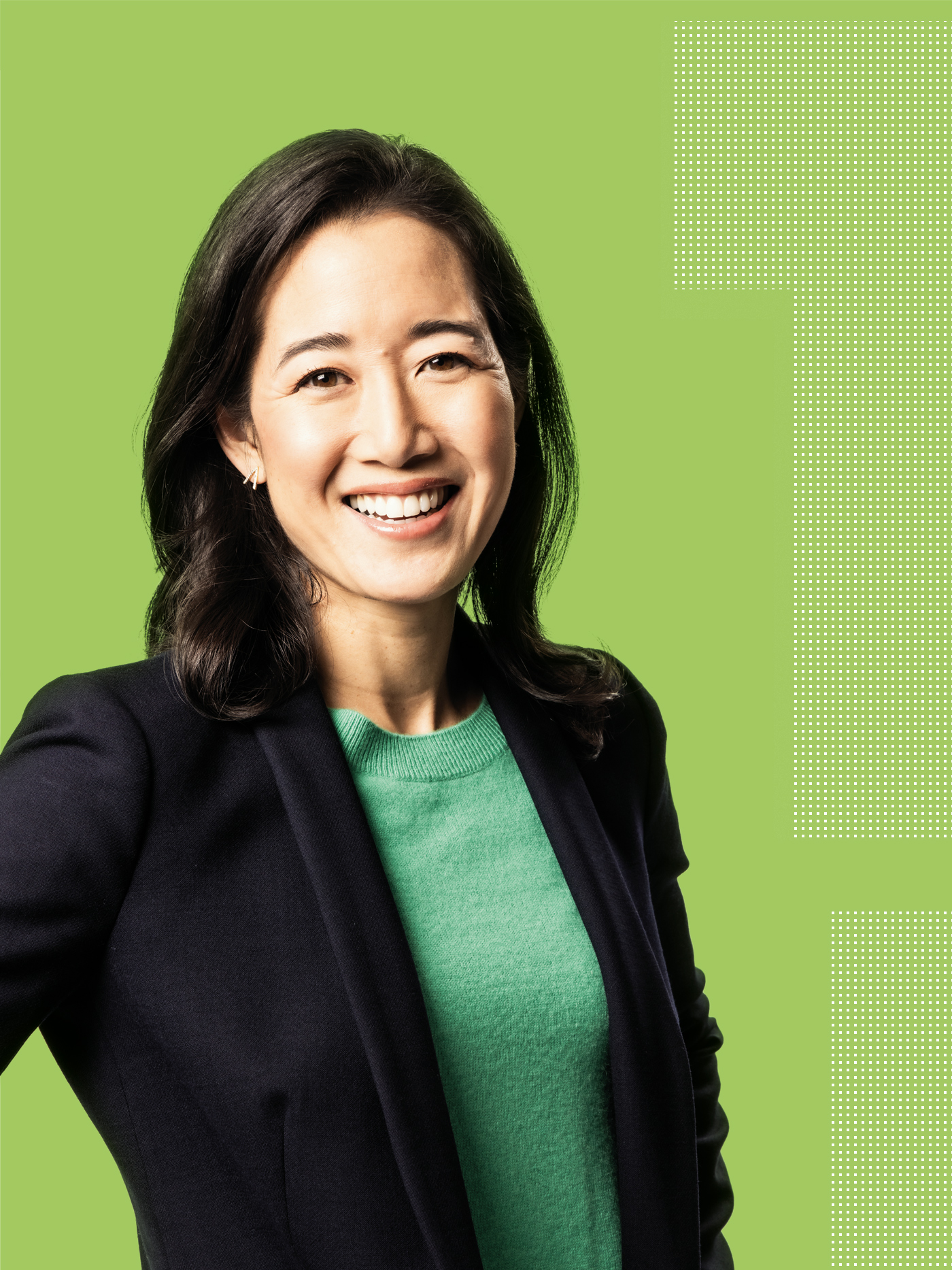
Melanie Nakagawa joined Microsoft as Chief Sustainability Officer in 2023 and as part of her duties she took up responsibility for the company’s $1 billion Climate Innovation Fund (CIF). In her previous roles she was in private equity, government and non-profits, bridging technology, finance and innovation. We asked her for the lowdown on the fund – and how corporations can help in the battle against climate change…
Why was Microsoft’s Climate Innovation Fund set up?
Melanie Nakagawa: When Microsoft launched its sustainability commitments to become carbon negative, water positive, and zero waste by 2030, we realized that there were some technologies and solutions that did not exist at scale yet but would need to be broadly available by 2030. The Climate Innovation Fund was set up to build the solutions the world needs for the market of the future.
How do you decide which investments to make?
MN: As a global technology leader, Microsoft sees an incredible array of new technologies as they emerge in the market. We identify the sustainable innovations with the highest climate impact potential at the edge of commercial adoption, and we match the right type of capital and partnership to bring those solutions to market at scale
What are some key things you have learned in the first five years of the fund?
MN: We’ve learned how we can push the frontier by validating emerging technologies. For example, Microsoft negotiated a ten-year offtake agreement [a deal to buy future product at set terms] with a carbon capture company called Climeworks to draw down around 10,000 tons of carbon dioxide from the atmosphere and store it safely underground. The deal, signed in 2022, was one of the largest long-term direct air capture contracts signed at that time. And then through the CIF, Microsoft provided first-of-a-kind project financing for Climeworks’ Orca plant in Iceland, the first commercial direct-air capture facility. We’ve also learned how we can act as a bridge to mainstream capital so that early-stage projects can scale. An example of this is Stegra, a low carbon green steel business, which we helped secure project financing. We’ve also learned the role that AI can play to accelerate and optimize systems with speed and innovation, and we have a handful of companies in the portfolio that are AI-first.
Tell me about a project the fund has invested in that you’re particularly proud of…
MN: Something that’s becoming increasingly relevant for companies is how to reduce their emissions from air travel. Through the fund we invested in a company called Twelve, whose flagship product is a drop-in power-to-liquid sustainable aviation fuel (SAF) made using renewable electricity, water and carbon dioxide. We invested to support the scale-up of its Moses Lake Washington facility, and it also helped lead to an SAF offtake for Microsoft.
I think that the way the offtake was put together is really useful for other corporations as a model because we structured it in a manner called ‘book and claim accounting’. That enables Microsoft to report lower emissions from using sustainable aviation fuel, but without requiring a physical delivery.
We don’t own airplanes so what we ended up doing was partnering with Alaska Airlines, a Washington state-headquartered business. When business travel happens, Microsoft has paid for the sustainable aviation fuel, Alaska is able to fly with that fuel and Twelve gets the investment to continue to scale and grow their business. Everybody benefits.
You have worked both within government and within the corporate world. What advantages do corporations have in making progress on tackling climate change?
MN: One of the things I’ve learned from the various hats that I’ve worn is that it actually takes all actors to make change – it requires governments, corporations, technology and finance. The role that corporations play is first and foremost to act with speed and agility, rather than being beholden to political cycles, and to respond quickly to emerging risks and opportunities. They can also influence their own value chain, how they embed sustainability into how they procure, influencing emission reductions across thousands of suppliers. And of course corporations have the opportunity to build and drive markets by building the ecosystem for innovation.
Are there particular pieces of advice that you give to CEOs and CSOs who are looking to multiply the effect of their spending on climate sustainability?
MN: We’re seeing how AI can have a transformative effect in accelerating solutions across nearly every industry, and if you look at the CIF investments in AI-driven companies, they show how data automation and advanced analytics can open up emerging pathways for decarbonization, resilience and market growth. So what we often tell others and many of our customers and partners is that the pace of progress has to increase.
This is an incredible moment for corporate leaders, investors and innovators to thoughtfully integrate AI into their strategies and use its potential to support the transition to lower carbon solutions, cleaner energy opportunities and more resilient and affordable solutions.
What are some of the most interesting innovations coming down the track in the next five years?
MN: As we look ahead five years to 2030, we see promising new technologies at the frontier of energy storage and generation, concrete and steel production, aviation fuel, carbon removal, and electronic waste recycling – all of which apply to our own global operations.
Tied to this, I am also passionate about how we bring more first-time co-investors into these technology innovations, especially those supported by the CIF. So far we’ve been able to catalyze $12 billion in follow-on financing from the over $800 million we’ve allocated through the fund. So far for every dollar we’ve allocated, a $15 follow-on has been attracted. If we can do this for those tech innovations I mentioned, we will be able to accelerate the pace and scale of important solutions.
What keeps you moving and motivated in your work?
MN: One of the key draws for me to join Microsoft a few years ago was the CIF, the notion that we are able to deploy and allocate Microsoft resources including our AI capabilities and know-how into the companies that are building the future. I get really enthused about the direct investments we’re making to bring on new supply in energy, fuels, carbon removal and advanced materials.
It’s great to know that ideas that were just a science project five or ten years ago are now commercial scale, mainstream products and projects that are being used by millions. And then there’s the opportunity to show the real meaning of strategic partnerships that deliver concrete results in unlocking the technologies, capital and talent needed to scale this market faster. It’s an exciting time for Microsoft’s Climate Innovation Fund.
This is a digital version of a sample feature from Issue 3 of Signal magazine. To explore the full issue, view the complete flip book here.
The Davos 10
Since 2017, chef Stefanie Hein has been welcoming visitors to LOKAL, her Davos restaurant that celebrates the region and its ingredients. She shares her insider tips for the best places to visit in and around town
1. Gourmet cheese shop Käch sells amazing local, regional and international cheeses and delicacies from across the region. The truffle raclette is not to be missed! If you want to take the flavor home, they offer vacuum packing to ensure your cheese stays fresh for your journey.
2. The small, family-run store Bioladen Davos offers some great organic products. The store plays a key role in the “Ünschi Härdöpfel” initiative, which began in 2019 under Bioladen’s owner Martin Hänggi and brought potato farming back to the Davos mountains after a roughly 70-year hiatus. It has recently expanded to include sustainable spring water from the surrounding mountains.
3. Tucked away opposite the Parsenn funicular, Café Weber is a fourthgeneration, family-run bakery-café that has been a Davos staple since 1903. It’s known for its breads – the sourdough is exceptional – and pastries such as the Bündner Nusstorte (a traditional nut-filled cake). It also offers the best brunch in town.
4. Located at Promenade 109 in Davos Platz, Vreni’s Teekanne is a unique tea boutique. Owner Vreni Federici and her daughter Carmen warmly welcome visitors to chat about their travels to tea plantations and share the stories behind the rare and exotic brews they bring back to Switzerland.
5. Perched high above Davos, Kessler’s Kulm is a hotel, spa and restaurants that is the ultimate spot for panoramic Alpine views. It sits at Wolfgang Pass, making it a natural pitstop for skiers tackling the long red run. They refuel on mountain classics including fondue or enjoy a well-earned drink on the picturesque terrace before continuing their journey. It also has a rooftop spa which overlooks the Landwasser Valley
6. The area has two great microbreweries. Monsteiner, in the heart of the Walser Village of Monstein, was established more than 20 years ago and produces 30,000 liters of beer each year. Visitors can book tours and tastings to learn about the brewing process and sample their signature beers along with local charcuterie and cheeses. Meanwhile Davoser Craft Beer, founded in 2018, brings bold flavors to the local beer scene. Brewmaster Hannes Gutschmidt, a renowned connoisseur, ensures every batch retains its characteristic punch. Davoser has an annual output of about 40,000 liters and offers tours and tastings for those keen to dive into the art of craft brewing.
7. Mountain restaurant Chalet Güggel is a Davos classic, perched high on the slopes of Jakobshorn with wonderful views over the Alps. Accessible by foot or via the Jakobshorn cable car, it’s a favorite for hikers and skiers. Try the roast chicken – so good, it gave the restaurant its name!
8. The beautiful Waldhotel, with sweeping views across the valley, is close to everything yet feels a world apart, making it the perfect getaway.
9. Go Vertical is my insider tip for high-end ski and bike gear and the place to book brilliant mountain guides and avalanche courses. It also hosts the Backcountry Weeks Festival, a four-day event every January that brings together freeriders and backcountry enthusiasts from across the country.
10. A visit to Sertig Valley is a must. Go for lunch at one of the village’s superb restaurants, including Bergführer, set in a 450-year-old traditional house with a stunning terrace overlooking the valley. Chef Nina Eyer is known for reinventing simple, traditional dishes – such as mountain guide soup, a carrot-ginger broth finished with sunflower seeds – with the utmost dedication and her meals are a foodie’s delight. Walserhuus Sertig, meanwhile, is more than 100 years old and offers breathtaking views and classic Swiss cuisine, with a particular expertise in game. Don’t miss the wine cellar for a perfect pairing. After lunch, take the short walk to the waterfall at the end of the valley for some of the best views in the world!
This is a digital version of a sample feature from Issue 3 of Signal magazine. To explore the full issue, view the complete flip book here.
The Father of AI
Signal visits the Eternal City to talk with Father Paolo Benanti about the Rome Call for Ethics in AI, the joys of vibe-coding and the prospects of a new Renaissance
Rome is in the midst of a torrential downpour. Tourists in €2 rain ponchos scurry for cover in the caffès that line the Via Cavour, whose pavements have become makeshift tributaries of the Tiber. Water cascades down the steep steps of Via Magnanapoli, where an enterprising restaurant displays AI images of Pope Francis digging into a bowl of the house spaghetti. Those taking shelter inside will see further unlikely photographic endorsements from Charlie Chaplin, Marilyn Monroe and a series of medieval knights enjoying a nice carbonara.
Just down the road meanwhile, in a quiet corner of a Franciscan monastery, we are snug, dry, and discussing some less frivolous uses of artificial intelligence. My host is Paolo Benanti, priest, author, professor of moral theology, tech advisor to the Vatican and one of the driving forces behind the influential Rome Call for AI Ethics. Before he found his vocation, however, he began training to be an engineer. “I studied on the other side of the street from here, at La Sapienza University,” he says. “I took the classes, but I didn’t finish my course because I found what I was looking for in the order. I said, ‘Okay, engineering, machines, computers, it’s all in my past.’”
But tech turned out to be harder to kick than he had thought. After completing his six years of religious education to join the order, Benanti was offered the opportunity by the other friars to undertake further studies. By then he had realized which subject most excited him. “I wanted to reconcile the two sides of the street, to mix philosophy and technology,” he says. This novel idea wasn’t very warmly received at first. “Can you imagine the faces of people in the church, looking at me in 2007 and asking “Why would you want to do this?’” he asks. Benanti managed to convince them and started a PhD focusing on the ethics of neurotechnology, brain implants and artificial intelligence. “The idea that 18 years later the first thing the new pope [Leo XIV] would do is to identify AI as a key topic for the church… let’s say that there was a little bit of transformation in that time,” he says with a grin. “AI is not only transforming society, it has also transformed the perceptions of the church.”
In 2017, having completed his PhD and begun lecturing at university alongside his religious devotions, Benanti met Pier Luigi Dal Pino, Microsoft’s Senior Regional Director of Government Affairs for Western Europe. “We started to talk about how AI is coming, and we found a lot of overlap between Microsoft’s perspective, my philosophical and ethical perspective and the interests of the Holy See,” he says. “We looked at each other and said, ‘Let’s try to do something together!’ And this is where Microsoft and academia and the Vatican started working on something that became the Rome Call for AI Ethics.”
The Call enshrines six principles designed to promote an ethical approach to the development of frontier AI systems – transparency, inclusion, accountability, impartiality, reliability, and security & privacy. It was signed by representatives of the Pontifical Academy for Life, Microsoft, IBM, the UN’s Food and Agriculture Organization and the Italian Ministry of Innovation on 28th February 2020. “It was a huge event with 2,000 people,” says Benanti. Thanks to the pandemic, it would be the last such gathering that year. “We signed and just a few days later, Rome went into lockdown.
Covid-19 put plans to gain more supporters on ice for a couple of years. “But after a dialog with [Microsoft Vice Chair and President] Brad Smith we started again in 2022,” says Benanti. “The power of this Call is that it is for everyone. Its real success would be to reach the day on which it is [so widely accepted that] it is not needed anymore.” As a next step, the group set their sights on gaining broad cultural and religious support. “We were able to obtain positive feedback from leaders of Judaism and Islam,” says Benanti. “In January 2023, the Rome Call became the first document in history on which the three monotheistic religions were in agreement.”
At the signing by Jewish and Muslim leaders, Benanti made a keynote speech. “In the manmachine relationship, the true expert and bearer of values is man,” he told the assembled dignitaries. “Human dignity and rights point out that man must be protected in the man-machine relationship.”
His comments were backed up by Brad Smith. “We must ensure that AI remains a tool created by humanity for humanity,” he said. “It’s imperative that we guide this work with a strong commitment to high ethical standards and a broad sense of societal responsibility.”
Benanti’s next move, in 2024, was a trip to Hiroshima, where representatives of 21 world religions signed the Call, and Amandeep Singh Gill, the UN Secretary-General’s Envoy on Technology, expressed his approval. “He said ‘You built something that we wanted to build!’” says Benanti with pride.
For all the groundswell of support, however, there is no statutory force to the Rome Call. “It is not a compliance list; we don’t check or mark what people do and don’t do,” says Benanti. “My perspective is that of an ethicist, so in a way I get to pose questions and run away before giving any answers! But the idea of opening up the debate is fundamentally to ask people, ‘What would you like to be remembered for?’ So, to every engineer now working at a tech company, we ask the question of which of two models they prefer, AI versus humans or AI as an enhancement. We want this symbiotic relationship in which the tools are a co-pilot not an autopilot.”
There are some clear practical advantages for organizations that sign up. “We want CEOs to see ethics not as the enemy of business but as something that can give it value,” says Benanti. “These days people want to see an ethical commitment from their company in order to feel that their job has real merit. Signing the Rome Call can be a huge magnet for companies to draw in the best talent.”
Benanti often wears an Apple watch and a smart ring and enthuses about the democratizing force of technology. “We are eight billion people on Earth,” he says. “Something like six billion of us have a smartphone. But only 27 million people are able to code. That means that 99.65 percent of people are excluded. But now I can use natural language, and the AI can translate it into code – and I can take possession of the machine.”
The friar has dabbled in AI-generated code himself. He gestures with delight at a new set of windows in his study. “Welcome to the revenue from my vibe-coding!” he says. “I designed four apps, which were sold on the market and gave us the money to change the windows.” The apps, which include one which helps people use the Zettelkasten brain method to help memorize notes and another for creating booklets for religious celebrations, “give me the ownership of the machine so I don’t have to depend on someone else’s software,” says Benanti. “Imagine we are heading for a future in which we are giving silicon back to people. They will not be customers of silicon anymore, but its owners. That could be a huge evolution, moving from 0.35 percent of the population able to code to 25 percent, much like the revolution we had with the invention of the printing press during the Renaissance when people started being able to read and to study.”
What’s more, Benanti says, “An AI companion could be the best servant for anyone – it could be a way of democratizing privilege, including education, that before was reserved for a small number of people. It could be the tool that allows us to express a better humanity for a much higher number of people.” He does, however, strike a note of caution. “We have to be realistic too, that this has not always happened with big changes in history and it’s not a one way street. In Europe, we reached a higher level of understanding of what it means to be human with the French Revolution. We had these principles – Liberté, Egalité, Fraternité. But then you can see what happened with Nazism and fascism. The fact that it’s not a one way street is exactly why it’s so important to have an ethical debate about this technology. Because AI could be the best tool to give humanity the best ever quality of life – or it could be the worst nightmare that allows a few elites to dominate others.”
As with the Renaissance and later technological leaps forward, Benanti can see AI unleashing new creativity. “If we went to Paris in the 19th century, you would see some artists painting what they saw, point by point, working for a month. Then a strange man came along with a box and a cape, made a click and in five seconds he had captured the same subject of the images as the painting. Did photography kill the painting? No! It democratized the making of images.”
Benanti foresees a role for distinguishing AI products from human creation. “We have to develop tools that allow us to connect a digital asset to its producer,” he says. “If I shoot a picture, I should be able to put on a cryptographical blueprint that connects it with my name, to take responsibility for it. Companies that make AI models can blueprint any AI-generated images as well, so that we have two guardrails – human-produced and AIproduced. It will be like the little lock that you see on a website. It will not guarantee to you that the content of the website is perfect, but would you put your credit card number in a site that does not have the lock? No! People have the right to know if there is a machine or a human being behind the content.”
Benanti draws a further parallel, this time with journalism, drawing on his experience as chair of the Italian government’s Commission on Artificial Intelligence for Information. “You can write something that is not true as a journalist, but if you can connect your name to it, you make a chain of responsibility. What is your professional name? Your area of expertise? Your reputation? We have to do the same things for all digital creations.”
Is there a worry, though, that people, particularly future generations, will cease to care whether cultural artifacts – music, film, photography, writing – have been created by AI or not? “I think that there will be processed creativity and it will be like processed food,” says Benanti. “You have a lot of consumption of Pringles today, but they don’t taste like food made by la mamma!”
On the morning I flew to Rome to meet with Father Benanti, I got talking to the taxi driver on the way to the airport. When he heard that I was going to meet the Vatican’s expert on AI, he told me how rattled he was by recent headlines about the technology undercutting white collar jobs, and asked me to pose the question of what his teenaged daughters should aim for in their education and careers.
Benanti considers the issue carefully. “We are in a transitional time and we cannot give guarantees to anyone,” he says. However, he warns against simply projecting forward based on some of the early indicators of AI-related job losses. “For evolutionary reasons our brains think in a linear fashion and you can have non-linear processes in AI, so it’s not so easy to make predictions and you may make really bad choices if you simply extrapolate recent tendencies in the direction of tomorrow.”
“The key point to make is that we have no other option than to bet on the next generation, and to enable them to be the best version of humanity that they can, which means equipping them with the best reasoning capabilities. Human thinking is likely to be the most highly required resource in the coming years. So it is vital to allow them to develop critical thinking, including ethics.”
In the last years of his reign, Pope Francis spoke out in favor of an ethical approach to AI, sending a powerful message to the delegates at the Hiroshima conference. “I ask you to show the world that we are united in asking for a proactive commitment to protect human dignity in this new era of machines,” he said. The new pope, Leo XIV has also made interventions on the technology, praising its potential in health care and science but also telling schoolchildren in the US that “Using AI responsibly means using it in ways that help you grow – never in ways that distract you from your dignity or your call to holiness.”
“This pope is really open-minded,” says Benanti. “He knows that AI is one of the most transformative things that we have now. He says that he took the name Leo XIV because Leo XIII was the one that opened up the social doctrine of the church with Rerum Novarum [an 1891 encyclical letter which addressed industrial-era issues produced by the adoption of new technology].” While Benanti says we will have to “wait and see” which final policies on AI will be pursued by the new pope, he hopes and believes that they will continue in a direction of being open to all rather than narrowly focused on the Catholic community. “We want to have an alliance of all different people on AI,” he says. “We want to push things in the direction of the biggest good for everyone.”
This is a digital version of a sample feature from Issue 3 of Signal magazine. To explore the full issue, view the complete flip book here.
“The leader has to understand, live, breathe and drive AI”
Former British prime minister Rishi Sunak has long been known for his interest in new technology. He tells Signal what he has learned about how leaders can make the most of the AI revolution for their countries and companies
Rishi Sunak was educated at the universities of Oxford and Stanford. He became an analyst at Goldman Sachs and went on to work at hedge funds and co-found an investment company. His election as MP for Richmond and Northallerton in 2015 was followed by a meteoric political ascent. He became chancellor in 2020 and then, two years later, at the age of 42, took up office as the youngest British prime minister in more than 200 years. Since his premiership ended in 2024 he has continued to represent his constituency as MP, worked in academia and launched The Richmond Project, a charity dedicated to improving numeracy in the UK, with his wife Akshata Murty. He has also taken up advisory roles with Goldman Sachs, Microsoft and Anthropic, where he provides strategic perspectives at the intersection of geopolitical trends, technological innovation and the AI revolution.
When did you first start to engage properly with AI?
Rishi Sunak I became UK chancellor in February 2020 and had to put a budget together for a G7 country in three weeks. I thought that would be the hardest thing that I ever had to do in the job, but it turned out to be the easiest because Covid hit a week or two after that and my tenure as chancellor was largely dominated by dealing with the disruptive impact it had on the country. But then in autumn 2021, I had the opportunity to do a big set piece speech at the annual party conference setting out a longer-term vision for the British economy. So I sat down late that summer and started to think about what I wanted to say, having spent the last 18 months firefighting. And that’s when I thought, ‘I want to talk about AI’.
What did you know about it at that stage?
RS: I was very fortunate to have been to Stanford for business school and then lived in California. Because of that experience I had a network of friends who were involved in the technology – in particular Fei-Fei Li, a professor at Stanford Business School, who is known as the godmother of AI. Speaking with them I understood that AI was going to be a general-purpose technology like steam or electricity, a really big deal. So in the conference speech in October 2021, I said that AI is going to happen and it’s going to change everything. It has the potential to transform whole economies and societies. I talked about the hundreds of billions of pounds of economic benefit it could bring to the UK and how I wanted us to take a lead, and I set out some policies to help us achieve that. Looking back now, I’m more convinced than ever about what I said then about the potential of AI.
In October 2022 you became prime minister and a year later you hosted the world’s first global AI Safety Summit at Bletchley Park. How was that experience?
RS: It is something that I’m really proud of. I was able to just rise above a lot of the day-to-day and do something that was more forward-looking, which was something I didn’t manage to do enough when I was prime minister. In 2022 I sat down with Demis Hassabis of DeepMind, Dario Amodei of Anthropic and Sam Altman of OpenAI, which I think was the first time all three of them had been together outside of a congressional hearing. They told me something that really resonated with me, which was how they were being continually surprised by how quickly and consistently AI technology was continuing to improve. They were saying that there are incredible transformational benefits that will come from this, but that like all new technologies, it’s capable of being misused. They were trying to be responsible in educating people like me about this, which is to their credit – I’m grateful to them for that. So that was the genesis of the summit, because there wasn’t a dedicated place on the international calendar for leaders to talk about AI. There was an appreciation among leaders and leading technology companies that it was a worthwhile endeavor and people were pretty energized by the conversations and the set of agreements that came out of Bletchley. In a way, though, the biggest legacy for this summit is that it has continued every year since. I wanted it to become a permanent fixture in the international calendar.
You announced the creation of the AI Safety Institute (AISI) at the same time. What did you want it to achieve?
RS: We wanted to allow for pre-deployment testing [of frontier AI models], to evaluate the risks to national security in domains like cyber, radiation, nuclear and bio. The companies creating those models have been working very co-operatively with the Institute, in part because it is not a regulator, it is a technical body. It’s filled with really smart people who work with our security services and national security teams. They can red-team and test models because of that heritage in a way that the companies themselves can’t alone, in an environment of transparency and collaboration. I think it has been a real addition to our collective security as a result.
You stepped down as prime minister in July 2024, but you remain the MP for Richmond and Northallerton in Yorkshire. How are you seeing AI being used in your own constituency?
RS: I have a very rural constituency and one of the things I’m interested in is agriculture – I joke that I represent more sheep than people! If you go to a local dairy farm you’ll see these cows wandering around wearing Fitbit-like devices which allow phones to track all sorts of things. It gives them alerts when the cows are at risk of mastitis [inflammation of the udder, caused by an infection], which is obviously very important for dairy cows. So you’re starting to see how it can optimize farming, particularly for smaller-scale family farms, which operate on very thin margins. These small improvements in efficiency can make a real difference, and they have broader applications around the world. The next AI summit in February 2026 is in India, where something like 40 percent of people work in agriculture, much of it very small scale, and being able to demonstrate AI applications in agriculture there will be extremely powerful.
As well as remaining an MP, you have begun working with leading tech companies including Microsoft, for whom you are a senior advisor. What have you learned about how business and political leaders should approach AI technology?
RS: I think that there is increasingly this view that AI can’t be something that is just left to the IT department. The leader has to understand, live, breathe and drive it. In government it is so farreaching in its transformational potential across public service delivery, economic growth and the function of government itself that it has to be driven by the prime minister or the president, from Downing Street, from the White House, from Delhi, wherever it is. Unless it’s coming from the person at the top, this just won’t happen.
It must feel quite daunting for leaders dealing with this, as they’re already trying to do so many things at the same time…
RS: Yes, but that’s the job! I didn’t get into politics to deal with a pandemic, I got into politics because I believe in public service and felt I could contribute, make a difference. But those are the cards I was dealt and those are the cards you have to play. And leaders should actually be thankful, because we’ve got lots of challenges in the West, particularly in Europe, when it comes to economic growth. So in a way you should be pleased to be running a country at a time when this thing has come along which has the potential to really help you and make a massive difference quite quickly. Your life would be far worse if you didn’t have it. And technology has never been more interlinked with national power and national security than it is today so policymakers really don’t have an excuse not to be on top of these things.
How should leaders reassure people about AI?
RS: The fears – around safety, economic displacement and jobs, around kids – are there, the anxiety is there. So political leaders have this extra onus to be candid with their countries about this change that is coming and to lead them through it. You need to show them how this is going to benefit them and their families, how it can be made to work for them, and then provide them with the tools and policies to ensure that they can make good on that. I do slightly worry that we need more focus on that because ultimately people won’t adopt a technology that they are scared of, and if they are scared of it they are much more likely to start arguing for regulatory roadblocks to stymie development and then we won’t get all the benefits. You’ve got to bring your countries, your public with you on this journey. But I think it’s eminently doable.
As AI permeates business, how should people prepare themselves for the new world of work?
RS: I’ve thought about this a lot in the context of my kids, who are 13 and 14 years old and are going to enter this world of work soon. What is clear is that regardless of what field you are in you need to be AI literate. The fastest-growing skill demanded on LinkedIn in the UK and US is AI literacy, and that’s across industries. You won’t necessarily lose your job to AI, but you might lose your job to someone who is proficient at AI. But beyond that, I think there are three things I am thinking about for my kids. The first is that you need to be good at figuring out the ‘Why?’. AI will not be able to replace the critical reasoning question, the ‘Why?’ rather than the ‘What?’ and the ‘How?’ The second thing is that when people enter the workforce they are very quickly going to have to manage teams of AI agents, and that is new because most people in their twenties are not managing anyone else. How do you divide up the tasks? How do you make sure that what you’re getting back is right? How does it fit together? Then the third thing is that there are certain skills which are just human-centric. Interestingly, of the top ten ‘hot skills’ on LinkedIn, two of them relate to AI but the other eight are all human-centered, around what we would typically describe as soft skills – empathy, leadership, conflict resolution, team building, and so on. So there’s a set of very human-oriented horizontal skills I would encourage my kids to be really good at. But again, that’s where the onus is on government to make sure people can equip themselves with the expertise they need to prosper.
Will all the AI prizes go to the nations that create the technology?
RS: I think the lesson from history is that you don’t have to invent the technology to be the beneficiary of it. That is the thesis of Jeffrey Ding in his book, Technology and the Rise of Great Powers. The printing press was invented in Mainz in Germany but it was the Dutch and the English who got the most benefit out of it because they built a ‘diffusion infrastructure’ around it. It’s a mix of complementary inventions, regulatory approaches and economic incentives. For example, both England and the Netherlands had quite liberal censorship rules, which spawned lots of creativity. In England we pioneered copyright law, and that was an incentive for writers to produce things, knowing they would get the economic benefit from them. And then because of the financial markets that existed in both London and Amsterdam, you could hedge paper prices which meant that printing companies could plan more straightforwardly.
The point being that you don’t need to be the US or China, racing at the frontier to develop the latest and greatest model, in order to be a country that is going to benefit from this incredible technology. Leaders and CEOs need to be thinking about the diffusion infrastructure. How do we use this thing, spread it at speed? What are the accompanying policies we need to put in place? Because history tells us we can do that.
Can AI strengthen democracy?
RS: I think it can, for two very specific reasons. One is state capacity. A lot of disenchantment at the moment is because there’s a perception in many Western countries that stuff is just not getting done, everything’s too hard. At its best, AI can transform people’s interaction with everything that the state has to do for them, and I think that will be enormously beneficial. If everyone’s day-today lived experience of interacting with the state is that much quicker, cheaper and more accurate, that will really help. And secondly, the thing that we all need more of is economic growth and for all the reasons we’ve talked about, AI is the only really big thing out there that could transform our growth trajectory over the next five to ten years. More economic growth and rising living standards alongside better state capacity can restore people’s confidence in democracy, which has taken a bit of a knock as of late.
This is a digital version of a sample feature from Issue 3 of Signal magazine. To explore the full issue, view the complete flip book here.
Branching out
Bettina von Hagen runs an innovative forest investment fund, EFM, which has received backing from Microsoft’s CIF. She tells us how her organization is improving the management of forests to unlock their benefits for investors – and the planet
Tell me about your background and how you came to EFM.
Bettina von Hagen: I co ‑founded this company 20 years ago and I’ve been doggedly persistent in the vision we established back then. But if I go further back, I’ve been passionate about forests and biodiversity since a visit to the Galapagos Islands when I was 13. That was a mind ‑blowing experience – seeing island biogeography, evolution, speciation, all of those things made the world fall into place for me studied biology and then returned to the Galapagos for a year, working at a research station as a volunteer and later as a guide on boats. After traveling for a while and working in Europe, I got an MBA from the University of Chicago, went into commercial banking for about six years and realized that I loved finance. I loved making deals, threading the needle and making things possible – but only if it was in pursuit of environmental and social goals.
So banking and I parted company. I found a wonderful nonprofit called Ecotrust, which focuses on using private capital and grant funding to create enterprises that advance environmental and social aims, specifically in the Pacific Northwest’s coastal temperate rainforest. While I was there we created a banking institution, redeveloped a historic building to [green building rating] LEED Gold standards, and eventually came up with our best idea: creating a forest investment fund. That became EFM. Today, EFM is independent from Ecotrust, it’s a privately owned forestland investment company with 14 employees and over $500M under management and advisement.
Image: Wild Salmon Center
What is EFM set up to do?
BVH: Our purpose is to acquire forests on behalf of investors and move them toward a desired future condition. That condition is one in which they are financially sound, store more carbon, produce higher ‑quality habitats, protect water, enhance soil and produce benefits for people and communities – with a special emphasis on tribal communities.
We want forests that are healthy and productive, producing a stream of benefits for the environment and for people over the long term. It’s really quite simple: managing forests as if they matter, and as if people matter.
What are the first steps with new acquisitions?
BVH: When we buy a forest property we evaluate what the desired future condition is. It’s always site ‑specific and community ‑specific, but many themes are similar. In a lot of forests, it’s about extending the age of trees before they are felled. In the American West, where we work, trees are very long ‑lived. Conifers like Sitka spruce, western hemlock, Douglas fir and ponderosa pine can live for a thousand years. They are very productive at 70, 80, 90, 100 years old – that’s when they’re at their peak in terms of wood quality and quantity.
But rotation ages have declined considerably over the last decade. Trees are now harvested at 35 to 40 years old – essentially as teenagers, long and skinny and producing just a single saw log. Natural forests with diverse species and age classes have been turned into something resembling plantations. Our intent is to move forests to longer rotations, work on structural complexity – trees of different sizes and heights – and focus on the understory [the vegetation between the forest canopy and the forest floor].
What does that involve?
BVH: One common practice in the region is spraying herbicides and pesticides by helicopter twice during the planting cycle. We don’t do that. No herbicides, no pesticides, except for those needed for persistent invasive species that don’t respond to other controls. We grow trees to much older ages and use thinning [the selective removal of trees to reduce density]. Commercial thinning has almost disappeared because of short rotations, but if you grow trees to 60, 70, 80 years, thinning makes sense again.
That creates healthier forests. Susceptibility to disease and fire comes from single ‑species, single ‑age plantations. Diversified forests are more resilient. Forest health is a primary driver, but productivity is also significant. We’re doing this in a commercial context, for investors, aiming to provide good returns. By growing trees older, you produce more valuable products, more volume per acre, at lower cost.
How do you make money out of forests?
BVH: The fundamental thing is that trees grow and forests are appreciating assets. Depending on site productivity and age, trees can grow three, six or even ten percent per year. That’s unusual compared to other assets. Forests don’t need annual harvests like agriculture. You can delay harvests for years, and the trees just get more valuable. That gives flexibility to time harvests for markets. If the market is poor one year, you can hold on – as long as your capital structure doesn’t require heavy cash payments. That flexibility also makes forests excellent for carbon strategies. You can extend rotations for 10, 20, 30 years, making forests more valuable while timing harvests for timber markets and carbon markets.
At EFM, we’ve entered into ten ‑year carbon contracts with Microsoft and others, selling carbon credits from our projects. So monetization comes from timber sales, carbon sales and capital appreciation when selling appreciated properties.
But how do you prove the value you’re adding in terms of CO2 removal?
BVH: The answer is additionality. All forests store carbon, and for Northwest tree species, carbon content is well understood – you just have to measure a tree’s height, diameter and taper to make the calculation. The carbon being transacted (through carbon credits) represents emissions reductions or storage that go above and beyond what would occur under standard business practices and existing regulations.
If a forest is clear ‑cut every 40 years, which is common practice, it doesn’t store additional carbon and wouldn’t qualify under rigorous carbon methodologies. Additionality is key, especially for buyers like Microsoft who want high ‑quality credits.
One recent innovation is dynamic baselines. A dynamic baseline looks at what is above and beyond common practices not just at the start of a project but periodically during it. If business practices or regulations change, the baseline changes too. That way, additionality is tested throughout the project to ensure it’s truly adding carbon beyond what would exist without it.
How do you evaluate millions of trees?
BVH: Forestry has long carried out inventories for timber; now we also do so for carbon. It’s statistical. You select plots based on a random sampling design, measure them, and extrapolate to the forest as a whole.
Technology like drones, LIDAR [a system which works on the principle of radar, but uses light from a laser] and aerial images are being developed, but carbon methodologies haven’t yet accepted them. So right now it’s all done on physical sampling. Teams establish plots with known locations, randomly selected. Independent third ‑party verifiers remeasure those plots to ensure the carbon volume being transacted is actually there. It’s complex work. Plots can be on steep slopes, across rivers, anywhere. Inventory teams and verifiers have to reach and measure them.
What happens if there’s a massive wildfire? Is that like a financial crash?
BVH: Yes. Fires, disease, wind – all can happen. That’s addressed through permanence, another key criterion. Carbon projects contribute credits to a buffer pool. If you produce, say, 100,000 credits a year, you put a portion into the buffer, depending on your project’s risk. The Registry manages it. If there’s an unintentional reversal – a fire – the environment is made whole by retiring credits from the buffer. Verifiers assess the fire’s impact, measure lost carbon and retire the appropriate credits.
Tell me about the investors in EFM.
BVH: They are all financial investors, but are motivated by their stakeholders to consider sound investments that also deliver strong social and environmental impacts. They care about the rate of return and about forestry’s role in their portfolio based on usual financial considerations. But they also care about impact – for example, some really care about salmon, and our forestry is very much focused on enhancing salmon habitats and recovery. They may come for the fish, for the carbon, for biodiversity or because they love forests. They all share our belief that superior financial returns are best achieved by creating environmental and social impact alongside economic value.
What was the last big forest that you took on?
BVH: The last big property that we purchased is actually the one that Microsoft participated in. It’s 68,000 acres of coastal temperate rainforest in the Olympic Peninsula, an absolutely breathtaking property. The Olympic Peninsula is west of Seattle, a three-million-acre landmass that is the furthest western point in the continental US. It is dominated by an almost million-acre national park that has glacial peaks, world-class rivers and old-growth forests that descend to the Pacific Ocean to the west. There is a wildlife refuge along the coast, which is full of rocks and sea stacks that harbor millions of seabirds and orcas and otters. The land that we purchased has been commercial forest land for 80 years and it is phenomenally well situated for the type of forest management that we plan to implement, which is to increase the rotation age of the trees, to create more structural complexity and work on restoration of the rivers. The Olympic rainforest stores more carbon than almost any other terrestrial ecosystem, because there is an absence of fire.
Microsoft’s backing for the project was absolutely instrumental. As well as the ten-year offtake agreement they made with us, their backing gave investors a lot of confidence around the financial performance of this forest and was instrumental for us in bringing other investors to the table.
What motivates you personally in this work?
BVH: It’s the intermingling of the natural and the financial. It’s a fascinating Venn diagram. For me, forests are about health, productivity, resilience and long‑term benefits for people and the environment. I can’t wait to get up each day and get more capital to acquire more forests and move them on that path. I think it is part of the equation of how we are going to prosper on this planet.
This is a digital version of a sample feature from Issue 3 of Signal magazine. To explore the full issue, view the complete flip book here.
Sometimes, being all-seeing is not everything it’s cracked up to be
Odin, the Norse god who traded an eye for wisdom, understood the price of vision: to see everything is to carry the burden of knowing too much, and sometimes, knowing too much is its own kind of trap.
In the world of modern communications, especially at a company like Microsoft, it can feel as if we’re channeling Odin, watching every headline, every tweet, every blog post, every whisper in the digital wind. And having seen everything, the temptation is strong to respond to everything, to correct every misconception, to stamp out every spark before it becomes a wildfire. But as Mike Masnick so memorably described in the Streisand effect, sometimes the very act of responding can amplify what we wish would fade away.
The calculus of response is never simple. I’ve seen firsthand how engaging with a flawed story can sometimes make it worse, drawing more attention and lending it legitimacy it never deserved. I’ve regretted not taking stronger action in the face of an inaccurate story, seeing it shared and accepted as truth by customers and influencers. I’ve also seen the power of silence, how, in some cases, letting a story pass without comment allows it to die a natural death. The challenge is knowing which is which. There’s no algorithm for this, no checklist that guarantees the right call.
The Streisand effect is a cautionary tale for all of us in communications. For context, in 2005 the singer sued a photographer about a photo of her house, collected as one of thousands documenting coastal erosion. At the time of the suit, the photo had been downloaded six times, two of those being by Streisand’s lawyers. After the suit and publicity? Nearly half a million downloads. And as companies and individuals increasingly have strong digital and social signals, it can be easy to accidentally take something we’ve seen but others have not and ensure everyone looks at it.
How to decide? Start with the audience we care most about and look at the intersection between the post or video or article and that audience. If it is a weak connection, then a response might not be needed. Next, consider timing. News and information move fast. If we can’t respond within that first cycle, our response will cause a second cycle. And finally, any response has to conclusively rebut or redirect the thesis. We might not have gotten the first word, but we should for sure have the last.
Wisdom, as Odin learned, is not omniscience, it’s discernment. It’s knowing when to act and when to hold back. It’s building trust and relationships over time, so that when we do speak, our words carry weight. In a world where every company is under a microscope, where every decision is scrutinized and every misstep magnified, the real challenge is not to see everything, but to know what to do with what we see.
Our goal is not to chase every story, but to help our readers make sense of the noise
Signal Magazine exists as a space for reflection, dialogue, and context, not just reaction. Our goal is not to chase every story, but to help our readers make sense of the noise. We invite you to join in the conversation, to help shape what matters, to bring your own wisdom to bear on the challenges we face. In a world of infinite signals, the real art is choosing which ones to amplify and which ones to let pass.
Frank X. Shaw
Chief Communications Officer, Microsoft
This is a digital version of the opening letter from Issue 2 of Signal magazine. To explore the full issue, view the complete flip book here.
A new perspective on AI
What Jaron Lanier learned about AI from a brush with blindness – and a turbo-charged obsession with jewelery
Jaron Lanier, the visionary behind virtual reality, has spent decades exploring the promises and pitfalls of the digital world he helped create. A computer scientist, musician and artist, Lanier co-founded the first VR company and popularized the ground-breaking technology. Named one of Time magazine’s 100 Most Influential People, he’s also the author of bestsellers You Are Not a Gadget and Who Owns the Future? In this exclusive piece for Signal, Lanier offers his tips for how to unlock the power of artificial intelligence.
In early 2025 I received a false diagnosis that I was likely to go blind by spring. I then had to endure a precipitous month until the corrective second opinion finally arrived. As it happens, during that month I developed a new creative obsession that has become precious to me. And that obsession was enabled by AI. One reason I am telling you about all this is that I hope to share some thoughts on how to get the most out of AI, but this confession might also help to undo a common misunderstanding that I am an AI skeptic or opponent. Instead, I am an AI enthusiast who thinks that many of us are thinking about AI wrong.
When I was told I had only a few months left to see, I did all I could to see well. I stared at plants and animals. Went on walks to ogle ravines and sunsets. I lingered on eyes and faces. But I was also obliged to go to the kind of meeting where there isn’t a lot to look at other than equations on a slide.
I grew up in New Mexico and adored native silverwork as a boy, so after my diagnosis I started to buy turquoise rings to adore on my fingers during long discussions about matrix operations. Lots of rings, an absurd number.
What a joy it was to learn at the end of that long month that the first retina guy had gotten it wrong. The reason was a little embarrassing for me. In the early 1980s I had collaborated on what was probably the first surgical simulation, at Stanford Med, with Joe Rosen, a surgeon, and Ann Lasko, an engineer from our startup VPL Research, which was also the first VR company. Then, around the end of the century, I had retinal laser surgery for a minor issue. It turned out that the retina surgeon was familiar with my earlier work and offered to let me briefly operate the laser to put a few of the dots on my retina. (I will not reveal this doctor’s name, obviously.)
I couldn’t help myself, I had to add a little variation, a little art, a wiggle along a circle of laser dots. So there’s a slight tattoo on my retina, which is something all the kids are not doing yet, but any minute. It was this deviation from the norm – which I had neglected to mention to the first retina specialist – that alarmed him.
By the time I got the good news, my appreciation of not only vision, but of jewelry, was supercharged. In a way, the false diagnosis had been a blessing. I was feeling ridiculous buying excessive amounts of jewelry, so I graduated to jewelry maker. Initially this meant simple beading, but then I went on to working with metal clays, then to proper soldering, cutting, and so much hammering and sanding – and then to casting, a laser cutter and a CNC (computerized machining) mill. I developed contacts in Jaipur and Sumatra to source rare gems to set. I got it bad.
Beading, the gateway drug of jewelry making, is as easy as could be, just arranging preexisting, pretty items with holes in them on a wire, but it is philosophically provocative. It is similar to AI! Consider: Is a string of beads creative? All you are doing is combining things other people have made. And yet a string of beads can be expressive. It can be more than the sources. But the value is elusive, in the eye of the beholder. You need a story, a context, to fully appreciate a string of beads. There have been beads for tens of thousands of years, and each work of jewelry art was a story in its time, and an evolving story to us now.
You can’t fully see my bead work without knowing that I thought I was going blind. The story has to be part of the beads for them to radiate light fully. Beads in the abstract are not beads at all.
The way I got my reputation for being an AI skeptic is that I do argue philosophy with my colleagues in our field quite a lot. The usual way of talking about AI is to say it’s the creation of some sort of new entity, and that anything wrong with it, like hallucinations, is a flaw to be fixed in that entity. The entity will eventually become a fully general source of value rather than a specific thing with specific uses. These are common ideas, so common we do not even notice that they are choices, but I do not embrace them.
I prefer to think of AI as the most productive form of human collaboration yet. There isn’t anyone home in an AI, no entity there, just all the people who made data that the AI was trained on. I like this framing better because it makes happy future paths for civilization clearer to imagine than if one thinks of people becoming economically obsolete, but that’s a big picture motivation. Here I want to focus on the personal, intimate level.
Jewelry making is tricky. When I was a boy in New Mexico I asked some Navajo makers if they would show me a little of how to do it, and they were happy to, but warned me it would take years to learn. But that was then. The digital world has not eclipsed physical jewelry but brought it nearer.
Online video is the new universal teacher of physical skills, and was helpful. (Those who follow my work know that I also worry about societal and psychological damage that can be wrought by online platforms, but the positive uses are also real.) Unfortunately, videos are poor at helping you learn details on demand. You can watch someone’s tutorial on how they made a ring, which can be revelatory, but if you are trying to figure out how to solve a specific problem, you might watch dozens of related videos and still not find the answer. Which modeling clays won’t contract if you use them to hold a space in a bezel within a sintering metal clay? The answer is out there, but hard to find. So you ask on forums. Unfortunately, these can also be slow to provide answers, and are prone to annoyances, as chat streams frequently go off path.
AI is an amalgam of people’s data. What we do when we make a large AI model is bring a lot of data under statistical analysis, in which patterns of words, sounds, pixels – really anything that can be digitized – are detected. These patterns are then called on to create responses. AI is that simple in its core. We detect patterns and extrapolate them.
While the usual way of thinking about AI suggests that a user should treat the program as a partner, as another entity, I don’t find that to be the most useful mindset. If I prompt with a question, the model naturally constructs a response that sounds like the way other people have answered each other. This increases the likelihood that the answer will reach a little beyond what the data justifies, because that is how all those people talked to each other in the time before their data was used for training. This is what is happening when AI seems to get ahead of known facts, usually called a hallucination.
If I instead prompt with something like, “Have other jewelers had success CNC milling jade and the silver it is set in in a single job without tool changes?”, then the model tells me stories of what has worked for other people. It is more concrete. If I ask the model directly, as if it knows anything, I am practically begging it to confabulate. There is no single answer to the general form of the question, since each piece of jewelry is unique, as is each jewelry workshop. The answer to a prompt with general framing becomes less reliable, and underplays the wondrous variety found among jewelers. By asking what has worked for others, I have grounded the prompt in how the AI model was created, and asked implicitly for a cluster of real-world answers instead of a constructed middle, single answer that does not exist.
Using AI with a grounded mindset brings personal benefits as well as more focused productivity. As you use AI, your personal autonomy – your degree of self-directedness – should both feel like it is increasing, and it should actually be increasing. When I direct my investigation tightly instead of wading through chat groups or videos, then I am in more control. When I ask an AI model where to find an obscure user interface option in a sprawling 3D design program, then I can work right away, while when I had to dragnet through documentation, it could take hours or days. The more directed I am, the more value I get, and the less I am vulnerable to feeling like the AI is replacing me.
Those who treat an AI model as a partner have to add the overhead of whatever that simulated relationship entails. When I watch people use AI in that way, it seems to me that they are substituting a new kind of delay that AI should have done away with. It is also true that simulating a relationship costs a nontrivial amount of computation, meaning energy, in the backend. So there is a tax on both the user and the computer for simulating a partner instead of just being a tool. But I understand people are different. No judgment! I can really only report what works for me.
Another principle that works for me is to remember that technology is always specific. Some might want to think of AI as eventually being fully general, able to solve any solvable problem. I refuse to be drawn into arguments about whether I am skeptical about how good AI will become. That is not the point. The point is that if you think concretely about what AI actually is – meaning what it is today, how it works today – then you can use it better. That makes AI into a specific thing instead of a general thing, even if it is a very good specific thing. And while AI might be something else in the future, the only tool you can use is the one that already exists.
One thing AI can do is use patterns in training data to extrapolate. Even if there is no treatise out there about a particular esoteric jewelry making method, there’s nothing wrong with the model extrapolating using language patterns. If you prompt the model to solve a problem as if you are confident an ideal solution is already within reach, then it might hallucinate to form an answer. On the other hand, if you prompt for a speculation about a technique that sounds like things that have already worked for specific people – and who are they, and has anyone speculated about this thing I want to try, so that the model can suggest ideas about it, or even why it might or might not work – then these types of grounded prompts eschew hallucinations even while moving a little beyond what is already known.
I don’t think there’s such a thing as a hallucination, really, just a misaligned expectation from a user. A model that is used more concretely and practically can be wrong, but can’t hallucinate, because it wasn’t given a theater for hallucinations. Try this approach, see if it works for you.
Finally, notice that it doesn’t make sense to worry about whether you really did anything, or if the AI did the work for you. Whatever you are doing, it is only meaningful and valuable in the context you created. Combining beads might not be hard, and would be a relatively easy thing for an algorithm to do well enough to pass a bead Turing Test, but that’s a deceptive way to understand the situation. Beads tell a story, and the story in combination with the beads is where the value is. The point of my beading was that it was a response to my fear of imminent blindness. The AI did not live that story, I did. Enduring value is always grounded in reality.
Using AI helped me learn jewelry making with an almost preposterous speed. It was a feeling of freedom and autonomy. I have made at least one piece a day since I started and many of them are pretty good. I like wearing the stuff. I like seeing other people wearing pieces I made. It’s not about the AI, and that is what makes the AI good.
This is a digital version of a sample feature from Issue 2 of Signal magazine. To explore the full issue, view the complete flip book here.
You have to innovate because the cybercriminal is always innovating
How Microsoft’s Digital Crimes Unit, a cybersecurity company and a global health organization came together to take on a new breed of hacker
One of the first signs of sabotage emerged before dawn on May 14, 2021, when doctors and nurses at several hospitals in Ireland found that they couldn’t access patient records. A ransomware attack had been silently unleashed across the country’s public health network in the middle of the night, after someone had prowled inside the IT system for weeks. By the time many employees arrived at work that morning, tens of thousands of devices had been encrypted, prompting staff to cut off internet access altogether to contain the devastation.
The cyberattack on the Ireland Health Service Executive (HSE) threw its large network of hospitals, clinics and services into chaos, endangering patients who faced delayed treatments and canceled appointments. Care providers, already dealing with the COVID-19 pandemic, reverted to pen and paper as they coped with no electronic patient records, networked phone lines or email.
Many ransomware attacks lock people out of their devices and data until a payment is made. This time, the attackers unexpectedly shared a free decryption key a few days after the strike. But it would still take the HSE four months to fully repair its IT system and 18 months to start contacting the 90,000 people affected by a data breach stemming from the attack. The incident and recovery were documented in a public report commissioned by the HSE.
“There is no underestimating the damage that this cyberattack has caused,” Paul Reid, then chief executive officer at the HSE, testified at a parliamentary health committee a month after the attack. “There are financial costs, certainly, but there will, unfortunately, also be human costs.”
Attackers had hijacked the HSE with a favorite tool of cybercriminals, a version of the legitimate security tool Cobalt Strike that had been “cracked” – i.e., stolen, pirated or otherwise manipulated to bypass licensing controls. A cracked version of the tool would also be used to extort the Costa Rican government a year later, triggering a state of emergency.
When used legitimately, Cobalt Strike is a powerful tool for “red teams,” or security testers who simulate cyberattacks in a safe, controlled environment to identify vulnerabilities. The tool can deploy malware (malicious software) to prowl a network, steal credentials, remotely control systems and carry out other harmful activities for testing purposes.
Around the time of the HSE attack, cracked Cobalt Strike was already emerging as a major threat on the radar of Microsoft’s Digital Crimes Unit (DCU), a diverse team of investigators, lawyers and other experts known for tackling cybercrime in groundbreaking ways.
When the team formed in 2008 to confront the growing problem of malware and other online threats, most cybersecurity groups at other companies were focused on more reactive efforts like patching vulnerabilities and improving antivirus software. Microsoft had a twofold interest in fighting malware: It wanted to safeguard its brand and software code – which hackers often exploit to attack Windows devices – and to proactively protect computer users worldwide.
Over the years, the DCU has developed an aggressive strategy of legal actions and global partnerships to lead more than 30 operations against malware systems, criminal groups, crime enablers and government-affiliated hackers. The operations have included disruptions of Waledac, a prolific botnet, in 2010; Forest Blizzard, a Russian-sponsored hacking group that targeted U.S. elections, in 2016; and Lumma Stealer, a fast evolving malware often used in credential theft, in 2025. The work has severed criminal control of millions of infected devices worldwide.
The operations generate valuable threat intelligence that the DCU shares with customers, partners and teams across Microsoft to help strengthen the security of the company’s services and enhance cybersecurity across global industries. The team also analyzes the intelligence and other data to identify evidence for law enforcement investigations, which has resulted in nearly 800 arrests.
“The dynamic nature of cybercrime demands constant vigilance and innovation,” says Steven Masada, Microsoft assistant general counsel and head of the DCU. “Each sector sees different aspects of the cybercrime ecosystem, and when we share our insights, we evolve our strategies to counter emerging threats more effectively.”
For cracked Cobalt Strike, the DCU deployed a novel playbook it has pioneered. Instead of targeting individual hackers, the strategy aimed to shut down hackers’ systems for spreading malware, specifically their elaborate web of internet domains and IP addresses. To do that, the DCU would need to file a lawsuit against alleged attackers and get a court order. But despite the team’s considerable expertise, the path to taking down cracked Cobalt Strike would be far from easy.
Unlike previous operations that had targeted malware directly, the DCU wanted to pursue unauthorized copies of a popular tool owned by another company. And it wanted to focus on many malware groups at once, instead of a single group or botnet (a network of infected computers). This would help drive maximum impact.
The complexities of this ambitious case meant that it would take two years of detailed technical and legal work to build, starting with Microsoft investigator Jason Lyons, who had worked on the DCU disruptions of TrickBot, Necurs and other notorious botnets.
From his home office in Texas, Lyons had been tracking the fallout from cyberattacks around the world, including those in Ireland and Costa Rica, as well as an attack on an essential U.S. fuel pipeline. A former U.S. Army counterintelligence special agent and cybersecurity incident responder, he had spent years working nights and weekends responding to crises in previous roles. Now he wanted to make a bigger impact on crime.
“Instead of me responding to the bad guys and being on call like a firefighter, I wanted to make their lives a little worse and disrupt their business, their networks,” says Lyons.
During the pandemic, he began to suspect that hackers were increasingly using cracked Cobalt Strike to attack businesses that had become distracted and vulnerable in the sudden shift to remote work. He just had to prove it.
For months, he and a coworker sifted through Microsoft data for clues, starting with alerts for all instances of Cobalt Strike use from the company’s antivirus product Defender. They studied forensic analyses from a company team that responds to customers’ cyberthreat incidents. They developed a database of known attacks involving the tool, with the picture becoming clearer. “The ransomware extortion angle was blowing up at the time, and… cracked Cobalt Strike was all over the internet,” says Lyons.
A full picture of how much hackers were using the tool would have to come from the tool’s owner, Fortra. The risk of failure was high for Microsoft to proceed alone – it needed Fortra to join the case and provide evidence and public support, prompting months of trust-building and information-sharing with an essential partner.
“We didn’t know where Fortra was going to land if we said, ‘Oh hey, we’ve got a huge problem, and you’re part of it,’” Lyons says. “Were they going to help? Were they just going to tell us to suck eggs? We just didn’t know.”
Early in the operation, Lyons and his team tried to buy a copy of Cobalt Strike to open it up and understand how it works. Fortra, a 3,000-employee company headquartered in Eden Prairie, Minnesota, said no. “We don’t just sell it to anybody,” says Bob Erdman, associate vice president for Research & Development at Fortra.
“There is a lot of background vetting before somebody can legitimately obtain a copy. We need to know their use case. Are they a real company? Are they going to use it in a manner that we’re OK with and meets the license criteria we have?”
Fortra already knew about the problem – it was seeing around a thousand instances of cracked Cobalt Strike activity every day. It had added more security controls to the software and was already removing unauthorized copies from hacker forums and file-sharing sites.
But Microsoft’s approach was much broader, prompting Fortra to join the case as a co-plaintiff in early 2023. The company shared a list of watermarks linked to unauthorized Cobalt Strike use that turned out to be a crucial piece of evidence. The watermarks are a unique value assigned to every licensed copy of the tool, giving the DCU team and its partners a thorough, precise way to identify unauthorized or compromised copies that needed to be disabled.
“Working with Microsoft allowed us to do what we were doing on a much larger footprint,” Erdman says. “They brought a lot of new data to the table, and we could bring the ability to tear apart the tool and know if it’s a real customer’s copy, or an unauthorized copy that shouldn’t be running.”
When it came to laying out the legal arguments for the case, Richard Boscovich, assistant general counsel for the DCU, knew he would have to present more than a simple intellectual property (IP) case. He had led almost every malware disruption for Microsoft and shaped the company’s legal approach with a knack for using civil laws creatively.
As in previous cases, he accused cracked Cobalt Strike defendants of breaking a copyright law more usually associated with protecting the work of musicians and artists, not the software code of tech companies. He said that defendants had violated a trademark law that’s often used to fight counterfeits like fake designer bags and stolen logos.
The defendants were never expected to show up in court – the lawsuit was just a mechanism to secure a court order for taking down their malware operation.
For the first time in his malware cases, Boscovich leveraged a civil racketeering law, arguing that developers, sellers, hackers, extortionists and money launderers colluded in a lucrative ransomware-as-a-service enterprise. “We look at all the tools that are available, including tools that weren’t meant to address cybercrime,” he says. “You have to innovate because the cybercriminal is always innovating.”
A former federal prosecutor for 17 years, he understood that it wasn’t enough to argue that hackers are simply misusing Fortra’s software and Microsoft’s code to run malware on Windows devices. For a court to allow the companies to take down other people’s digital assets, Boscovich had to show the public devastation of malware. “Judges don’t really care too much about Microsoft as a multinational corporation that’s suffering. They’re like, ‘Why are you in my courtroom?’” he says. “So the case became less about protecting Microsoft’s IP or Fortra’s IP, and more about protecting the ecosystem and our customers.”
Enter Health-ISAC, a global health security organization representing more than 1,000 member institutions. The Florida-headquartered group joined the case as a co-plaintiff to show the vulnerability of healthcare organizations and the human toll of ransomware.
The pandemic and years of underfunded IT security had left many healthcare organizations susceptible to ransomware. Meanwhile, the need to continue patient care and maintain critical systems like electronic medical records and diagnostic equipment forced some hospitals to pay attackers off, making them profitable targets. In the same year as the HSE attack, U.S. healthcare organizations were hit by a staggering wave of more than 400 ransomware assaults, according to the U.S. Office of the Director of National Intelligence, which oversees the country’s intelligence agencies.
“The modern-day hospital is so reliant on IT that when these systems go down, it’s incredibly devastating,” says Errol Weiss, chief security officer for Health-ISAC. “They can’t do patient intake, and ambulances are diverted. Services slow down because they’re relying on paper and manual processes. If you’re with a patient trying to do surgery and need to know their blood type, you’ve got to go to paper backup and hope it’s available and reliable.”
Ransomware often has severe downstream consequences, and Weiss ticks off a few that made headlines. A rural hospital in Illinois closed after spiraling financially from an attack and the pandemic. Hackers stole patient records from a health network in Pennsylvania and published them, including naked photos of cancer patients receiving treatment. The attack led to a class-action lawsuit against the network and a $65 million settlement. In Finland, a patient died by suicide after a hacker stole confidential records from a psychotherapy center, failed to get a ransom, exposed the records and blackmailed patients.
Health-ISAC, Fortra and Microsoft were able to merge their considerable data and expertise to link cracked Cobalt Strike to 68 health-related ransomware attacks in 19 countries. Their investigation connected cracked copies to eight malware families, including LockBit, a fast encryption and denial-of-service attacker, and Conti, the malware used in the HSE and Costa Rican attacks.
“I’m a big advocate for the work that’s being done,” Weiss says. “There’s an ecosystem that criminals can use to their heart’s content, and unless we do something about that, this problem will not go away.”
Anatomy of a takedown
How Microsoft’s Digital Crimes Unit team break up networks that use “cracked” copies of legitimate software to spread malware
1. With the help of the software’s creators, identify online distributors of unauthorized or compromised copies of software that are being used to mount malware attacks.
2. Bring a civil lawsuit against these distributors based on alleged violations of trademark law. The defendants won’t show up in court, but that doesn’t matter.
3. In court, link the use of cracked software to malware attacks, show the public devastation it causes, and demonstrate the necessity of protecting the digital ecosystem.
4. Gain a court order allowing for the seizure of domains hosting cracked software copies and directing hosting providers to remove them.
5. Systematize the takedowns by crawling the web for instances of cracked software and automatically sending out removal notices to hosting providers.
6.Result: a huge drop in the number of servers hosting unauthorized copies of the cracked software and a reduction in how long unauthorized servers stay active.
Nearly two years after the HSE attack, a U.S. federal judge issued a court order in 2023 allowing Microsoft to seize domains and direct hosting providers to remove instances of cracked Cobalt Strike. The immediate impact was swift, with all malicious .com and .net domains seized within 24 hours of the order.
The disruption has since evolved into a collaborative, automated takedown process, with the DCU crawling the internet for instances of cracked Cobalt Strike, Fortra providing a list of unauthorized watermarks and the DCU sending notices to hosting providers and government cybersecurity authorities to remove illegal IP addresses.
The work has contributed to a 72% drop in the number of servers hosting unauthorized Cobalt Strike and a sharp decline in the lifespan of those servers, which are used to control infected computers. Before the operation, unauthorized servers stayed active for an average of 49 days. By the summer of 2025, the lifespan was a mere 16 days.
“This is the impact of persistent notifications and the automated framework,” says Zoe Krumm, director of data analytics for the DCU. “It’s not just that unauthorized C2s (command-and-control servers) go down. When they go up, they’re not up as long. That gives me chills.”
The operation has had a particularly significant impact in the U.S., thanks to the Digital Millennium Copyright Act (DMCA), a federal law that imposes steep fines on hosting providers who fail to quickly remove IP addresses hosting infringing content. “The DMCA is a very big hammer,” Boscovich says. “The order goes out. The sites go down.”
In response, hackers have moved many cracked Cobalt Strike servers out of the U.S. and into countries with less regulation like China and Russia. Some security experts compare the maneuvering to a game of Whac-A-Mole, with the DCU chasing hackers globally with rapid takedowns customized for different countries, local laws and international IP treaties.
The DCU is also continuing to seize domains and “sinkhole” them, redirecting malicious traffic to Microsoft servers for threat intelligence analysis. It has shared evidence from the case with law enforcement agencies to support criminal investigations. Fortra has worked with European law enforcement agencies to remove nearly 600 malicious IP addresses. And both companies have shared their expertise in the case at security conferences to help others battle ransomware.
“This case is a powerful example of our team’s mission in action,” says DCU head Masada, a former federal prosecutor who led cases against major cybercrime groups in that role. “It highlights our commitment to strong partnerships and continual innovation to disrupt cybercriminal operations and protect not just our customers but the broader digital ecosystem.”
For DCU investigator Lyons, the operation was another opportunity to make the digital world a little safer for large numbers of customers through teamwork with his colleagues, an eclectic group of lawyers, analysts, former law enforcement and government workers, and other experts dedicated to fighting cybercrime. “I’ve been able to do a lot of cool things in my life, protecting national security with the military and counterintelligence and things like that,” Lyons says. “But if I had to look back on my career, the greatest impact I’ve ever had is this job. We are helping millions of people.”
This is a digital version of a sample feature from Issue 2 of Signal magazine. To explore the full issue, view the complete flip book here.
“I haven’t felt this sort of excitement in a while”
Microsoft’s chief technology officer and amateur potter Kevin Scott on how the web will be transformed by AI in coming years
Back in 1993, Kevin Scott saw a demo of the Mosaic browser, the first widely used graphical interface for the nascent World Wide Web. As a technologist more interested in back-end workings than user experiences, he wasn’t impressed.
“I was like, this is the stupidest thing I’ve ever seen,” recalls Scott, then an intern at the National Center for Supercomputing Applications at the University of Illinois Urbana-Champaign, where Mosaic was developed. “I didn’t understand it at all. Like, why would anyone care about that?”
But a few years later, Scott’s thinking shifted.
He built his own HTTP server from scratch, stood it up on a public IP address and realized anyone in the world could access it. Scott saw how easy it was to create and share on the internet – an open platform that offered people the power of permissionless innovation, a place where anyone with imagination could go experiment and try out their ideas. Using a simple set of protocols, people could build what they wanted, how they wanted, no approval needed.
Now Microsoft’s Chief Technology Officer, Scott sees a similar spirit of openness and innovation around the agentic web, an emerging vision of an internet powered by artificial intelligence (AI). “I haven’t felt this sort of excitement and this amount of creative energy about building brand new things in a while,” he says.
As Scott explains, the agentic web is an open ecosystem of AI agents that can act on behalf of users. These agents won’t just answer questions. They’ll perform complex tasks, make purchases and interact with services. They can navigate websites and APIs. They will understand users’ goals and preferences, learning from interactions to improve over time.
“You want to be able to tell an agent to go do arbitrarily complicated things,” he says. “And it should be able to get access to all the resources it needs to do those things relatively autonomously, inside of the parameters you’ve defined for how much you want to be involved in the process.”
From scroll to solve
The agentic web represents a radical shift in how we use the internet and what we have come to expect from it. In the 1990s, websites were mostly read-only, static pages of content that users couldn’t interact with. There was no AI involved, and any “intelligence” came from basic algorithms and humans creating and linking content.
Over the following decades, the web became a more dynamic and engaging experience. Social media platforms allowed people to connect online, and websites evolved from static information hubs to virtual communities. Users became participants and content creators, not just consumers of information.
As the web evolved through the 2000s, artificial intelligence was advancing in ways that would soon converge with internet services. AI researchers leveraged the massive datasets the web produced to train powerful models. That laid the groundwork for large language models, which began to emerge in the 2010s and transformed how we interact with digital content, enabling machines to understand and respond to human language with unprecedented fluency.
Large language models, Scott says, shifted web search from typing keywords into a box – “that was revolutionary technology 20 years ago that kind of looks barbaric now by comparison” – to a more interactive, natural way of getting information.
“You don’t have to think about things in terms of keywords,” he says. “You just say exactly what you want, and to the extent that the system has to guess at all about what it is you’re looking for, it can even ask you to clarify.”
Microsoft’s launch of Copilot in 2023 further redefined how people use and interact with the internet. Not simply a standalone chatbot, Copilot was designed to enhance productivity and creativity in work and daily life. Integrated across Microsoft applications, the conversational assistant quickly became a valuable tool capable of helping with everything from summarizing meetings and managing inboxes to helping plan vacations and suggesting what to make for dinner.
In late 2024, Microsoft introduced Copilot Agents, task-specific assistants that can act autonomously, orchestrate workflows and respond to triggers from external systems. While Copilot began as a productivity assistant, it has become a foundational layer for Microsoft’s vision of the agentic web, where AI agents collaborate across systems and websites to handle complex tasks for people.
Achieving that vision, Scott says, requires a new set of protocols, standards and conventions that allow agents to interact with the web in meaningful ways. And crucially, he says, the agentic web must remain as open as possible to encourage broad participation and not stifle innovation.
“The thing that worries me most about AI, more than anything else, is that we lose that environment of participation too soon because of commercial pressures,” Scott says. “In the early stages of something like AI, you have no idea whether you’ve discovered the best possible idea yet. So you don’t want anything to get in the way of that discovery of the best possible.” Everyone working in AI right now, Scott says, should strive for more openness, not less.
“We should want things to evolve more in the direction of how the internet evolved, where it really is simple and permissionless and encourages lots of people being able to do the most creative thing that they can imagine doing – rather than things being more vertically integrated and closed off to people being able to freely participate.”
Microsoft’s role, Scott believes, is to provide platforms that empower others. Microsoft’s partnership with OpenAI is key to advancing the agentic web, he says, but there is a need for broader collaboration – with AI infrastructure companies, developers and regulators.
“As a platform company, we’re only as good as our partners are,” he says. “We have to create the conditions for lots of people to have a lot of success.”
‘A super simple protocol’
As an example of that openness, Scott points to the Model Context Protocol (MCP), a new standard introduced by AI company Anthropic that standardizes how AI systems connect to external data sources and tools. Like early internet protocols, MCP is composable – designed to be modular and interoperable – and can be combined with other components or systems to build more complex functionality. Scott likens it to HTTP, the system that lets browsers communicate with websites.
“It’s a super, super simple protocol – it’s open source, and it’s not that much work to wire a thing you’re already doing or build something from scratch and give it an MCP interface,” he says with enthusiasm. “Anything that can speak to an MCP endpoint can then access the thing you just put out there. It has all of the things that I thought were really interesting about the early web protocols.”
Another key innovation is NLWeb, an open-source framework developed by Microsoft to bring conversational interfaces to websites. The system lets any site become an AI app by enabling users and AI agents to interact with web content using natural language. Instead of having to rely on site menus or keyword searches, users can just ask questions – for example, “Can you tell me which recipes on this site are gluten-free?” – and the NLWeb-equipped site responds intelligently.
NLWeb was developed and conceived by R.V. Guha, a technical fellow at Microsoft and the creator of widely used web standards including RSS, RDF and Schema.org. Built on those standards, NLWeb makes it easy to make content and services discoverable by AI agents, Scott says.
“It’s a low-effort way to participate in the agentic web,” he says. “There are businesses that don’t exist yet that are going to use NLWeb as the way to build their little slice of the agentic web to help agents serve their users better.”
Scott gives a practical example from his own life: sourcing specialized and sometimes obscure materials for his pottery projects, like sodium hexametaphosphate (the active ingredient in Calgon), which is used to enhance ceramic glazes. With NLWeb-enabled sites, an agent could find suppliers, compare prices and even make purchases – all without Scott needing to do anything.
“Instead of having to make a list of things that I want to buy and ordering them, I could have had the agent do all of it,” he says.
Building agentic memory
One recurring theme in Scott’s agentic web vision is that of memory – specifically, how AI agents remember and use information. Without memory, agent interactions are transactional and limiting. “If you were delegating a task to an employee or colleague who had no memory, it would be very difficult for them to do anything useful,” he says. “Memory will make agents more efficient and useful.”
Scott envisions standards for memory like those around documents – created, owned and shared by their users. The approach, he says, would allow people to control how their data is used and prevent fragmentation, with different agents having siloed memories and being unable to collaborate on tasks.
“You don’t want to have to teach every new agent you’re using what your preferences are,” he says. “It would be way easier if those were part of a set of memory preferences you could share.”
Recent breakthroughs are already improving those capabilities, Scott says. Copilot and other agentic systems are getting better at remembering information from previous interactions and using it in the appropriate context, similar to how human memory works.
“If you think about biological memory, it has really good recall. You can recall across a huge number of experiences,” Scott says. “The first thing that you remember about something may not be accurate, but you have a whole bunch of tools at your disposal to refine the precision of the recollections. I think that’s going to be an important quality of the memories that agents have.”
A tool for creativity
Scott grew up in the small rural town of Gladys, Virginia. His was a family of makers, the sort of folks who were forever tinkering with cars or restoring furniture and couldn’t let their hands be idle, even for a moment. Working on furniture projects with his dad and grandfathers as a kid, Scott developed a deep curiosity about craftsmanship and a fascination with how things are made.
As someone who is passionate about making things – from digital tools to books, jewelry and ceramics – Scott views the question of the role of artificial intelligence in creativity as “one of the more interesting challenges of our times.”
In an interesting experiment, he recently used Copilot and other AI tools to reverse-engineer a 17th-century Japanese ceramic firing process called hikidashi, in which pots are pulled from a hot kiln to quickly cool and develop a distinctive glaze. There is little documented about the technique in English, and AI helped Scott find Japanese sources of information, translate them and adapt the process to modern materials.
“If I didn’t have AI to help, the problem would probably be so daunting that I would just have to give up on it before I got it solved, because I’d have to move onto something else,” he says. “For me, it’s really about accelerating my own creative productivity.”
But Scott is clear that AI should support creativity, not replace it. “I don’t want AI designing anything I’m making. I’m perfectly happy to use it to help me solve a technical problem with something that I’m doing, but I want to do the work,” he says. “I think the most important thing for a creative person is that they should be able to choose how they want to use AI tools, if at all.”
That philosophy extends to Scott’s broader view of AI. Tools are only as important as the people who use them, he says. And the best tools empower people to create for each other.
“You can have a whole universe where AI is making a bunch of shit for other AIs,” he says. “But we as human beings would be profoundly uninterested in that. We do things for each other.”
The path forward
Scott is optimistic about the current moment, seeing it as an inflection point that could rival or even surpass the mobile revolution. “We are on an inevitable course right now,” he says. “The technology exists. It’s good enough. The only thing stopping it is cost and diffusion.”
His advice? Be ambitious. Try things. AI technology is getting better and cheaper all the time, so don’t wait and risk having to play catch-up later. To Scott, the agentic web offers the same exhilarating, limitless possibility he felt standing up that server decades ago.
“There are a whole bunch of people who are working feverishly using these AI tools to make brand new things that I haven’t even imagined yet,” he says. “And it could be the most amazing thing in the world. And then I get the chance to experience new things and have my mind changed.”

“To me, it’s just awesome when the world’s in that state.”
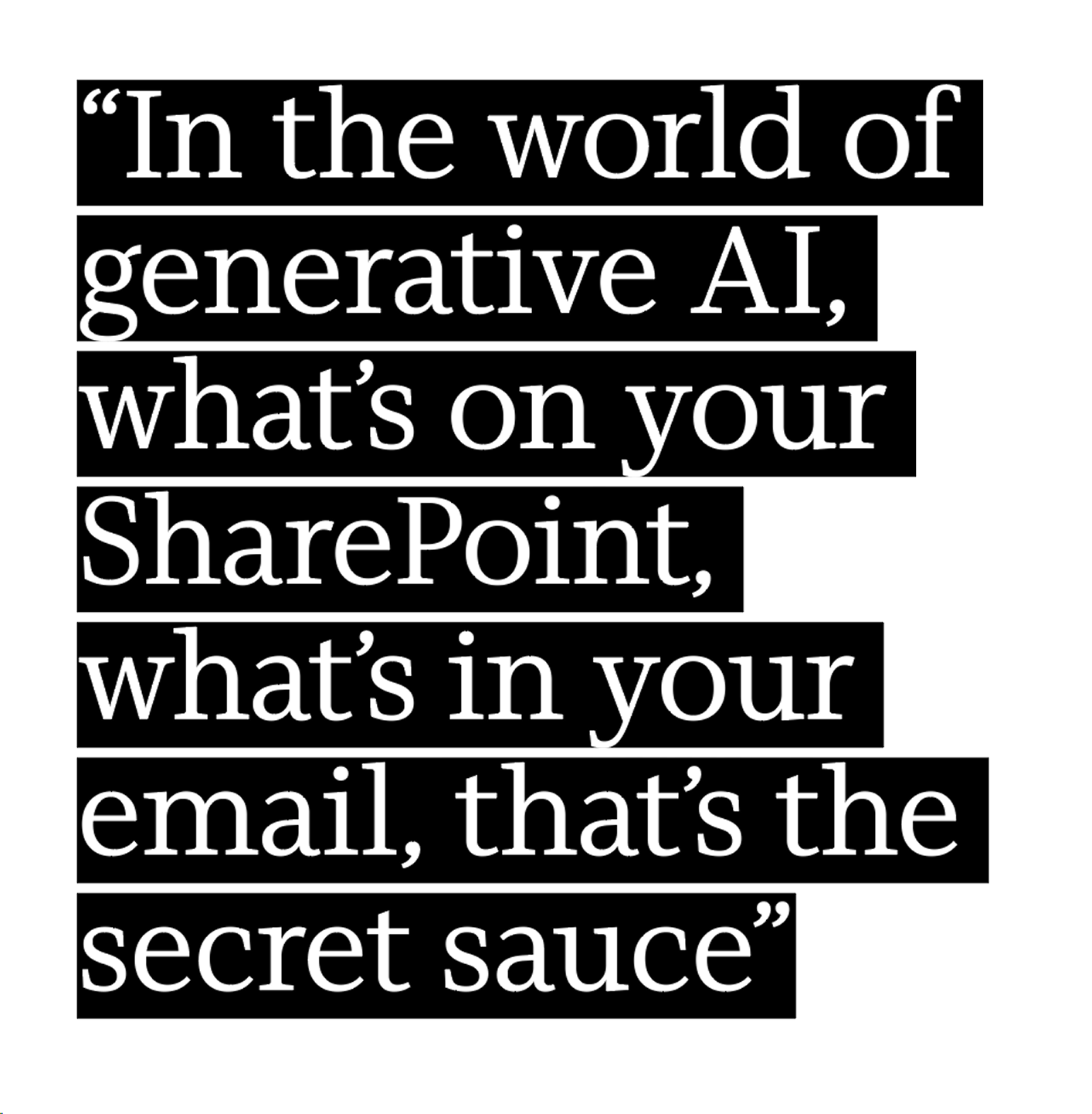
What’s the agentic web all about?
Key terms to help you understand this new AI-powered version of the internet
Agent (A)
An AI-powered helper that can take actions, make decisions and interact with other agents or humans on your behalf. Think of an agent as a digital assistant that’s proactive, not just reactive – able to handle tasks, answer questions and learn as it goes.
Agentic web (B)
An open ecosystem in which AI agents act on behalf of users – from handling complex tasks to making purchases and collaborating with other agents across different sites and services. The next evolution of the internet, the agentic web will make online experiences more personalized and efficient.
Agentic memory (C)
An agent’s ability to remember things over time, like your preferences, past conversations and tasks you’ve asked it to do. Instead of starting from scratch every time, agentic memory helps agents build up knowledge and get smarter about helping you.
Copilot Agents (D)
Specialized AI agents built into Microsoft Copilot that can help with specific tasks like researching, summarizing or organizing information. Designed to work together and with you, Copilot Agents can be customized for different roles and workflows.
Model Context Protocol (E)
A new technical standard introduced by AI company Anthropic that helps AI agents connect to external tools, apps and data sources in a smart and consistent way, even if they’re running on different platforms or models. MCP is like a common language that allows AI agents to “talk to” other systems to get things done.

NLWeb (F)
Short for “Natural Language Web”, NLWeb is an open-source framework developed by Microsoft that lets humans and AI agents interact with web content using natural language. Any NLWeb-enabled site can become an AI app – instead of clicking through menus or forms, you just ask for what you want using natural language.
This is a digital version of a sample feature from Issue 2 of Signal magazine. To explore the full issue, view the complete flip book here.
The designer’s notebook
Carl Ledbetter has been shaping the world for 30 years. As Microsoft’s Partner Director of Design, he is the visionary behind landmarks in hardware including the IntelliMouse, the Xbox and the game-changing Adaptive Controller. He talks us through five influential creations he helped bring to life
The IntelliMouse (1996)
“My first day at Microsoft was 30th January 1995, when I was hired to design a new mouse. At the time, Microsoft was very much a software company, so I expected to pick up a few new skills, meet interesting people and create a product or two and be done. I certainly didn’t expect to still be here 30 years later contributing to a legacy of hardware design.
I soon realized the most important thing when designing products for Microsoft was to understand the customer. With the mouse, the challenge was coming from the Excel team. They were saying that people were producing enormous spreadsheets that were too big to fit on a screen. The only way to navigate around this environment was through scroll bars at the top and bottom and then trying to zoom in and out. My job was to create a mouse that made that easier.
I quickly learned a lot about spatial mapping. When someone is navigating on a screen, their mind maps forward, back, left and right in a certain way. It’s abstract and subconscious, but you cannot mess with that as an industrial designer. If a product looks good and brings beauty to what you’re doing, that’s great, but it needs to be intuitive, and it must have a functional value.
With that in mind, I started thinking about how to put control directly in the user’s hands. I created sketches and built prototypes with all these different ways to zoom in and out, to pan, to scroll… Eventually I determined that a wheel was probably the best way of doing this: it was adaptable and flexible and fit naturally within the mouse’s shape. We refined it, shaped the mouse to fit the hand and made the wheel feel as intuitive as possible. The result was the IntelliMouse – which went on to be Microsoft’s most popular and best-selling mouse for years. I’m proud that it set the bar for ergonomics, and it is great to see the wheel still deployed in a lot of mice today. When people ask what I do, my wife always jokes, ‘Yeah, he invented the wheel.’”
ActiMates Barney (1997)
“Six months into my role at Microsoft, the hardware division made a bold move, acquiring a company pushing the boundaries of interactive technology. Together, we launched a new generation of toys – starting in 1997 with none other than the beloved purple dinosaur Barney. The reason I’ve included ActiMates Barney in my selection is because it’s another example of where Microsoft was ahead of its time.
The industrial design aspect was limited – we created intuitive receivers that fit into both the ActiMates ecosystem and the home – but the experience was incredible. Kids could play with Barney on his own – you could cover his eyes and he would say, “I can’t see you” and then you’d pull your hand away and he would say, “there you are” – but the real differentiator was when you connected him to a PC. There was a game which asked you math problems and, as you were going through them, Barney could help you because of the connection between the game, the PC and the toy. If you plugged a receiver into your TV, you could watch the Barney & Friends show with the toy next to you and it would respond to whatever was happening on screen. It was like having a virtual friend there for these kids. That didn’t exist before.
ActiMates was an ambitious and forward-thinking entry into consumer entertainment and helped Microsoft build momentum in the PC gaming space. It also proved that Microsoft technology could be more than just functional – it could be magical.
Like pretty much everything I’ve been involved in, it is part of a quest to try to do things that impact people in new ways. Of course there’s a business behind these things, but that’s never the starting point. The beginning is always ‘How do we do something that can really change the way people engage with the world?’ And that’s not a bad way to spend your career.”
The Xbox (2001-today)
“The mission behind these consoles echoes everything I’ve learned over 30 years – to create technology that’s powerful, purposeful and beautifully integrated into people’s lives. How did Xbox come to be? For the first-generation version (released in 2001), we had to be super scrappy: we were leveraging off-the-shelf components to get it out. But what is interesting for me is how we refined it with every new iteration.
One of the first things I did was to work on the controller. The first controller was way too big. It hurt people’s hands, so we used our human factors expertise for the next iteration – it was designed for comfort. We thought about control layouts and worked with female gamers to see what was needed for their hand sizes.
This human-centric design was at the heart of everything we did with Xbox from then on. With Xbox 360 (2005), we started to push what could be done with wireless technology and online gaming. Xbox 360 S was an exercise in reduction. Instead of having all these plug-in wireless receiver antennas and the hard drive on top that looked a bit like Frankenstein’s forehead, we were able to make the console significantly smaller and still build in everything.
We made a misstep with 2013’s Xbox One, we got a few things wrong with that, but it’s like soccer, right? You miss, but it’s all about the recovery. How fast did you bounce back? And Xbox One S and Xbox One X were definitely comebacks. These products are incredible.
I just love the progression. We design for the everchanging landscape of devices and the way people play. Every time we make a new edition, it’s this exercise of refine, refine, refine. So while on the inside we’re adding more and more technological capabilities, on the outside we’re striving to keep it simple. And we’re not done yet. We recently launched Ally X, which is a collaboration with Asus [to create a new line of handheld gaming devices]. This world just keeps getting bigger.”
Zune (2006)
“While it wasn’t the commercial success I thought it deserved to be, Zune was, in many ways, the highlight of my career. There were so many ideas crammed into that music player. It was a physical device but also an entire ecosystem that had a bunch of technological advancements you can see in technology today – it has had a real ripple effect. You could share tracks Zune-to-Zune, Airdrop before Airdrop if you will; it had a PC client so you could listen across devices, Zune marketplace where you could buy tracks and set up playlists and a subscription service, offering unlimited access to millions of songs. Looking back on it, I don’t even know how we did it all in the time we had.
From an industrial design perspective, we were really pushing what you could do with molded resins. If you look at the design of that first device, you can see what’s called a ‘double shot’ plastic casing on it. The first shot was an opaque color, sort of root beer brown, and then over the top of that, we layered a coating that almost made it look like worn beach glass. What that gives you is a depth to the product, thanks to the ways light would come through and reflect off the surfaces. We really wanted to create something that when you held it in your hand, it felt special, not just like a hunk of plastic. We wanted to feel you’re getting a glimpse into this world of music.
Zune was one of the most collaborative projects I have worked on. Everybody was shipped into this small building down in Bear Creek, which is off Microsoft campus down in Redmond. You had marketing, designers, program managers and engineers all jammed into this building, and it felt like this small community of purpose. Everything was about celebrating the art of creating music. There’s a whole case study on Zune that would show how if you can mobilize people with a clear goal to go do something, you can change the world.
While we may not have sold millions, it’s awesome to see the ideas we had in that space play out in different ways, in different businesses and different teams. I love that. There are certainly no sour grapes.”
The Xbox Adaptive Controller (2018)
“In my 30-plus years in design, the product I am most proud of is the Xbox Adaptive Controller, which was designed to meet the unique needs of gamers with limited mobility. It was one of those grassroots ideas that seems to take on a life of its own. You can trace the origins back to the Xbox Elite controller, which allowed you to personalize the device by remapping buttons and controls for how you play. When we were doing some research on what people think of it, we discovered that people with disabilities were modding it so they could play games one-handed. This started us thinking about what more we could do. After a Microsoft Hackathon, we came up with a design that we thought would be even more adaptable and inclusive, but when we started meeting with these players, we found that it provided little value because many of them couldn’t hold the controller. We were being told, ‘The idea of it is right, but the solution is wrong.’ That’s when I first heard the phrase: ‘Nothing about us without us.’ We were being told, ‘Don’t pretend you know what we need and what we want on your own: Work with us.’ This became something I applied across my professional life from then on – don’t be so bold as to design for people whose needs you don’t understand. So, we started working with hospitals and wounded veterans. They tried prototypes, gave us feedback and helped create the Adaptive Controller we know.
It’s not a mass market product, but I don’t think I’ve worked on anything with a bigger impact. We created something that unlocked the ability for people to play games that they could not otherwise, and as a designer, that’s a proud moment. I’ll never forget talking to a wounded veteran who told me that this product changed his life. Before he felt like an outcast, like he no longer fit in, that all the things that he used to like to do, he couldn’t do any more because of his disabilities. But through gaming he found a new sense of purpose and a place where the playing field was even. That was very powerful. Since 2014, Microsoft’s core mission statement has been ‘to empower every person and every organization on the planet to achieve more.’ I can’t think of a product I’ve worked on that better embodies this than the Adaptive Controller.
It’s part of the reason I’m still excited to be at Microsoft 30 years on. There’s always a new challenge. Right now, we are seeing a pivot for the entire industry with AI, and Microsoft is at the heart of that. I, like a lot of people, use AI every day, and it has profoundly changed the way I work. I can get a lot more done. We’re in a constant state of change with technology, and AI is the latest great leap forward. Being in the middle of that, seeing how we work and interact with the world changing, is a pretty cool place to be.”
This is a digital version of a sample feature from Issue 2 of Signal magazine. To explore the full issue, view the complete flip book here.
“I just thought that there’s a better way to do things”
What do you do when you’ve run one of the biggest companies in the world? If you’re former Microsoft CEO Steve Ballmer you set about changing the way people watch live sports…
Surely Kevin Durant couldn’t miss. It was October 2024 and with moments left of the LA Clippers’ first game in its new home, the Intuit Dome, the visiting Phoenix Suns’ star player looked like he was about to change the course of a tight contest.
Durant, fresh from winning Olympic gold with the US basketball team, had secured two free throws following a foul. He has some of the best stats in the NBA when it comes to shooting – netting 88.4 percent from the line – and seemed likely to hit both. But he had never come up against The Wall before. The jewel in the crown of Steve Ballmer’s $2bn sports arena, The Wall is an imposing grandstand of 51 rows of seats reserved for the 4,500 loudest Clippers superfans that has been designed to change the game – literally. Away teams face the Wall for the second half of games, the theory being that it will provide a sizable home court advantage by intimidating and distracting those who come up against it – and it certainly had the desired effect on Durant. He missed both shots. “It was crazy,” Durant said after the game, which the Suns won in overtime. “I was just staring at it the whole time. You’re not used to that.”
The Wall is only one of the things at the Intuit Dome that people are not used to. When we take a tour of the Dome in the off season, it feels like we are coming across something unprecedented around every corner. The club store and food stalls are frictionless, using facial recognition via the Dome’s app to allow you to simply grab what you want and walk straight out, with payment taken automatically from your account. On game days the same system is used to allow people quickly to gain entry to the arena without waiting in line. Not only does every one of the 18,000-plus seats have a built-in USB port for charging your cellphone, but also its own climate control, thanks to a ventilation system that draws air directly from the roof. Noise levels aren’t just monitored as a whole, but for every seat. This is how the Clippers’ management builds up The Wall – if you’re in The Wall section and not making enough noise during a game, you’ll be politely encouraged to up the volume levels or directed to a more sedate spot next time around.
Above the court hangs a 4K Halo board. Covering the better part of an acre, it is the largest doublesided display in any arena in the world, and when staff flip the switch during our tour to turn on its 233 million LEDs we are left blinking as if the sun has just re-emerged after an eclipse.
The arena, which is planned to be the first in the NBA to be carbon-neutral, bears the hallmarks of a man known for his obsession with detail. Over his 30 years at Microsoft, Steve Ballmer helped steer the company through its most explosive period of growth. As CEO from 2000 to 2014, he tripled revenue and doubled profits, overseeing the launch of products like Xbox, Office 365 and the Surface tablet. Having left the company, he purchased the Clippers in 2014 and has delivered the same precision and focus he applied to software to the world of sports. Over a wide-ranging conversation he tells us how he brought the noise…
What was it like, watching an event in the IntuitDome for the first time?
Steve Ballmer: The first event was a Bruno Mars concert and I was mostly just harried as hell, a bundle of nerves going around the building. Bruno played the next night too and I was calmer: we were getting good feedback, people really liked the building. But the first basketball game was very different because I wasn’t worrying about the logistics of the building. I was worried about two things: Firstly, how the basketball-specific stuff, particularly the scoreboard, would perform and, secondly, how the crowd would sound and feel. I sat with my wife, my son and my oldest friends and it was like, ‘Yeah, this feels good. This feels right’. And then I got sad because we lost the game. We actually lost our first four in a row in the building. I’m glad we won our fifth. I’d told the team I’d have to start building a new arena from scratch if they lost that, because this one clearly isn’t working. Our players got a little chuckle out of that.
I get the impression that you spent years as a fan going to games and feeling frustrated by the experience. Is that right?
SB: I just observed things that I thought could be better. The only team I ever had season tickets for, before the Clippers, was the Seattle Supersonics. And yeah, I got frustrated waiting in line for bathrooms and drinks, for sure. I just thought that there’s a better way to do things. And so I mostly came at it thinking ‘How do we do the best job anybody’s ever done?’. I wanted something special for our fans. You can watch our games elsewhere [on TV or streaming services] so a lot of it is about the live entertainment experience. And how do our fans help our team win? What does it mean to have fans engaging in a way that can actually help with winning?
It’s ironic, because wasn’t one of the reasons you bought the Clippers in the first place was because they didn’t need a new arena building – the team was happily sharing an arena with the Lakers and the NHL’s Los Angeles Kings?
SB: Yes. Originally, when I bought the team, I said, ‘It’s great, I don’t need to buy a new arena!’ I looked at buying Milwaukee, Sacramento and Seattle. In all three instances, they needed new arenas and I said ‘I never want to do this. It’s not my area of expertise.’ Then a friend of mine said: ‘Hey, this is not our home. This is the Lakers’ home. How do we have a place that our fans can feel is special? How do we break out of the shadows?’ This was in 2015 and we knew we needed to be out in 2024 [when the Clippers’ 25 year lease at the Crypto.com Arena expired]. So that put us on a firm timeline.
How did you approach the development of Intuit? You’ve obviously developed a lot of products at Microsoft. Was it the same process?
SB: It’s different. It’s not as if I was closely involved in the development of all the products at Microsoft, but with the Intuit Dome I had a very clear vision of what I wanted the thing to be. I’d never been involved in construction projects, even house remodeling, my wife had done all that, I had no experience with architecture, but I knew what I wanted. I wanted a place that would pulse with energy. I wanted a place where the fans would become part of the experience and part of helping us win. I knew we had to have concerts. I knew I didn’t want hockey. Hockey is a great sport, but a hockey building’s never going to be as intimate because the rink just spreads things out. I wanted people to be in their seats. That’s partly how you bring energy. You have to be there. You can’t say, ‘Oh, I’m caught in a line for the bathroom or to go get food.’ So those were design principles. That’s why we have facial recognition in the stores, admission gates and food stands. We put that in place to get people into their seats faster. [Intuit also has three times the number of toilets of the average NBA arena].
How do you set about keeping people in their seats?
SB: Leg room is a big issue. I want to give people leg room because if you don’t give people leg room, you’re losing their attention on the game, you’re driving them to stand up, walk around, whatever, but the more leg room people have, the further back people get pushed. So we had to sort of balance that. Same thing with headroom. I didn’t want people to struggle to see over the people in front of them.
Did you get involved in the discussions surrounding tech in the stadium?
SB: I told the guys all along the way, ‘I don’t want technology in here for technology’s sake.’ This is about being the greatest live entertainment experience, particularly for basketball, in the world. We decided to connect power to every seat so people can charge their phones, but that opened up other interesting options – we could also put lights in the seat, we built a mini video game controller into the seat so you can interact with the big board, because people like to do that. We can do a lot of different things and that all came for free once we had power in the seats. I had another design principle: we’re going to treat people who sit up top and pay less for their seats as well as we treat people down below. They have to have a good seat, they have to have legroom, they have to have good access.
One of the major features of the stadium is The Wall. To what extent have you seen that influencing games?
SB: If you look objectively at the statistics when it comes to free throw shooting percentages by the opposing team when facing The Wall, it’s the lowest in the NBA by an interesting margin. So that worked.
And technology plays a role in The Wall too, I believe…
SB: It does! How do you get people to make noise and be in their seats? We have proximity sensors in the seats. We can tell whether you’re in, out, how much time you’re in your seat during the game. We have something we call sound cameras. So we don’t hear what you’re saying, but we can tell how noisy you are, and can tailor a rewards system in order to try to use the infrastructure to get you to be noisy. We have a thing that we copied from airports where two people standing next to each other are looking at the same screen, but see different things. We have one of those at The Wall entrance and at the moment it says say ‘Hey, Joe, welcome’. Now that we have a reward system, we could say ‘You didn’t make much noise that last game! Get it up this game and you get a free hot dog’. We’re still playing with what the rewards infrastructure looks like, but everything’s about getting people into the experience.
What about players – how have they reacted to the new building?
SB: I knew I wanted to have the best player spaces in the NBA as a tool to help boost results, but also recruitment. We want to tell the players on our team – and for the word to get out around the league – that we invest in our players, this is a good place to go play. Obviously if players are getting paid a lot more money someplace else, they’ll go, but for those on the margin, the fact we care more is the message. For example, the guys want to have long coats even though it’s LA. That style drove part of the design of a locker we made. You need room for lots of shoes, because a lot of these guys have lots of them, so every one of our lockers holds 32 pairs.
Have you seen other teams taking note of what you’re doing and then starting to copy it?
SB: We certainly have had a lot of NBA owners come through and look at our place, particularly if they’re going to build a new arena. It’s my belief that you’ll see other stadiums built over the next five to 10 years that have “Walls” or that kind of intimacy and steepness in the bleachers.
You’ve said you want to create an experience of watching a game live that has the best elements of watching at home. What do you mean by that?
SB: You’ve got to have a great view. You have to have leg room, and the ability to run to the bathroom or grab a drink quickly. You want to be able to see some of the statistics that get overlaid on the broadcast. We don’t want people looking at their phones to get these because if people look at their phones, they’re distracted from the game. So that’s why we built the controller into the seats. That’s why we have a huge scoreboard. The goal is to not drive you away from the live game experience. What is it that people crave when they come? It’s the energy, it’s the excitement. And perhaps increasingly so, given that we spend so much of our time just buried in screens.
You’ve done some incredible things in your life. How does buying the Clippers and then creating this stadium compare?
SB: Will anything I ever achieve or do match the kind of importance and complexity of growing Microsoft from 30 people and $2.5 million in revenue to 88,000 people and $88 billion revenue? No, of course not. With that said, this [buying a basketball team and building a stadium] is a great opportunity to make a civic contribution. But it’s also, for me, just the joy of watching basketball. I love it and I love being involved. I don’t try to drive too many decisions about who’s on the team and who should play, that’s on the coaches, but I ask a lot of questions. In a sense, it’s a little bit like me managing engineers. I learned to ask a lot of good questions. For pure fun this blows Microsoft away for me.
How do the worlds of sport and business compare?
SB: Business people think they’re highly accountable, but compared to sports people? It’s not even close. Every 24 seconds, you either score or you don’t score. You’re getting your performance reviewed in real time. If the coach doesn’t think you’re doing a good job, he pulls you out of the game. That’s a performance review. So everything is more intense, more accountable.
Are there any similarities?
SB: One thing that’s like the software business, at least the software business of old, is we do major version upgrades once a year. Every summer we pivot the roster, change anything we’re going to do differently in the arena. That’s the major upgrade. We do minor upgrades at the trade deadline. That’s the next place where people redesign the product, if you will. And I guess in the world of agile development, the coach is continuously making upgrades and changes in the way we play. So yeah, it’s got that notion of rapid change that was so wonderful in the software business.
You were famous at Microsoft for being very focused on the numbers. What’s the metric in basketball that you track that might surprise people?
SB: There’s a lot of data on the basketball side, obviously, but what we’re doing now is what I call a user sum. We’ve got the old revenue sums – where the revenue comes from – but because you essentially log in when you come into our building we can chart that. How many times does that fan come back? Why are they coming back? Were they noisy? Did they bring a guest? What did it all look like? And what do we do to improve not just the fan experience, but the fan involvement? At Microsoft you’d have these Windows fans, and not only were they good customers, but they’d help spread the word to others. They would help Windows succeed. Clippers fans need to help our team succeed. And so we came to this notion of having a complete map of their behavior.
What has been your most memorable moment in the Intuit Dome so far?
SB: It’s funny, but on this stuff I have more of an emotional memory than I do specifics, but I’ll give you two. Our first victory, after four straight defeats, that’s a top memory for me, no question. The second is the game we lost in the 2025 playoffs [game four, against the Denver Nuggets]. We were tied with 13 seconds left and the Denver Nuggets’ best player, maybe the best player in the world, Nikola Jokic, goes to take a three-point shot. He air balls it, but one of his teammates catches it midflight, dunks it and with less than one second left and they win the game. There used to be a show in the US called Wide World of Sports and they always talked about the joy of victory and the agony of defeat. And I guess I have one of each of those moments etched in my head. I would say those two things, but also opening night. Just having my closest people with me and being able to say, ‘Yeah! We built this’
This is a digital version of a sample feature from Issue 2 of Signal magazine. To explore the full issue, view the complete flip book here.
Why on Earth is Microsoft making a magazine?
In her 1939 poem “Upon This Age,” Edna St. Vincent Millay bemoans the ever-increasing speed of information and facts, writing these prophetic words: In 1939!!!
And here we are today, each of us subjected to a torrent of news and information, texts and emails and social media feeds, conversations and team chats, news articles and opinions, stock prices and analysis, numbers upon numbers, words upon words, and still, no loom. And too often, the sources of news we’ve counted on now tell us what is happening, but not always what it means, or why we should care, or who we should trust. As the Chief Communications Officer for Microsoft for more than 15 years, I’m both a victim of this deluge of facts, and a contributor to it. I regularly read three or four daily newspapers, mostly get through both the New Yorker and the Economist, have news alerts, scan forums and aggregator sites for tech news, listen to probably ten podcasts and at the end of the day often wonder… what was true? Through this lens, welcome to the first edition of Microsoft Signal, a magazine for senior business leaders interested in hearing directly from Microsoft and from each other. How is technology changing the way we work? What are best practices, by industry, on how to thrive? Who is doing interesting work? What does the future hold? In this changing landscape of media, each of us has choices about where we go for news, information, context. We hope you’ll appreciate the chance to hear from us, in areas where we have expertise, and from your peers on the topics most important to them. Enjoy this first issue! And let us know what else you might want to see.
Frank X. Shaw,
Chief Communications Officer, Microsoft
This is a digital version of the opening letter from Issue 1 of Signal magazine. To explore the full issue, view the complete flip book here.
“It’s not a new technology wave, it’s a new way of working”
Marcus Fontoura, a Microsoft Technical Fellow, Azure CTO and author of the new book A Platform Mindset, sits down with Microsoft’s Chairman and CEO Satya Nadella to discuss building a culture of innovation within a platform company, and the future of the firm in this accelerating age of AI computing.
Marcus Fontoura: Satya, thanks for being here. One thing I’d like to discuss with you is the culture of organizations that are embracing AI at an astonishing rate. What is the advice that you have for leaders who want to drive transformation in their organizations?
Satya Nadella: When I think about the times we are living in, this is one of the largest transformations I’ve seen. It’s not a new technology wave, it’s a new way of working. Look back at the pre-PC era. How did we do even such simple things, like build a forecast? We had no digital spreadsheets or email, so we had to fax interoffice memos around. And little by little a forecast emerged. Then, suddenly, PCs became standard issue. We started attaching a spreadsheet to an email. People simply entered numbers, and you had a forecast. The work, the work artifact and the workflow all changed. That’s what’s happening now with AI. Knowledge work is changing.
If somebody came from Mars to observe my work, they’d think I’m an email typist, but the reality is, I’m doing knowledge work. And that knowledge work now will be accomplished with the help of AI and AI agents.
When I prepare for customer meetings today, I go to Researcher for Copilot. It’s like having a really smart analyst who composes everything from the web, from SharePoint, from my CRM database, and brings it all together so that I’m briefed. Instead of sending five mails, getting six documents, and assembling all of that information, it’s now one click away. Same thing with data analysis. It will mean a significant change to what I describe as the new production function for knowledge work. Whether it’s tech and software, or health care, financial services and even the back-office operations of any manufacturing company, production is going to be fundamentally redone, rethought. It’s going to be more and more efficient. The mobile and cloud revolutions were big, but they were incremental. We’re doing things 10x faster now. That’s convenient but it does require significant change. And talking about that, Marcus, I love your new book, A Platform Mindset, and the way you framed it. You’ve seen this from a variety of vantage points – from Microsoft to Google, to Stone. What’s your take on what’s happening and what is the big takeaway for you?
MF: I wrote the book as an examination of how culture can leverage the best skills in an organization to foster innovation. Platforms have a multiplier effect because they can help us imagine new scenarios and new businesses and then scale them quickly. The title was inspired by the growth mindset you’ve cultivated at Microsoft. How do you create this standardization in the platform so that teams can focus on creative and innovative solutions?
SN: Your perspective is beautifully said. More and more of our work is driven by digital platforms. An organization improves the more it integrates continuous improvement into the platform. The bottom line is you need a leadership mindset that cultivates this. Investment decisions are not about any single feature. It is about a platform that enables you to build features faster. That’s the biggest change. More and more of our work is being driven by these digital platforms. One thing you learn very quickly is the integrative effects; you want to make continuous improvements in the platform to leverage your investment.
MF: I write about an engineering culture that I like to call fearless execution. I want to empower the engineers to be able to just write code and put the code in production without being afraid that they will be singled out for problems down the road. We have such rigorous checks and balances across the stack, throughout the platform. Problems will happen but I want to encourage confidence individually and as a team. I’d love your take on this.
SN: I love all those terms you use. In fact, I’ll add one more, which is toil. As leaders, we are responsible for finding the toil of people, our engineers. It’s frustrating if they are having a tough time making code changes and getting them deployed because of all the manual processes. The key thing is to standardize, standardize, standardize; automate, automate, automate. Build processes that you can really depend on so that when you push the execute button there will be lots of checks, there will be lots of tests. And even when you deploy, you will deploy to a small percentage of users. It will automatically revert if it doesn’t work, and it will give you a notification to fix something. There’s so much rigor that has been applied to standardization and automation to help make sure that you are not going through so much toil. If we can get that, then we’ve enabled our people to produce more and more innovation. We can focus on how we are going to get better. Something obviously will go wrong. That’s where you embrace the red. You want to see scorecards that are mostly red, so that you can go back and say, what should be standardized? What should we build that is robust? How should we make sure our flighting system or experimentation system allows us to test things on small sizes before we have a massive blast radius?
MF: I love that. I want to ask you about innovation. We all live in this world of tight budgets, and we need to do the next thing, the next feature that our customers are demanding. On the other hand, you also have to plan for the future. How do you balance that?
SN: The constraints are very real. There are time-to-market constraints, cost constraints, and many others. But leadership is all about picking, deciding. It’s not about doing all things. It’s about making choices on what to do. What will add value for customers and what will competitively differentiate. Start there, but then really use the platform effects to your advantage. One of the classic things we all fall into is the trap of, “Oh no, my competition is doing x, now I’ve got to do x”, so therefore I need incremental revenue. You’ve got to reframe that: in order to do x to match a competitor or customer expectation, how can I do that better than anybody else because of the platform investments I’ve already made. Build that strength. And so, we have to become very good at constraint solving, because, of course, all of us can be great if there are no constraints. But the reality of leadership and business is all about managing constraints and yet remaining competitive.
MF: It’s like using platforms and the leverage that you get from platforms to create efficiencies that you can then reinvest to innovate; to do things in a different, more productive and scalable way.
SN: Exactly. You had a good reference in your book. You called it the bicycle for the team. You want to talk a little bit about that?
MF: Yeah, the idea is that there is always this time-to-market constraint. But think of a long race, a marathon. If I start running in front of you the fastest I can, you should probably stop to build a bicycle. It’s worth “wasting” the time needed to build long-lasting bikes – the races are long, and those bikes will help us win not only the current races, but also the ones we cannot yet foresee. I’m convinced technology companies need generic, reusable platforms to have a competitive edge.
SN: It’s a nice metaphor. I know Steve Jobs had that metaphor of computers being like bicycles for the mind. And this is another way to say it. Platforms are bicycles for teams to get ahead. That’s a great way to describe the leverage of a platform mindset.
MF: This requires a cultural change. How would you go about doing that, and especially in a large organization?
SN: Ultimately, I think a lot of leadership challenges come down to not being clear. So having that ability to bring teams together and drive clarity around what the ultimate goal is, is critical. It’s not about any one thing. It’s about ultimately doing something of significant impact and value to customers, and being able to get back to framing that with clarity, creating the capability that is needed for it, which is, how do you build? In order to win that race, let’s make the right investments and really constraint solving for what ultimately is the winning play and that building the right expertise in the team, the right platforms in the team to go after it, and then bringing, quite frankly, culture and the energy to your point. And so, ultimately, I think of this as getting clarity on the concept, having the capability to go after that concept with this platform leverage, and then I would say the culture that allows you to build that capability to go after the concept. I always go back to those three Cs.
MF: Thank you so much, Satya. I think this was great.
SN: Fantastic. I’m so glad you wrote this book. And I think this would be a very useful thing for a lot of people, because, quite frankly, as both computing and AI becomes so much prevalent in all walks of life, in all organizations, I think this idea of really empowering people with the latest tools and then having a platform mindset, I think will allow us to drive, ultimately, what is our collective goal of driving economic value and growth all around the world and so I’m really looking forward to it.
This is a digital version of a sample feature from Issue 1 of Signal magazine. To explore the full issue, view the complete flip book here.
“It was a leap of faith, but after six months we saw a return”
Over recent years Vodafone has revolutionized its business using the power of machine learning and generative AI. Scott Petty, Chief Technology Officer at the telecommunications company – which operates in 15 countries and partners with mobile networks in over 45 more – explains how they did it and offers his ten-point plan for others wishing to follow suit.
Vodafone began work on AI and machine learning back in 2018. Scott Petty, the telecommunications company’s Chief Technology Officer, says that the starting point was to build an underlying data platform, which he describes as “a data ocean,” to ingest all of the information across the business. “Our data infrastructure – which was curated, maintained and understood – gave us a really strong starting position to build generative AI applications,” he says. “With GenAI the quality of the data will dictate whether the application is usable and will drive improvements.”
Rather than attempt to build their own data infrastructure and AI systems, Vodafone decided in 2018 to dedicate resources to the areas that directors felt would really make a difference. “We made a very deliberate decision to focus on the application layer sitting above our data, not developing, say, our own large language models,” says Petty. “So, we formed partnerships with key hyperscalers, like Microsoft. That minimized our investment in the infrastructure layers, which we felt was going to consume a lot of CapEx, and allow us to spend our money on applications that we felt would really enable our business and generate value.”
Petty and the Vodafone team split their application strategy into three components: internal productivity, external interfaces and building generative AI into their products. The third of these is a work in progress, but the first two are already well-advanced and have generated significant learnings. “We find thinking about it across those three pillars is a very effective way to stop being overwhelmed,” says Petty.
The first pillar, he says, involved “harnessing the benefits of generative AI to get rid of the drudgery of routine administrative tasks and to help accelerate processes.” This involved deploying Microsoft Copilot to 50,000 users across the organization. “I have to be honest, this was a bit of a leap of faith, but after six months we really saw a return economically,” he says.
Petty cites the use of Copilot across Vodafone as a prime example of generative AI in action, along with more specific tools such as Power BI for business planning and GitHub Copilot for software developers. While the investment in generative AI could be seen as a risk, Petty says this was mitigated by the speed of the returns. “With a normal IT project you can spend a year deploying something and then a year training people and then eventually in the third year you get some value,” he says. “We’ve seen with generative AI, you deploy very quickly, people get up to speed very quickly and you start getting value much faster than you would in a traditional IT project.”
We asked Petty what he learned through rolling out AI internally and in external interfaces – these are the tips he gave us for anyone looking to do the same…
1. Share the power
Petty believes that the success the company has had in increasing productivity via generative AI is down to the efforts it made in training. “We have champions in every business unit that show people how to use GenAI technology,” he says. “I do it myself. I show how I use Copilot to prepare for meetings, to create external briefings, to monitor all the things that I need to track.” He highlights the danger of assumed knowledge. “Don’t presume that because you’ve given your employees a new technology tool that they’re going to immediately benefit from it,” he says. “You’ve got to make sure that you’re educating them.”
When the GenAI tools were first deployed, says Petty, there was an even three-way split among the workforce between those who found them incredibly useful, those that saw some use and those that didn’t see any value at all. “When looking at that final third, who didn’t like it at all, it turned out they didn’t really know how to use Outlook, Word, Excel, PowerPoint or Teams beyond the basics,” he says. “People assume everyone has learned how to use these tools and no one does any training on them, but to unlock GenAI you need to be using those tools effectively. As we started to level up their skills on the basics, we could then show them how Copilot could make them more efficient in their dayto-day jobs.”
2. Go all in
Today the use of generative AI is seen as a positive by most in the company. Petty also thinks Vodafone benefited from making the tools available companywide. “We didn’t want to cherry pick and give it to a few people in, say, finance or legal, everyone needed these tools,” he says. “It’s become a bit competitive internally,” he adds. “We saw cases of different business units comparing how much value they were getting from [GenAI] versus other teams”.
Another important element of the internal pillar was creating applications that would be useful for members of staff. “Our most broadly deployed internal app is called Ask HR,” says Petty, referring to a chatbot that can answer an array of employee questions from how to complete leave forms to what the company’s policy is for working abroad. “We used to have a traditional chatbot, but it had low resolution rates, so you ended up needing a contact center just to support your internal staff,” he says. “The new app has really high uptake across the business. It’s optimized support for our 100,000 employees and has given us tangible productivity returns.”
3. Supercharge your sales
“In every company you have a basic conundrum: The more salespeople you have, the more you’re going to sell, but if those people aren’t working efficiently, you may not be able to justify their costs,” says Petty. A huge percentage of a Vodafone salesperson’s time used to be spent generating proposals, with the process of meeting a client, gathering their requirements and generating a proposal document to send back to them taking weeks. “When we analyzed all these documents, they were pretty consistent with each other,” he says. “So we thought this would be a great place for the application of generative AI.”
The team developed an application that would allow salespeople to generate such documents in real time during meetings, by using generative AI to cherrypick from proposals created for different clients across the business to create something bespoke for the new client. “We were amazed with both the quality of the proposals and how keen the sales team were to use the tool,” says Petty. “We then realized that if we integrated it into Teams, we would make them even more productive because you now have Teams’ capability of interfacing with the support people, the systems engineers, the presale support person, etc. We were suddenly leveraging the power of both our people and technology.”
4. Support your support team
“Our non-GenAI chatbot, TOBI, was OK at answering pretty standard questions, such as ‘What’s the price of roaming in the United States?’, but not very good at more difficult questions or longer conversations,” says Petty. The company used generative AI to create a “SuperTOBI”. It featured huge improvements in comprehension and, as a result, the percentage of inquiries that could be solved without an employee needing to get involved.
“When talking to a chatbot, most people get annoyed, because it doesn’t really understand what they are asking, they give up and ask to speak to a person,” explains Petty. “With generative AI, users felt they were having a conversation. SuperTOBI could suddenly understand what people were asking, and even if it didn’t know the answer, it could ask for more information to help draw that out.” The company was even able to use the chatbot to generate sales. “So now when you ask the chatbot about roaming rates in the U.S., it not only answers you but offers you a proposal,” says Petty. “It will say ‘Did you know that for five pounds a day you can have roaming for 30 days? Would you like to place that order now?’ We can complete that whole journey through generative AI.”
5. Go beyond the chatbot
It used to be the case that while customers who had called a Vodafone contact center were answering security questions, call handlers were frantically scanning through different screens to work out things like who was calling in, whether they had called before, how long they had been a customer for and what services they use. Now an app dubbed Super Agent does this for them, providing a summary in moments. “They can start the call by greeting the caller by name and asking questions like, ‘How’s it going? Have we resolved your smartphone problem?’,” says Petty. “The caller thinks ‘They actually know who I am, that makes a nice change’.”
Generative AI is also used to transcribe the conversation, which it summarizes along with every other interaction the user has had either on the phone or via the chatbot, meaning the agent no longer needs to multitask and can focus on having a meaningful conversation. Petty says that as a result resolution rates are much higher, as is the level of customer satisfaction, which is judged by NPS (net promoter score) rates, which Petty says have gone from minus numbers to plus 30. “It is really rethinking the way that we do customer care and customer service,” he says. “Digital is not just a cost-efficiency play, it’s actually a quality play and can improve your customer service if you get it right.
6. Create an ocean of data
Petty believes that the success Vodafone has had with generative AI is down to the quality of its “data ocean” but admits that creating it wasn’t easy, pointing out the difference between structured and unstructured data. The former was in the company’s CRM and core transactional systems and Petty says that harmonizing it was “a heavy lift” but that “once it is done it is done”. The harder part was the unstructured data, which was stored in employees’ SharePoints, network drives or email.
“When we first launched a GenAI chatbot for our FAQs, we were really disappointed with the results,” says Petty by way of example. He describes how, despite having documents on everything from where to find your SIM slot to how to upgrade devices, the AI could not always generate satisfactory answers. Petty says that you can think of all this unstructured data that the AI is searching across platforms as one big bucket. “The AI gets confused because in this bucket it’s got 27 versions of a smartphone document; it doesn’t know which one is the right one.
7. Clean up your act
To combat the problems of confusing the AI, the team invested in lifecycle management, building an application that could encourage individuals to clean up their data act. “The tool says, ‘Hey, you’ve got two gigabytes of data on your SharePoint. It looks like 80 percent of it hasn’t been used for the last year. Can we get rid of it?’” explains Petty. “The more we did that, the higher the quality of the output from generative AI. The mistake I think most companies make is putting all the effort into their structured data. They forget about their unstructured data, because they’ve never had to worry about it in the past, but in the world of generative AI, what’s on your SharePoint, what’s in your email, that’s the secret sauce: That’s the intelligence that you’re trying to unlock and use effectively.”
8. Classify your documents
Securing sensitive information is another issue – the AI needs to know what is appropriate for certain users as it might otherwise surface sensitive financial records or classified information. “We have a four-level system in Vodafone that we use Office 365 for,” Petty says. “You tag every document. C1 means public, C2 means generally available, C3 means can’t be shared outside the company and C4 means confidential. As long as you tag your document correctly, Microsoft’s GenAI will apply the right rules and the right controls to sit around that.”
9. Act now
While Petty warns about getting sucked into “the hype cycle” around generative AI, he does believe that businesses yet to engage with the tools risk being left behind. “Generative AI is going to transform every industry in the same way that the internet and mobile apps did,” he says. “It is probably not going to happen as quickly as the hype cycle says, it could take three to seven years, but in that window, the way businesses run will fundamentally change.”
Petty believes there is a window of opportunity for companies to capitalize on the adoption process. “The trick for leadership is to work out where AI is going to add the most value soonest in their industry and unlock that value quicker than their competitors,” he says. This will be achieved by businesses limiting focus to a few areas that have the potential to scale. “There’s so much hype about GenAI that I think a lot of businesses are not quite sure how to get to scale,” Petty says, adding that he’s seen a lot of companies that are running as many as 500 proofs of concept (POCs) across their business. “I think it’s important to ask how many use cases you have with 10 million users or 20 million users,” he says. “I’d argue that without that you’re not really extracting value from generative AI. You need to get to scale in a small number of cases to unlock value, not run hundreds of POCs that never really deliver into operational benefit.”
10. Stick to what you’re good at
When asked for his final piece of advice, Petty talks again about the dangers of companies getting drawn into sinking huge amounts of money into the technical infrastructure instead of concentrating on their own area of expertise. “My fear for many companies is that they focus in the wrong place,” he says. “They talk about how many processing chips they’re going to buy. They talk about training their own large language models or doing their own fine-tuning. I think they’re making a mistake; they should really focus on the application layer. That’s where the value comes from. You can rent all the infrastructure you need from Microsoft, Google, Oracle or the other companies spending a large amount of CapEx to build that. If you can create, say, a 15 percent productivity increase over your nearest competitor by using Copilot, then you can grow faster than them. It’s a huge competitive advantage.”
This is a digital version of a sample feature from Issue 1 of Signal magazine. To explore the full issue, view the complete flip book here.
Changing the game
Can artificial intelligence help level the playing field in sports? A Barcelona soccer club, an international group of students and a tech start-up are attempting to find out
Club Esportiu Europa’s home stadium is a delightfully no-frills affair. The Nou Sardenya soccer ground in Barcelona’s working-class district of Gràcia is flanked by apartment blocks and a busy highway. Bleachers line one side of the artificial pitch – which hosts matches for the club’s 14 teams, from the men’s and women’s senior squads down to junior level – and terraces for standing fans line the other three. While the nearby Camp Nou stadium, home to FC Barcelona, will soon reopen after a recent $1.6 billion renovation with an expanded capacity of 105,000 spectators, the Nou Sardenya can hold only 4,000. At the new Camp Nou, VIP box sales alone are projected to generate $33.5 million a year. At the Nou Sardenya, meanwhile, the only difference between the VIP seats and the regular ones is a thin cushion on the hard plastic seats.
Yet when given the opportunity, the Nou Sardenya can generate an atmosphere like no other – and right now, three minutes into the game against Real Racing Club, the fans of Europa women’s team are celebrating a corner kick with surprising fervor. As winger Júlia Gómez prepares to take the kick, she crosses her arms to signal her intentions to her teammates. The majority of the team runs into the box, drawing opposition players with them. But the ball is rolled to the near side where captain Pili Porta meets it, arching a perfect shot into the top corner. The crowd erupts, its celebrations rattling the windows of the apartment block that towers over the south stand.
Fans of Europa haven’t had much to cheer about in recent years. The men’s team was one of the founding members of La Liga, the highest division in Spanish soccer, but has since slipped to the fourth tier of the country’s league system, overtaken by clubs with bigger stadiums and budgets. Last season, after a disastrous run of results, the women’s team was relegated from the second tier in which it has played for most seasons since it was founded in 2001, to the third – raising real fears about its future. “In women’s football in particular, relegation can mean disaster,” says Europa’s coach María Victoria Haces, known by all at Nou Sardenya as Nany. She explains that clubs can get locked in a downward spiral, with the loss of revenue and prestige following demotion leading to a mass exodus of players and staff, which can often lead to further relegations. “You see so many relegated teams disappear within a year or two,” she says. Assistant coach Lucía Martínez agrees. “I think the relegation made us think about what we were doing and the things we need to do better,” she adds. “It also makes you look for new ways of doing things.”
This season, Europa has indeed tried something different – and it seems to be working. As expected, the team lost some key players and members of the coaching staff after relegation. Yet rather than sinking to the foot of the table, as many had feared, when Signal visits the stadium in March 2025 Europa is flying. With seven games of the season to go, the women’s team sits near the top of the table, locked in a three-way battle for promotion. One of the new things the club has embraced is the use of AI. And the goal that sparked the window-rattling celebrations may well be the result of the new approach.
Backing the underdogs
The arrival of AI in sports has threatened to widen the gulf between the elite teams and the rest of the pack further. Clubs like FC Barcelona are investing huge sums in AI, and they seem to be paying dividends. One insider says that following machine learning analysis, the starting positions of the FC Barcelona men’s defensive line was moved by the tiniest of margins in the run-up to the 2024/2025 season in the hope of winning more free kicks by catching opposition players offside. In the first half of the season, the team won 201 free kicks this way, more than twice as many as any other major club in Europe.
But an initiative led by Founderz, the new sponsors of Europa’s women’s team, is trying to prove that you don’t need to spend millions to get good results. Founderz is an online platform that uses AI to bring the learning, collaboration and networking opportunities available at the world’s best business schools to the online world. The company was initially approached by Europa to simply sponsor the team’s shirts, but the joint CEOs Pau Garcia-Milà and Anna Cejudo soon sensed an opportunity for a deeper collaboration. “We became fans,” says Cejudo, who played soccer herself as a teenager. “And like all fans you want to do what you can to help the team. Europa doesn’t have huge resources and we thought AI could bridge that gap.”
“The goal is to use AI tools that are available to everyone to provide the team with the insights they need to be competitive,” adds Garcia-Milà. “Can we use these tools, that weren’t available two or three years ago, to affect real change? Can we help?” Their efforts to assist the team began with Founderz building an AI model that the coaches could interrogate using Copilot. “There’s a lot of data in football at every level,” says Garcia-Milà. “We fed in match reports, statistics on running speed, how goals were scored, video… We showed the model to Nany and the team at the start of the season and told them how to interrogate it via Copilot.” The team could ask the AI questions such as: Who is the fastest player in the team we are due to play next weekend? What is their starting line-up likely to be? Where are we losing possession? Where do the moves that lead to our goals usually start? “The coaches seemed really impressed, but they didn’t use it,” says Garcia-Milà with a laugh. “I’d ask them ‘How are you getting on?’ and they’d say ‘Fine’, but I could see exactly how many queries the model had fielded. And it was none.”
Rebooting soccer
The reason for this initial lack of engagement with Copilot was time. Alongside coaching the women’s first team, Nany is also sports director at Europa, and a lot of the staff have other jobs to supplement their modest income from soccer. “We didn’t want to force things,” says Garcia-Milà. “We thought this could be useful, but we know the realities of the workload of everyone in the club. So we left it.” The project seemed to be over before it had begun – but as in all good sporting stories, salvation came just in the nick of time. A group of students who had been using the Founderz platform reached out to Garcia-Milà; they had heard about the company’s involvement in Europa and wanted in. Together they created a new way of working in which the students became researchers, interrogating the data using Copilot to produce reports to help the coaches prepare for matches. “They knew the Microsoft tools, they love football and Nany was super open to the idea of them being involved,” says Garcia-Milà. “It was the perfect match.”
Moneyball meets Ted Lasso
Sitting at the table in Europa’s office it is easy to see why Endika Alonso, Angela Blanco, Valeria Coto, Álvaro Rivera and Daniela Pérez-Pasten make such a good team. They are from different countries – Spain, Bolivia, Costa Rica, Chile and Mexico respectively – but have a shared passion for soccer and the potential of the technology, and talk about both with an infectious enthusiasm. “If we do this right, we can prove that these types of tools can help a team without all the resources in the world to compete like a really big club,” says Rivera. “At Europa’s level you can really see the difference between clubs that have money and those that don’t,” adds Coto. “I believe that this can level the playing field.”
Every week the research team receives a raft of data from the coaching staff and external sources. It can include everything from voice or text notes from Nany and the team with ideas and observations to GPS data from trackers in the players’ kits and videos of opposition teams. This is all fed into the model and the researchers then interrogate that data in different ways to create an easily understandable report for the time-poor coaches.
“Like football it is a mixture of art and science,” says Rivera. “The art is learning how to ask the right question of Copilot, the prompt that yields the most valuable insights.” The researchers then compile the best findings, such as profiles of the opposition, suggested line-ups and possible areas of advantage, into the report. What the coaches do with that information is totally up to them. “This project is Moneyball meets Ted Lasso,” says Garcia-Milà, referencing the 2011 biopic starring Brad Pitt and the feel-good soccer comedy featuring Jason Sudeikis in the title role. The former, based on a nonfiction book by Michael Lewis, looked at how a baseball team used statistics to assemble a competitive team on a limited budget while the latter was all about the importance of communication in turning a group of individuals into a successful team. “You need the human interpretation of that information to bring it to life. That’s Nany’s genius.”
Pérez-Pasten says that the reports are improving all the time, thanks to feedback from the coaches. “You keep going, but dig deeper,” she says. “The more we learn, the better we can get.” Blanco agrees. “A football team doesn’t come together overnight, we need to work at it,” she says. “Every week the reports are getting better because we are getting more data and we are learning what we can do with it.”
One of the areas the team decided to focus on was set pieces: dead-ball situations such as goal kicks, free kicks and corners. Speaking the day before Europa scored from just such a situation, the team hinted at what was to come. “This week we’ve done a lot of work on player positioning,” says Alonso. “The starting positions from corners, what could we do to take the opposition team by surprise.” Lucía Martínez is the assistant coach responsible for set pieces. “AI can make things faster,” she says. “I watched a few videos and shared my observations with the research team. They then applied these insights across a larger sample – 40, 50, 60 videos – to verify patterns. That kind of analysis would take me hours, and I don’t have that kind of time.”
Against Real Racing Club, the system seemed to work perfectly. After Porta’s well-worked goal the players ran to the bench to celebrate with Martínez, suggesting that the successful corner routine had come straight off the training ground. After the game, neither the coaches nor the researchers would say whether AI insight was behind the goal, with inquiries met with a series of wry smiles. Whoever or whatever was responsible, the goal was the foundation for a 2-1 victory. With Europa’s two nearest competitors drawing on the same day, the win took them to the top of the table.
A game of two halves
Nobody at Europa is suggesting that the AI system is some sort of cheat code that will allow any team with access to the technology the ability to suddenly win every match. “We have to be honest that football is played by 11 people versus 11 on the pitch,” says coach Nany. “The teams with the most money can afford the best players and the players will ultimately make the difference, but when the teams are close then small things can have an impact. I hope that soon the AI will start to show us things that the eye cannot see. To see patterns and reveal tactics that we cannot. We are not there yet, but we are beginning to see marginal gains.”
Gains are also being made off the pitch. As part of its involvement in the club, Founderz made scholarships available to all the players on the women’s team. The scholarships allow the team, who play on a semi-professional basis, to study several subjects, including AI, on the Founderz platform. Two players embracing the opportunity are Adriana Manau and Aina Ortiz. Manau juggles her work as an architect with playing as striker for Europa. She also plays beach soccer and represented Spain at the sport’s recent World Cup. “I would not change my life, but it is very busy,” she says. “Every second is accounted for.”
In a bid to claw back some precious time, she has started using Copilot in her day job, which involves sending out tenders for public building projects. “I have learned a lot with Founderz, and I am applying it every day. It has helped me be more efficient at writing reviews and tenders. I have such little time, so it is perfect.”
Ortiz, meanwhile, was just a month into her career at Europa when she was badly injured. Damaging her anterior cruciate ligament (ACL) and meniscus, she faced a year on the sidelines and, having already studied sports science, jumped at the opportunity to expand her knowledge with Founderz. “These types of courses can help you grow,” she says. “It is incredible what you can learn on this platform.” Ortiz now hopes to use her newfound knowledge to help others avoid the types of injury she is suffering from. ACL injuries account for nearly a third of playing time lost to injury in soccer, with female players thought to be up to six times more at risk than their male counterparts. “I think AI, with the access to the right sort of data, can help avoid these injuries,” says Ortiz. “My injury happened in the 14th minute, I wasn’t tired, I was warmed up, it wasn’t a foul. There is a video of my injury and there will be hundreds of other videos. I hope that AI can help find the connection and we can avoid future injuries. That for me is as exciting as any goal.”
With seven games left to secure promotion, the researchers’ efforts are focused on the performances on the pitch, but they too are looking at other ways AI can have an impact. “I think this can be bigger,” says Coto, to enthusiastic nods from her fellow students. “We are all studying business alongside AI and football is a business. Once the season is over, we are going to look at how AI can help grow the club. We are hoping to launch an agency that not only looks at performance but also at how AI can help a club sell more tickets and attract more sponsors. We are very optimistic that the AI will help a club find more fans, to research the perfect moment to sell more tickets and how to target sponsors. A full stadium can only help the performances on the field and the finances off it.”
Founderz is thinking of the bigger picture too. “There’s a full circle of things that you can do with AI,” says Cejudo. “For example, AI can help with fan engagement. AI can predict if it is going to be a cold day, so you can stock the bar with more coffee. It can help you sell more jerseys online. All of this adds to the income of the club. It can help them grow.”
“We know there is a gap in terms of technology and money,” concludes Garcia-Milà. “But you can think of it in a different way. So-called ‘bigger clubs’ are investing millions in bespoke technology. But Microsoft has invested billions in this technology. All we need to do is unlock it.” At the start of April, the league pauses for its spring break to mark Easter celebrations. Europa remains top going into the break and hopes are high that it can secure a return to the second division. Regardless of how the season ends, the team has at least one new set of supporters. “We don’t see an expiration date,” says Cejudo. “When we commit, we commit fully. We are all in. We can’t wait to see where this can go.”
This is a digital version of a sample feature from Issue 1 of Signal magazine. To explore the full issue, view the complete flip book here.
The quantum leap
How a group of physicists and computer scientists set out on an unlikely and wildly ambitious quest to unlock the power of quantum computing
No one at the otherwise unmemorable Harvard dinner — a casual gathering of physicists, mathematicians, and researchers in the early 2000s — could have predicted that a single intriguing question posed between bites would ignite a 20-year journey and lead to an entirely new state of matter.
It began as such dinners often do, with plates clinking and conversations meandering, until someone asked: Could topology, the mathematical study of shapes immune to distortion from stretching or bending, be harnessed to isolate and control a quantum bit — a “qubit” — to power a quantum computer?
Qubits are the fundamental information unit in quantum computing, the counterpart of the binary digits of classical computing. They are also incredibly fragile, which means that while in theory they could power a new generation of computing light years ahead of today’s capabilities, in practice they have proved almost impossible to use. That’s because their fragility causes them to have very high error rates, which means it takes many of them working in parallel to do even the simplest calculation. But a topological qubit – that could be something different.
The idea prompted animated debate and blackboard sketches. Among those intrigued was young academic physicist Chetan Nayak.
Nayak’s mind was racing as he boarded his flight to return to the West Coast; at the time he was a professor of physics at the University of California, Los Angeles. Settling into his seat, he pulled out his laptop to write down his thoughts. By the time he landed, he had transformed the evening’s vague concepts into a clear, if preliminary, blueprint – an initial vision for creating a topological qubit. It was the first step on a journey to reshape the world of computing as we know it.
In February of this year, almost a quarter of a century later, Microsoft announced it had achieved a new state of matter called topological superconductivity and built the Majorana 1, the world’s first quantum processor powered by topological qubits.
Tackling the corn maze
Topology, the discipline that started everything, focuses on geometric configurations that are not altered when they are bent or stretched, which means that structures can be disturbed without being transformed. Topology could allow for a new future for the notoriously fragile qubits, one that could see them withstand being disturbed, say, to be looked at or measured – and maybe even harnessed to power a new type of chip.
Unlike a regular computer bit, which can hold information as either a 0 or 1, a qubit – usually made from subatomic particles – can hold both values at once, which means it can process exponentially more information, exponentially faster. Think about it as the difference between exploring a corn maze by following each path one at a time then retracing your steps to start the next path versus exploring every path at once.
This ability means quantum computers could potentially find solutions for problems of a global scale such as climate change. That potential to make the world better was why Nayak and others at that dinner couldn’t let go of the idea. With his in-flight plan in hand, Nayak connected with some colleagues and in 2004 they wrote a paper detailing their approach.
Another attendee at the fateful Harvard dinner was renowned mathematician and researcher Michael Freedman, who had been exploring quantum topology and physics as part of Microsoft Research’s Theory Group for several years. After the dinner, he suggested to Microsoft executive Craig Mundie that the company should invest in researching topological qubits. After a few conversations, Mundie not only greenlit the idea, but also told Freedman that he would now have to be both a mathematician and a program manager – and that he had better start assembling his team.
Freedman wasted no time in hiring experts in math, computer science and physics, some of whom had attended the Harvard dinner. One of them was Nayak, who joined as a senior researcher of quantum hardware. In 2005, Microsoft established its first quantum research lab, Station Q, and the team got to work. Their first job? To find something that may not even exist.
Straight up the mountain
Their idea that a qubit could be rendered more stable by being topologically protected relied on the existence of exotic particles called Majorana fermions, which were still only theoretical, having never been seen or made.
So why would an organization known for practical tools such as Windows and Outlook take a risk on a theoretical particle that was not even guaranteed to help their mission if they did find it? For Mundie, the answer was obvious: “To me, the reason to do this was that it was going to change computing.”
Peter Lee, head of Microsoft Research, believes that the company’s willingness to invest decades in quantum was rooted in its fundamental vision. “Microsoft isn’t only doing the here and now but is creating the conditions for success and growth in the future,” he says. “One of the things that means is that we actually do invest in things that will define that future.”
But while the will was strong, the challenge was immense. Not only did the team have to prove the existence of the Majorana and create the architecture and materials to house and control topological qubits, but they also had to develop the software that would someday run on the new quantum computers. Mundie has described the multidisciplinary effort as “the most complex engineering task that humans have ever undertaken.”
You can think of the conventional route to quantum computing as akin to setting off on an easy hiking trail, making steady progress for a while but eventually reaching a cliff, which you always knew was there, that completely blocks progress. Microsoft, on the other hand, decided to labor straight up a seemingly unscalable mountain.
The qubit hunters
Freedman’s team at Station Q partnered closely with academics who could set up experiments to try to detect Majoranas. Having the experimental portion of the work carried out externally made sense at the time because it can take years to build a lab, which would have been a massive disruption to the project. There were other benefits, too. “We would get a lot of exciting science happening at universities, and students were being trained who we could eventually hire,” Nayak says. “We viewed it as a conveyor belt of talent toward Microsoft.”
In 2012, there were the first glimmers that the unconventional path just might be the right one: a team at Delft University in the Netherlands that was working with Microsoft had detected evidence of Majorana quasiparticles. These signals did not yet demonstrate the protected qubits of theory, but they did excite the physics community. Reflecting on the discovery in 2014, Lee said: “It’s not definitive proof, but very strong evidence, and several other experimental physics groups around the world have since come up with similar results in their own independent experiments.”
By late 2016, it was time to bring the experimental arm of the topological qubit-hunting journey in-house. Microsoft entrusted the project to the leadership of engineer Jason Zander, who was instrumental in building the first enterprise-scale Azure cloud for Microsoft.
“Once we became firmly convinced that this stuff would work, the level of engineering precision and scale got very serious and researchers and research leaders like me, we’re just not going to be that reliable taking something like that on,” Lee says. “I mean, if you’re building the Large Hadron Collider, you don’t have a bunch of theoretical physicists doing that. You have real construction engineers and people who know how to oversee an army of people who do that.”
Dodging roadblocks
To create conditions to prompt the formation of Majorana fermions and support topological states, Microsoft needed to combine the properties of a semiconductor with superconductivity.
But which semiconductor material to use? The team had a couple of ideas and had to choose one because working with two different semiconductors would mean creating two complete sets of tools to avoid contamination. Should they go with indium arsenide or indium antimonide?
“This was a decision with imperfect information,” Nayak says. “We said, ‘Let’s pick one and fail fast.’”
Lee says that this choice highlights a fundamental difference between how research is done at Microsoft versus at a university, where researchers typically have more freedom to explore multiple ideas – even if that isn’t always conducive to rapid progress. “At some point things get expensive enough where you just want to force a level of focus,” Lee explains. “Yes, there are some uncertainties, but this is the path that we’ve chosen, and we’re going to devote all of our time and attention to do this.”
Indium arsenide won out. The team concentrated all their efforts on seeing whether it could be used to create nanowires a thousand times smaller than a human hair – and if these wires, when placed in the right magnetic field at the right temperature, could support Majorana fermions at their ends.
Experiment followed experiment as they looked to coax Majoranas into existence and harness them. “We were just smarter every day than the previous day,” Nayak says. “And we were making progress. Not necessarily linearly, but we weren’t stuck at an impasse for any period of time. We would hit roadblocks. We’d figure out a way around them.”
In 2021 came an announcement that seemed like it could be more than a roadblock – it could be the end of the road entirely. A 2018 paper by researchers at Delft University of Technology’s Microsoft Quantum Lab that had shown evidence of Majorana zero modes – a manifestation of Majorana fermions and a crucial part of the proposed quantum system – was retracted. At the time of its original publication, it had been seen as important validation of the path Microsoft had taken.
Despite the very public setback, the team pushed forward. Microsoft had already abandoned the nanowires and semiconducting material behind the paper, so the team at Station Q chose to view the glass as half full: the paper’s retraction validated the choices Microsoft had made in the interim.
The materials stack the team ultimately designed and fabricated atom by atom combines indium arsenide, a semiconductor, and aluminum, a superconductor. When cooled to near absolute zero – to keep disruptive thermal vibrations and noise to a minimum – and tuned with magnetic fields, these devices would form topological superconducting nanowires with Majorana zero modes at the wires’ ends. Or so everyone hoped.
The breakthrough
Nayak remembers the breakthrough moment in the project. It was late at night in the U.S., just another regular workday for the European teams collecting data. The devices were tuned. The measurements were running. And then, there it was – a pattern in the oscillations that matched exactly what they’d been hoping to see. “It looked surprisingly good,” Nayak says.
They had just captured what they suspected could be evidence of a new phase of matter – a topological phase, defined by the emergence of Majorana zero modes. After that long-ago dinner of sparked inspiration and excited blackboard scribbling, followed by two decades of theorizing, revising, discarding entire fabrication methods, and building the team and process from the ground up, the team from Microsoft appeared to have taken a giant leap toward a new quantum era.
Nayak knew this data was too important to sit on. An impromptu meeting was called. It didn’t matter that it was 11 p.m. for the West Coast team. “Everyone needs to understand this,” Nayak remembers.
The team certainly had more work to do – replications, validations, independent checks. But for the first time, they could see it clearly: the qubit they’d envisioned more than 20 years earlier wasn’t purely theoretical anymore – they finally had compelling evidence it might be real.
The team invited an external council of quantum experts to review the results in detail and offer feedback and validation for the discovery. Then they got to work harnessing the properties of a topological qubit and combining it with control and measurement components to create what became the Majorana 1, a processor that can fit in the palm of your hand. It holds eight topological qubits and their surrounding control electronics, and is designed to scale to a million qubits.
The million number is crucial, as it’s a widely understood threshold for quantum computers to solve currently unsolvable problems. Every computer in the world working together could not accomplish what a computer with a million qubits will some day be able to do in minutes.
Qubits under control
Traditional approaches to controlling qubits have used analog wires – one for every qubit. That would get impossibly unwieldy when dealing with a million qubits. Microsoft instead designed a system that sends digital signals distributed as voltage pulses to the chips, controlling them at the physical level. Changes in the qubit are measured using microwaves.
The Majorana 1 also has to be cold enough for superconductivity, so it is housed inside a dilution refrigerator that can reach temperatures 100 times colder than those found in deep space. But cold is not enough; the device must also be immersed in a magnetic field a thousand times more powerful than the magnetic field of the Earth. The dilution refrigerator also houses amplifiers originally developed for radio astronomy but now used to listen to quantum devices.
And of course the chip cannot act alone. Even before there was proof of Majoranas, computer scientists like Microsoft Technical Fellow Krysta Svore were developing software that would someday run on the quantum computers that would harness them.
Svore’s fascination with quantum computing began in college, when she heard about it in a seminar and was drawn to the notion that “something we intuitively think is a hard problem can be solved by a different mode of computation.” But quantum was a new field with few opportunities when she began her career, so she focused on machine learning instead, joining Microsoft Research in 2007. She and her team developed the algorithm that initially powered Microsoft’s internet search engine Bing.
Then she met Freedman and got the opportunity she had always wanted. Svore was tapped to lead Microsoft Research’s Quantum Architectures and Computation Group, known as QuArC, which focused on building the systems that would run on quantum computers and could integrate them with AI and classical computers. In 2017, Svore and her colleagues introduced Microsoft’s Quantum Development Kit and Q#, a new programming language that would allow engineers to write their own quantum algorithms.
Svore likens Microsoft’s quantum computing journey to the familiar tale of the tortoise and the hare. Because Microsoft has been working in parallel on all the components needed to complete a full-stack system, progress will start to speed up from here, as the work continues with the creation of more complex devices and better qubits. “The tortoise ends up taking over, but not immediately,” she says. “Because it’s a harder path initially and becomes the easier path later. The other pieces of the full system, the full quantum computer, already exist. The hardest part was this new phase of matter and getting this qubit to prove out.”
Nayak reflects on the path so far with a sense of humility and awe – not only the physics, but at the team that made it possible. The 2005 version of the team – or even of himself – couldn’t have done it. The equipment didn’t exist. The required skills hadn’t yet been invented. The collaborative structure wasn’t there.
Over time, Microsoft’s quantum group has transformed from a scrappy band of researchers and physicists theorizing about what could perhaps be done into a multidisciplinary operation capable of solving one of the hardest engineering problems in human history. “The things we had to discover and invent to make this happen could have only happened through this journey,” he says.
“There’s no way three people writing a paper in 2004 could do this,” he continues. “Being able to stand there holding a chip took over 100 people. That team didn’t exist 10 or 15 years ago, but it was able to work together to accomplish something that no individual could have done.”
This is a digital version of a sample feature from Issue 1 of Signal magazine. To explore the full issue, view the complete flip book here.